

Table of Contents
- Understanding the Root Cause of Personality Clashes
- Types of Workplace Conflict and How They Escalate
- Emotional Intelligence in Conflict Resolution
- Communication Strategies for Workplace Conflict
- Workplace Conflict Resolution Techniques That Work
- Strategies for Resolving Personality Clashes in Remote and Hybrid Settings
- When to Involve HR and Legal Compliance Considerations
- Conclusion
Last Updated: July 24, 2026
Workplace personality clashes can derail even the most talented teams. When two employees fundamentally clash on how they work, communicate, or approach problems, the friction spreads quickly, affecting morale, productivity, and retention. Most personality clashes can be resolved with the right approach, one that focuses on understanding behavioral drivers rather than forcing compatibility.
Understanding the Root Cause of Personality Clashes
The biggest mistake teams make is treating personality clashes as personal attacks. Most workplace conflicts rooted in personality differences stem from unmet expectations, miscommunicated work styles, or fundamentally different approaches to problem-solving.
Before jumping to solutions, diagnose what’s actually driving the tension. Is it a difference in pace? A mismatch between someone who values direct feedback and someone who prefers gentle coaching? Conflicting priorities between perfection and speed?
Identifying Behavioral Triggers and Personality Differences
People have natural behavioral patterns. Some are naturally direct and decisive. Others are more collaborative and consensus-focused. Some thrive on data and analysis. Others lead with emotion and intuition. When two people with opposite patterns work closely together without understanding each other, friction is inevitable.
Common behavioral triggers include:
- Pace differences: One person wants to move fast and decide; the other needs time to think and consult
- Communication style: Direct communicators frustrate those who prefer indirect, diplomatic approaches
- Risk tolerance: Detail-oriented people clash with big-picture thinkers comfortable with ambiguity
- Decision-making: Some people decide alone and inform others; others want input before committing
- Feedback preferences: Some want immediate, blunt feedback; others find that demotivating
Once you identify the specific trigger, "they make decisions without consulting me" or "they slow everything down with endless analysis", you have something concrete to address.
Ask each person separately: “What specifically frustrates you about working with this person?” Listen for patterns. Often, the stated complaint masks the real issue. The real issue is what you need to address.
Types of Workplace Conflict and How They Escalate
Understanding which type of conflict you’re dealing with helps you choose the right resolution strategy.
Task-focused conflict happens when people disagree on how work should be done. One person thinks the project needs more planning; another thinks you should start building and learn as you go. This type escalates when people stop listening and start defending their approach as the only right one.
Process conflict emerges when people clash over how decisions get made, who gets input, or how communication flows. One person feels excluded from decisions. Another feels over-consulted and slowed down. This type escalates quickly because it touches on respect and psychological safety.
Interpersonal conflict is personal friction where two people simply don’t like each other. This is the hardest type to resolve because it’s not about the work; it’s about how they interact. It often develops when task or process conflicts go unresolved long enough that people start attributing bad motives to each other.
Status or resource conflict happens when people compete for recognition, resources, or advancement. This type escalates when leadership doesn’t clearly define how decisions will be made.
Most conflicts start as one type and escalate into another. A task disagreement becomes a process problem when one person feels unheard. That becomes interpersonal when people stop assuming good intent.
The moment you hear someone say “I don’t trust them” or “they don’t respect my work,” the conflict has moved from task-focused to interpersonal. At this stage, resolving it requires addressing both the work issue AND rebuilding trust.
Emotional Intelligence in Conflict Resolution
Emotional intelligence, the ability to recognize and manage emotions in yourself and others, is the foundation of effective conflict resolution. When two people are in conflict, emotions are high. Logical arguments alone won’t resolve it. You need to help both parties feel heard and understood first.
High emotional intelligence in conflict means:
- Self-awareness: Understanding your own triggers and how your emotions affect your behavior
- Self-regulation: Staying calm and professional even when frustrated
- Empathy: Genuinely trying to understand the other person’s perspective
- Relationship management: Staying focused on the relationship and shared goal, not on winning the argument
- Motivation: Maintaining focus on what’s best for the team
When you approach a personality clash with high emotional intelligence, you shift from "you’re wrong" to "I want to understand your perspective." That single shift changes how the other person responds.
Self-Reflection Exercises for Personal Awareness
Before addressing the conflict with the other person, do your own work first.
Exercise 1: Identify Your Own Triggers
Write down: "When this person [specific behavior], I feel [emotion]." Be specific. Not "when they’re difficult" but "when they make decisions without asking my input, I feel disrespected." Now ask yourself: Is that a fair interpretation, or am I adding meaning?
Exercise 2: Examine Your Assumptions
Write down what you believe about this person’s motives. Now ask: What evidence do I have for this? What evidence contradicts it? Most assumptions about motives are guesses. Focus only on observable behavior.
Exercise 3: Identify Your Role in the Dynamic
How do you contribute to the conflict? Do you avoid them, which makes them feel excluded? Do you go around them instead of working with them directly? You can’t control their behavior, but you can control yours.
The person most responsible for changing a conflict dynamic is often the person reading this article. You’re the one willing to examine your role and change your approach. That’s where power lies.
Communication Strategies for Workplace Conflict
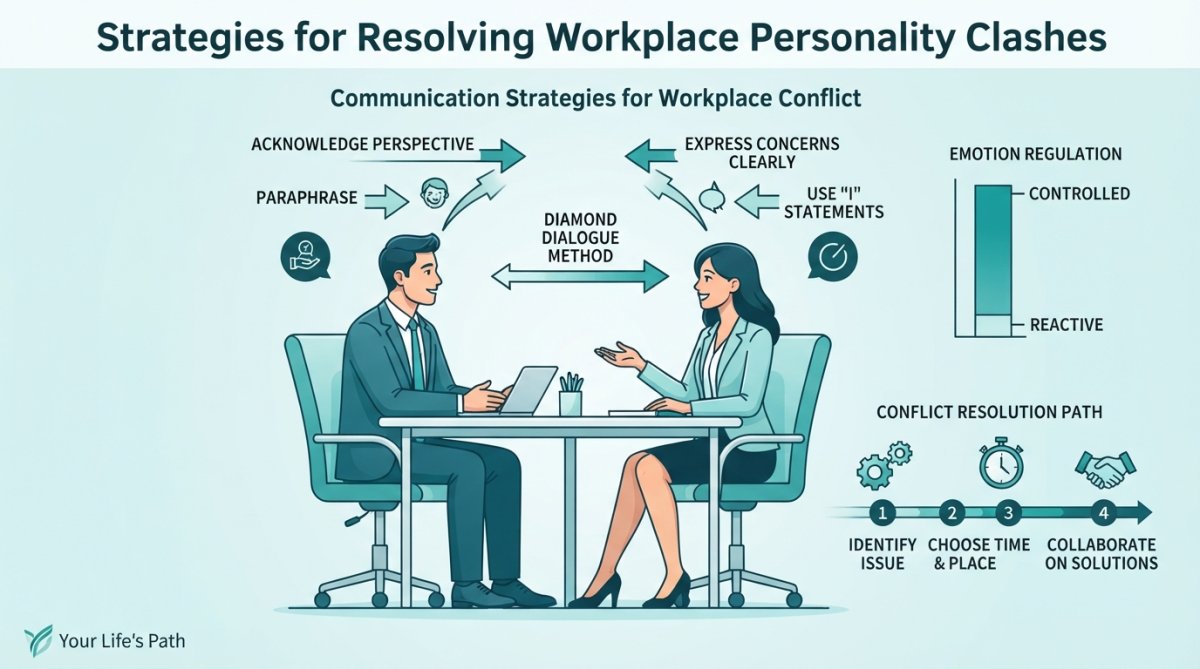
Clear, honest communication is the bridge between conflict and resolution. The most common communication mistake is assuming the other person understands your perspective when they don’t.
Effective communication in conflict requires:
- Clarity: Say what you mean, directly but respectfully
- Specificity: Talk about observable behavior and concrete impact, not character judgments
- Listening: Actually hear what the other person is saying
- Curiosity: Ask questions to understand their perspective fully before responding
- Ownership: Take responsibility for your part without making excuses
Active Listening and De-Escalation Techniques
Active listening is the most underused tool in conflict resolution. Most people listen to respond, not to understand.
True active listening means:
- You listen without interrupting
- You reflect back what you heard: "So what I’m hearing is…"
- You ask clarifying questions: "Can you give me an example?"
- You acknowledge their perspective without necessarily agreeing: "I can see why that would be frustrating"
- You look for the legitimate concern beneath the complaint
This approach de-escalates conflict because it signals respect. Once both people feel heard, problem-solving becomes possible.
De-escalation in the moment:
When emotions are high, pause the conversation. "I can see this is important to you, and I want to understand fully. Can we take 10 minutes and come back to this?" Use "I" statements instead of "you" accusations: "I feel frustrated when decisions happen without my input" instead of "You always exclude me."
Workplace Conflict Resolution Techniques That Work
Once you understand the root cause and have opened communication, you need a structured approach to resolve the conflict.
Direct conversation between the two parties works when both people are willing to engage and the conflict hasn’t become deeply personal. This is the fastest path to resolution.
Mediation by a neutral third party becomes necessary when direct conversation breaks down, emotions are too high, or one person won’t engage. A mediator (manager, HR, or external facilitator) helps both parties communicate more effectively and guides them toward resolution.
Structured problem-solving focuses on the work issue, not the personality clash. Instead of debating whose approach is better, you define the problem together and work toward a solution both people can live with.
One-on-One Meetings and Neutral Mediation
One-on-one meetings are the foundation of conflict resolution. Before bringing both people together, meet with each separately.
In the first one-on-one:
- Listen more than you talk
- Ask: "What’s frustrating you about this situation?" and "What do you need from this person?"
- Avoid taking sides
- Look for the legitimate concern beneath the complaint
When you bring both people together:
- Define the shared goal: "We all want this project to succeed and this team to work well together"
- Each person states their perspective without interruption
- Reflect back what you heard to confirm understanding
- Identify the core disagreement: Is it about process? Values? Expectations?
- Problem-solve together: "How can we handle this differently going forward?"
- Agree on specific actions: Not "let’s communicate better" but "I’ll send you a draft by Tuesday so you have time to review before the meeting"
Setting Professional Boundaries and Expectations
Many personality clashes persist because expectations are unclear. Clear professional boundaries prevent many conflicts from starting.
Examples of professional boundaries:
- How decisions get made (who decides, who gets input, what the timeline is)
- How communication happens (email for formal decisions, Slack for quick questions, weekly meetings for strategy)
- What autonomy looks like (when someone can decide alone vs. when they need approval)
- How feedback is given (in private, with specific examples, focused on behavior not character)
- Response time expectations (respond within 24 hours on email)
When people help create the boundaries, they’re more likely to follow them. When boundaries are clear, personality differences become less of a problem.
Document these boundaries. Write them down. Share them. Reference them when conflicts arise. This removes emotion from enforcement.
Strategies for Resolving Personality Clashes in Remote and Hybrid Settings
Remote and hybrid work creates unique challenges for resolving personality clashes. You can’t read body language in Slack. Misunderstandings happen more easily when communication is asynchronous.
Remote-specific strategies:
Over-communicate expectations. Be explicit: "When I send you a draft, I need feedback by Friday" instead of "let me know your thoughts."
Use video for difficult conversations. Text-based communication removes tone and body language, which increases misunderstanding. When addressing conflict, use video calls.
Create structured check-ins. Regular one-on-one meetings prevent small frustrations from becoming big conflicts. Ask: "How are things going with [other person]?" early, before resentment builds.
Document decisions and agreements. After a conflict resolution conversation, send a follow-up email summarizing what you discussed and what will change.
Be aware of asynchronous communication delays. Someone doesn’t respond immediately. Avoid attributing bad motives to delays.
When to Involve HR and Legal Compliance Considerations
Most personality clashes can be resolved between the people involved, with support from a direct manager. But some situations require HR involvement.
Involve HR when:
- The conflict involves harassment, discrimination, or bullying
- One person has made threats or engaged in aggressive behavior
- The conflict has persisted despite multiple resolution attempts
- The behavior violates company policy
- Legal liability is a concern
- You need documentation for potential disciplinary action
HR’s role is to investigate, ensure fairness, and protect the company legally. They can also facilitate mediation or provide conflict resolution resources.
Legal compliance considerations:
- Document everything: dates, what happened, what was said, what actions were taken
- Ensure any investigation is fair and unbiased
- Don’t retaliate against someone for reporting a problem
- Be aware of protected classes: conflict cannot be resolved by targeting someone based on race, gender, age, disability, or other protected characteristics
- Understand your company’s policies on harassment, bullying, and conduct
Personality clashes are inevitable in any workplace. The question isn’t whether they’ll happen, it’s how quickly you’ll resolve them when they do. The strategies covered here, identifying root causes, improving communication, setting clear boundaries, and addressing conflict directly, work across industries and team sizes.
To accelerate this process and build a culture where different personalities strengthen rather than divide your team, consider the DiSC® Workplace Profile and Virtual Workshops from Your Life’s Path. These tools help employees understand their own behavioral style and appreciate how others think and work differently. By giving your team a common language for discussing personality and work style differences, you transform potential friction into collaborative advantage. Take The Official DiSC® Assessment Online Now and start building a more unified, productive team.
Frequently Asked Questions
What are the main causes of personality clashes in the workplace?
Personality clashes typically stem from differences in communication styles, work preferences, and behavioral traits. When team members have conflicting approaches to problem-solving or interpersonal dynamics, tension can build. Understanding these personality differences through behavioral assessments helps identify root causes early. Common triggers include misaligned expectations, unmet needs for recognition, or incompatible work rhythms. Addressing the underlying causes, rather than just the surface conflict, creates lasting resolution and improves workplace culture.
How can emotional intelligence help resolve workplace personality clashes?
Emotional intelligence enables you to recognize your own emotional triggers and manage them effectively, while also understanding others' perspectives. High emotional intelligence supports active listening, empathy, and de-escalation during tense interactions. Self-reflection exercises help you identify patterns in how you respond to conflict. By building awareness of your emotions and those of your colleagues, you can choose more constructive responses, communicate with greater clarity, and foster psychological safety in your team environment.
What communication strategies work best for de-escalating workplace conflict?
Effective de-escalation relies on active listening, using calm language, and focusing on facts over emotions. Avoid blame-focused statements; instead, describe the specific behavior or situation that concerns you. Ask clarifying questions to understand the other person's perspective fully. Non-verbal communication matters too, maintain open body language and a neutral tone. One-on-one meetings in a private setting reduce defensiveness. Acknowledge the other person's feelings without dismissing your own concerns, and work collaboratively toward solutions that respect professional boundaries.
How do I resolve personality clashes when team members work remotely or in hybrid settings?
Remote and hybrid work complicates conflict resolution because non-verbal cues are limited and misunderstandings escalate quickly. Schedule synchronous video calls rather than relying on email for sensitive conversations. Use written summaries after discussions to confirm understanding. Establish clear communication norms and professional expectations upfront. Behavioral assessments can help remote teams understand personality differences and communication preferences without in-person interaction. Create structured check-ins and ensure psychological safety through consistent, transparent dialogue across distributed team members.
This article was written using GrandRanker