

Table of Contents
- Understanding Enterprise DiSC Assessment Pricing Models
- DiSC Assessment Cost for Companies: Key Variables
- Volume Discounts for DiSC Assessments: What to Expect
- Everything DiSC Pricing for Enterprises: Subscription vs. One-Time Models
- ROI of DiSC Training for Employees and Teams: Measuring Value
- How to Choose the Right Enterprise DiSC Assessment Pricing Model
- Common Mistakes When Selecting Enterprise DiSC Assessment Pricing
- Conclusion
Enterprise DiSC Assessment Pricing Models: A 2026 Guide
Last Updated: July 24, 2026
Understanding enterprise disc assessment pricing models is critical for organizations planning behavioral assessment rollouts. At Your Life’s Path, we help companies navigate the complex landscape of assessment costs, licensing structures, and ROI calculations. Whether you’re evaluating your first DiSC deployment or optimizing an existing program, the pricing decisions you make today will ripple through your organization for years.
Understanding Enterprise DiSC Assessment Pricing Models
The pricing landscape for DISC assessments varies dramatically based on how you structure your purchase. Some vendors bundle facilitation, others separate it entirely. Some lock you into annual commitments, while others allow pay-as-you-go flexibility. Understanding these fundamental differences is the first step toward controlling costs and maximizing your investment.
What drives these differences? The answer lies in three core areas: how many participants you’re assessing, what level of specialization you need, and how much support you want bundled into your pricing. A company with 50 employees assessing everyone once has completely different needs than an enterprise with 5,000 employees rolling out specialized profiles to different departments.
What Drives Pricing Differences Across Providers
Several factors create wide variance when comparing enterprise disc assessment pricing models across providers. Participant volume is the most obvious: assessing 100 people costs less per person than assessing 10.
Profile specialization matters significantly. A basic Workplace Profile costs less than a Management Profile, which costs less than a Work of Leaders Profile. When deploying multiple specialized assessments across different departments, your total cost compounds quickly.
Support services are the hidden cost driver that catches most procurement teams off-guard. Some vendors include facilitation, debrief coaching, and learning platform access in their base price. Others charge separately for each element. The delivery method affects pricing too, online self-administered assessments cost less than live facilitated workshops. Digital platforms with built-in learning tools allow organizations to scale assessments without proportional increases in facilitator costs. Many organizations benefit from structured Virtual Workshops that combine assessment delivery with facilitation, creating a more integrated and cost-effective rollout experience.
Why Enterprise Organizations Need Customized Pricing
Large organizations rarely fit into standard pricing tiers. A company with 2,000 employees isn’t just a bigger version of a 200-person company; it has different complexity, different timelines, and different risk profiles. This is why most serious vendors offer custom enterprise pricing rather than published rate cards.
Enterprise organizations typically need multi-year commitments because they’re rolling out assessments in phases. Year one might focus on leadership and management. Year two expands to high-potential employees. Year three brings in all individual contributors. A vendor willing to negotiate multi-year pricing can lock in volume discounts while giving you flexibility to adjust scope within the contract.
Compliance and reporting requirements also drive custom pricing. Some organizations need detailed assessment data integrated with their HRIS system. Others require specialized reporting for specific departments or geographies.
DiSC Assessment Cost for Companies: Key Variables
The actual cost of a DISC assessment program depends on four primary variables.
Participant Volume and Seat Licensing
The number of people you’re assessing is the primary cost driver. Most vendors use a “seat” model where you purchase licenses for specific participants. Some charge per assessment (you pay each time someone takes a test), while others use annual seat licenses (you pay once per year for unlimited retakes). Volume discounts typically kick in at specific thresholds: a small company buying 50 seats might pay one price per seat, while a mid-market company buying 500 seats gets a better rate, and an enterprise buying 5,000 seats negotiates an entirely different structure.
Profile Specialization and Scope
Not all DISC profiles cost the same. The basic DiSC Workplace Profile is the entry point. Management profiles, Sales profiles, and specialized leadership assessments command premium pricing. A typical enterprise scenario includes leadership taking Work of Leaders, managers taking Management Profile, individual contributors taking Workplace Profile, and sales teams taking Sales Profile, four different profile licenses across different employee segments.
Facilitation and Support Services
Some vendors bundle facilitation into the assessment cost. Others separate it entirely. Some offer tiered support: basic (self-guided), standard (group debrief), and premium (one-on-one coaching). Facilitation costs typically include initial debrief sessions, team coaching and application workshops, manager training, and ongoing support. A vendor charging a low per-assessment price but requiring paid facilitation might cost more overall than a vendor with higher per-seat pricing that includes basic facilitation.
Volume Discounts for DiSC Assessments: What to Expect
Volume discounts follow predictable patterns, though specific thresholds and percentages vary by vendor.
Tiered Pricing Structures
Most vendors use a tiered model where you pay different per-seat rates based on total volume purchased. A typical structure might include 1-100 seats at standard rate, 101-500 seats at 15-20% discount, 501-2,000 seats at 25-35% discount, and 2,000+ seats at custom pricing (often 40-50% discount). The exact percentages and thresholds vary, which is why you should always ask vendors where the discount tiers fall.
Some vendors also offer profile-specific discounts. Bundling different profiles together might yield a blended rate better than either profile alone.
Multi-Year Commitments and Savings
Committing to a multi-year contract typically unlocks additional discounts beyond volume pricing. Multi-year pricing makes sense for organizations planning phased rollouts. The trade-off is flexibility, if your business changes materially, you might be locked into a commitment that no longer fits. Some vendors build in adjustment clauses for material changes, while others enforce the contract as written.
Everything DiSC Pricing for Enterprises: Subscription vs. One-Time Models
The fundamental choice in enterprise disc assessment pricing models is whether to subscribe (ongoing annual fees) or purchase licenses (one-time or periodic purchases).
Subscription-Based Pricing and Ongoing Access
Subscription models charge an annual fee for access to assessments, learning platforms, and support. You know your annual cost and get new profile versions and platform improvements automatically. The disadvantage is that costs never stop; if you cancel, you lose access to everything. Subscription pricing typically scales with volume, and some vendors offer tiered subscriptions where you pay more for premium support, advanced reporting, or integration services.
Per-Assessment and Licensing Models
One-time licensing models charge you per assessment or per participant, and you keep that license indefinitely. The advantage is cost control and the ability to scale up or down without long-term commitments. The disadvantage is that you don’t get automatic updates or new features. Many vendors use hybrid models: you purchase licenses upfront, then pay an annual platform or support fee to maintain access and get updates.
ROI of DiSC Training for Employees and Teams: Measuring Value
The most important pricing question isn’t “How much does this cost?” but “What’s it worth?”
Quantifying Improvements in Communication and Engagement
DISC assessments improve communication by helping teams understand behavioral preferences and communication styles. When managers understand that one direct report is detail-oriented and another is relationship-focused, they adjust their communication accordingly. These improvements are real but difficult to quantify in dollars. You can measure engagement through pulse surveys before and after implementation and track internal communication metrics.
Some organizations measure communication impact indirectly through reduced turnover. If DISC training helps managers communicate more effectively with their teams, employees stay longer, saving significant replacement costs.
Retention, Productivity, and Culture Impact
The strongest ROI case for DISC assessments comes through retention and culture. Organizations that invest in understanding their people and improving team dynamics see measurable improvements in employee retention. Culture improvements are harder to monetize but easier to observe, teams that understand each other’s working styles report higher psychological safety and are more likely to collaborate across silos.
Productivity improvements typically manifest as faster decision-making, fewer conflicts, and better project outcomes. When teams understand each other’s styles, they spend less time managing interpersonal dynamics and more time on actual work.
How to Choose the Right Enterprise DiSC Assessment Pricing Model
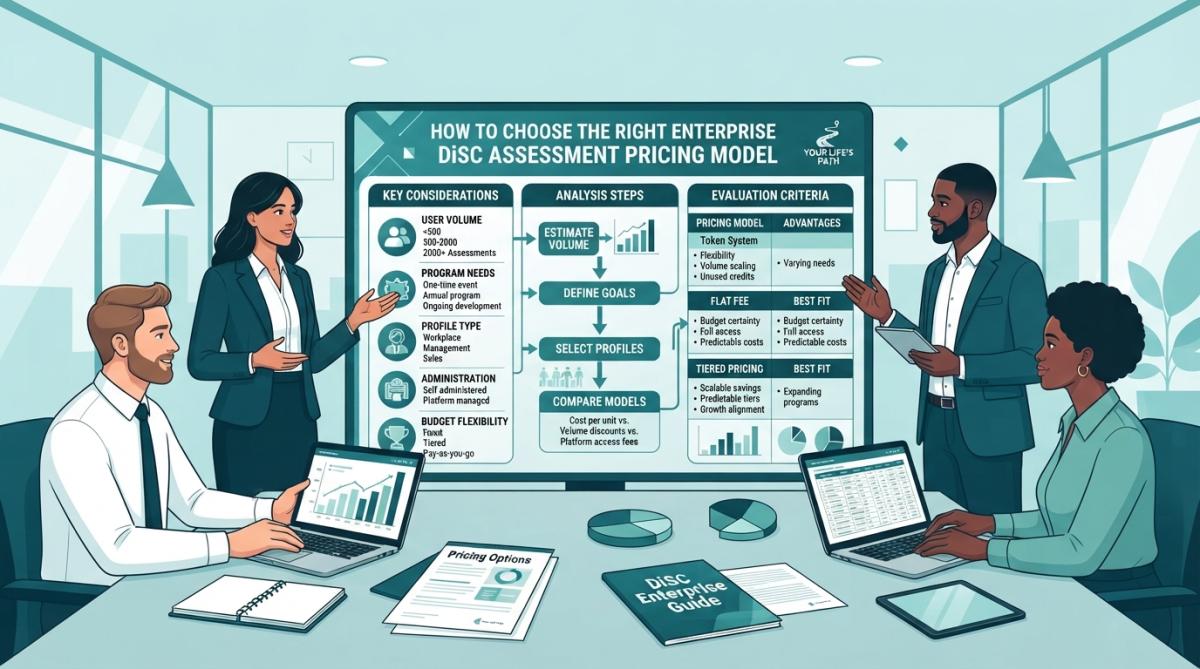
Selecting the right pricing model requires matching your organization’s specific situation to the vendor’s offering structure.
Assessing Your Organization’s Needs and Scale
Start by mapping your actual assessment scenario in detail. How many people will you assess in year one? Year two? Year three? Will everyone take the same profile or will you use specialized profiles for different groups? Document your support requirements too, will your internal team facilitate all debriefs or do you need vendor support? Do you need one-on-one coaching or just group workshops?
Evaluating Hidden Costs and Total Cost of Ownership
The headline price is never the real price. Calculate total cost of ownership by including per-assessment or per-seat licensing costs, facilitation and coaching (if not bundled), platform or subscription fees, integration and customization services, training for internal facilitators, and ongoing support and maintenance.
Build a spreadsheet comparing vendors across your actual scenario. Include year-by-year costs for your projected rollout and all services you actually need, not just the base assessment. This forces apples-to-apples comparison and reveals which vendor is actually cheapest for your situation.
Negotiating Terms and Securing Quotes
Once you’ve identified your scenario and compared options, negotiate. Most vendors have room to move, especially on enterprise deals. Volume discounts are the obvious starting point, but also negotiate support levels, platform access, integration services, and contract terms.
Multi-year pricing is worth exploring if you have a clear three-year plan. Ask about adjustment clauses, if your business changes materially, can you adjust your commitment? Get everything in writing, confirming exactly what’s included, what’s extra, and what support you’ll receive.
Common Mistakes When Selecting Enterprise DiSC Assessment Pricing
Organizations make predictable mistakes when choosing enterprise disc assessment pricing models.
Mistake 1: Comparing Headline Pricing Without Context
The cheapest per-seat price isn’t the cheapest total cost. Always compare total cost of ownership, not just per-seat licensing, including every service you actually need.
Mistake 2: Underestimating Facilitation Costs
Many organizations buy assessments assuming employees will self-debrief. In reality, assessments need facilitation to drive behavior change. Without facilitation, people take the test and forget about it. With proper facilitation, they understand their style, understand others’ styles, and change how they work together. Budget for facilitation from the start.
Mistake 3: Locking Into Long-Term Commitments Too Early
Multi-year commitments offer discounts, but they lock you in before you understand what works for your organization. A better approach: start with a one-year commitment, prove the value, then negotiate multi-year pricing once you’re confident in the program.
Mistake 4: Forgetting About Ongoing Costs
Some organizations calculate the cost of initial assessments but forget about ongoing costs. Build a three-year cost projection including all ongoing expenses to prevent budget surprises.
Mistake 5: Choosing Based on Price Alone
The cheapest vendor isn’t always the best value. Evaluate vendors on profile quality and specialization, support quality, platform features, vendor stability, and references from similar organizations. Price is one factor, not the only factor.
Choosing the right enterprise disc assessment pricing model requires matching your organization’s actual needs to a vendor’s offering. Your Life’s Path provides official DiSC® assessments with specialized profiles including the DiSC Workplace Profile, DiSC Management Profile, DiSC Sales Profile, and DiSC Work of Leaders Profile, along with flexible Free EPIC Sub-Accounts for streamlined administration and the DiSC Catalyst For Teams platform for scalable facilitation. Rather than forcing your situation into a standard pricing tier, Your Life’s Path works with enterprise clients to build custom pricing that matches your timeline, volume, and support needs. Get started with Your Life’s Path and align your assessment investment with measurable improvements in communication, engagement, and organizational culture.
Frequently Asked Questions
What factors most influence the total cost of an enterprise DiSC assessment?
The primary cost drivers include the number of participants (volume), the specific DiSC profile types needed (Workplace, Management, Sales, or Work of Leaders), facilitation and coaching support levels, and whether you choose a subscription or one-time licensing model. Administration tools like EPIC sub-accounts and learning platforms such as Catalyst may also affect pricing. Organizations should request detailed quotes based on their exact needs rather than relying on generic estimates.
Do DiSC assessment providers offer volume discounts for large organizations?
Yes, most providers structure pricing with volume discounts that increase as participant numbers grow. Many use tiered pricing models where costs per assessment decrease at higher volumes—typically at thresholds like 50, 100, 250, or 500+ participants. Multi-year commitments may unlock additional savings. Contact providers directly for specific volume discount structures, as they vary significantly and are often negotiable based on organizational scale and commitment length.
What is the difference between subscription and per-assessment pricing for enterprise DiSC assessments?
Subscription models charge recurring fees (monthly or annually) for ongoing access to assessments, platforms, and sometimes support. Per-assessment or licensing models charge based on the number of individual assessments taken. Subscriptions work well for organizations with continuous onboarding or ongoing development needs; per-assessment pricing suits one-time initiatives. Your Life's Path offers flexible options to match your organization's learning cadence and budget structure.
How can I calculate the ROI of DiSC training investment for my team?
ROI is measured by comparing benefits (improved retention, reduced communication-related conflicts, faster team cohesion, higher engagement scores) against total investment. Track metrics like employee engagement scores, voluntary attrition rates, manager effectiveness ratings, and team performance before and after implementation. Many organizations see measurable improvements in psychological safety, transparency, and employee recognition within 3–6 months. Request case studies from your provider to see realistic timelines and outcomes for similar-sized organizations.
This article was written using GrandRanker