

Table of Contents
- Why Conflict Resolution Differs in Remote Environments
- Virtual Team Conflict Resolution Examples That Work
- Conflict Resolution Scripts for Managers
- Best Practices for Remote Team Communication
- Tools for Managing Remote Team Conflict
- Building Trust and Psychological Safety Across Distance
- Implementing a Framework for Asynchronous Conflict Resolution
- Conclusion
Last Updated: August 10, 2026
Why Conflict Resolution Differs in Remote Environments
Remote work fundamentally changes how conflict emerges and escalates. Without physical proximity, misunderstandings happen faster. A tone-deaf email can trigger days of tension. A delayed response feels like rejection. The absence of casual hallway conversations means small frustrations never get aired and resolved informally, they accumulate instead.
The challenge runs deeper than communication tools. In traditional offices, body language softens disagreements. A manager can read a team member’s frustration before it boils over. Remote environments strip away these non-verbal cues. You lose the ability to sense when someone needs a moment, when they’re about to disengage, or when a quick chat would defuse something before it becomes a formal conflict.
Conflict resolution strategies for remote teams must account for this friction. The strategies that worked in conference rooms often fail across distance. Asynchronous communication, time zone delays, and the formality of written words all change how conflicts develop and how they need to be addressed. The good news: remote conflict resolution is learnable. It requires intentionality, clear frameworks, and the right tools. But once you understand the mechanics, you can actually prevent conflicts from escalating in the first place.
Virtual Team Conflict Resolution Examples That Work
Real-world examples reveal what actually works when teams clash across distance. Consider a sales team where two reps disagreed over territory assignments. In an office, they might have grabbed coffee and hashed it out. Remotely, the frustration festered in Slack messages and email threads. The manager intervened with a structured approach: she scheduled a synchronous call, acknowledged both perspectives without judgment, and asked each person to propose a solution. Within 30 minutes, they’d found a middle ground neither had considered. The key wasn’t the medium, it was the deliberate structure.
Another example: a product team split across three time zones faced constant miscommunication about feature priorities. Developers in one zone would build something; designers in another would question the approach; managers in a third would wonder why progress stalled. Conflict was baked into asynchronous workflows. The fix came from establishing a clear decision-making protocol and a shared document that captured reasoning, not just conclusions. When people could see why a choice was made, disagreements shifted from personal to professional.
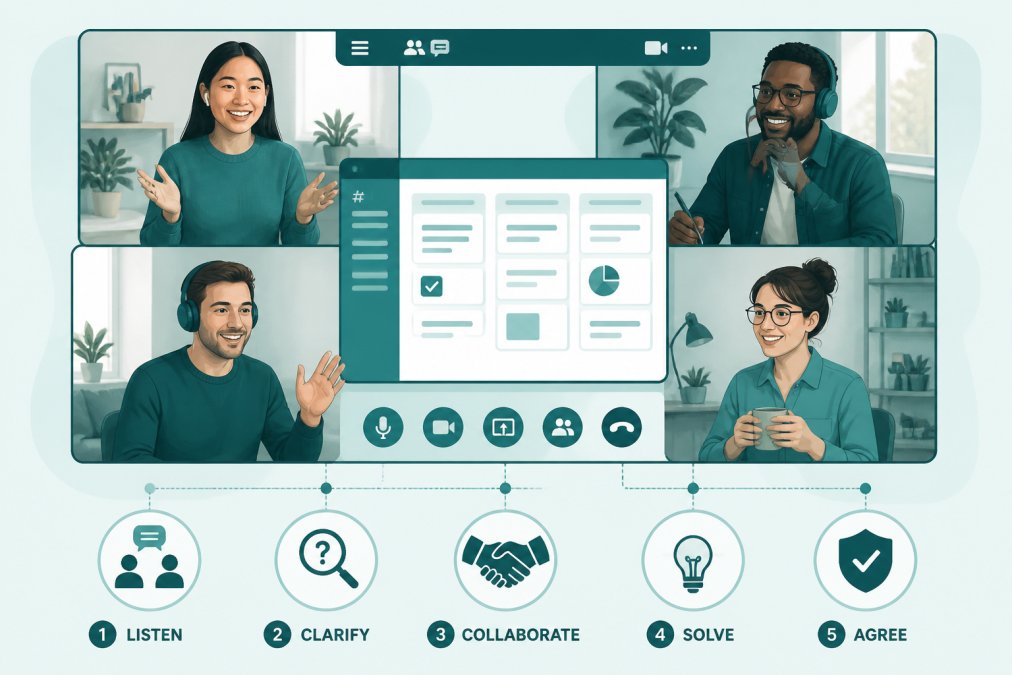
The pattern across successful virtual team conflict resolution examples is consistency. Teams that prevent escalation use the same process every time. They name the conflict early. They separate the person from the problem. They make decisions visible and reversible when possible. These aren’t new ideas, they’re just harder to execute remotely, so teams that do it well stand out.
One more example worth noting: a healthcare organization with departments spread across the country struggled with cross-functional tensions. Clinicians felt administrative teams didn’t understand patient care constraints. Administrators felt clinicians ignored operational realities. The breakthrough came when leadership invested in a structured dialogue process, monthly calls where each side presented their actual constraints, not complaints. Understanding shifted. Conflict didn’t disappear, but it became collaborative problem-solving instead of blame.
Conflict Resolution Scripts for Managers
Managers need language they can use in the moment. Vague advice to “communicate better” doesn’t help when you’re staring at a heated email thread. Here are scripts that work:
Opening a difficult conversation: “I’ve noticed tension between you and [colleague] around [specific issue]. I want to understand what’s happening from your perspective before we figure out next steps. Can we talk for 20 minutes today?”
This script works because it names the specific conflict, signals that you’re not taking sides, and creates a bounded conversation. The 20-minute frame prevents it from becoming an open-ended venting session.
Reframing a disagreement: “You both care about [shared goal]. Right now you disagree on how to get there. Let’s separate the goal from the method and see if we can find an approach that works for both of you.”
This script acknowledges that conflict often stems from different paths to the same destination, not fundamentally opposed values. It depersonalizes the disagreement.
Setting expectations after conflict: “Here’s what I need to see going forward: [specific behavior]. Here’s what you can expect from me: [specific support]. We’ll check in on this in two weeks.”
This script creates accountability and signals that the conflict has a resolution date. It also makes clear that the manager is invested in making things work.
Addressing asynchronous communication problems: “I noticed this conversation has been happening in email for three days. Before it goes further, let’s talk synchronously. Some things are just faster to resolve on a call.”
This script gives permission to shift mediums when written communication isn’t working. It’s not a criticism, it’s a practical adjustment.
The underlying principle: conflict resolution scripts for managers should be direct, name the specific issue, separate people from problems, and create forward movement. Generic scripts sound robotic. Scripts tied to real situations sound like leadership.
Best Practices for Remote Team Communication
Prevention beats intervention. The strongest best practices for remote team communication reduce conflict before it starts.
Establish communication norms explicitly. Don’t assume everyone knows when to use email versus Slack versus a call. Document it. “Urgent decisions require synchronous discussion. Strategic disagreements get a dedicated call, not a thread. Feedback on work happens in writing so people can process before responding.” Clear norms prevent misinterpretation.
Create redundancy in important conversations. If a critical decision gets made in a Slack thread, follow up with an email summary. If feedback is given verbally, confirm it in writing. This redundancy catches misunderstandings and creates a paper trail that prevents “I thought you said…” conflicts.
Build in cooling-off periods for digital communication. When someone sends a heated message, they shouldn’t expect an immediate response. A norm of “we respond to non-urgent messages within 24 hours” gives people time to think before reacting. This single practice prevents escalation more than almost anything else.
Make decision-making transparent. Document not just what was decided, but why. When people understand reasoning, they’re less likely to interpret decisions as personal slights. A decision that seems arbitrary breeds resentment. A decision that’s explained, even if someone disagrees with it, feels fair.
Use asynchronous updates to build context. Before synchronous meetings, share written updates so everyone arrives with the same information. This prevents meetings from becoming arguments about facts. You’re debating interpretation, not scrambling to get aligned on basics.
Create psychological safety in writing. Remote communication is permanent. People are more cautious. Explicitly invite questions and different viewpoints. “I want to hear if you see this differently” in a Slack message might feel small, but it signals that disagreement is welcome.
Tools for Managing Remote Team Conflict
The right tools don’t resolve conflict, but they can structure how teams communicate and prevent misunderstandings.
Shared documentation platforms (like Notion, Confluence, or Google Workspace) create a single source of truth. When decisions are documented with context, people spend less time confused and more time aligned. This prevents conflicts rooted in information gaps.
Project management tools with clear ownership and timelines reduce ambiguity about who’s responsible for what. Conflict often stems from unclear expectations. A tool that makes expectations visible prevents that entirely.
Video conferencing with recording capability matters for asynchronous teams. If a critical conversation happens when not everyone can attend, recording it and sharing a summary ensures no one is left out. Exclusion breeds resentment.
Feedback tools designed for remote teams (like 15Five or similar platforms) create structured space for input without it feeling like informal gossip. Structured feedback is less likely to be misinterpreted or escalate.
Communication guidelines documents aren’t tools, but they function like one. A shared document that outlines how your team communicates, when to use which channel, and how conflicts get addressed is a reference point when things get tense. It removes the guesswork.
The most important thing about tools for managing remote team conflict is that they should reduce friction, not add it. A tool that requires constant navigation or creates more meetings defeats the purpose. Choose tools that your team already uses and that fit your actual workflows.
Building Trust and Psychological Safety Across Distance
Trust is the foundation that prevents conflict from escalating. Without it, every disagreement feels personal. With it, disagreement feels like problem-solving.
Remote environments make trust harder to build. You don’t bump into colleagues. You don’t have casual conversations that build rapport. You interact around tasks, not as whole people. This creates distance, literal and emotional.

Building trust across distance requires deliberate action. Start with visibility. When people understand each other’s constraints, pressures, and priorities, they’re more forgiving of mistakes. A manager who shares that they’re struggling with a new system is more relatable than one who appears to have it all figured out. Vulnerability builds connection.
Create regular touchpoints that aren’t about work. Monthly coffee chats, virtual team lunches, or even brief check-ins where you ask about someone’s weekend, these create the informal connections that offices generate naturally. They’re not wasted time. They’re relationship maintenance.
Make decisions inclusively. People trust leaders who ask for input before deciding. Even if you don’t follow every suggestion, the fact that you asked matters. It signals that you value their perspective.
Follow through on commitments. In remote environments, trust lives or dies based on whether people do what they say they’ll do. If you commit to a decision and then change it without explanation, trust erodes. If you say you’ll follow up and don’t, people notice.
Psychological safety, the belief that you can speak up without fear of embarrassment or punishment, is what transforms conflict from destructive to constructive. Teams with psychological safety disagree openly and resolve disagreements faster. Teams without it hide problems until they explode.
Create psychological safety by responding well when people raise concerns. If someone points out a problem and you get defensive, you’ve just taught everyone to stay silent. If someone disagrees with you and you listen genuinely, you’ve created permission for honest dialogue.
Implementing a Framework for Asynchronous Conflict Resolution
Not every conflict can be resolved in a real-time call. Time zones, schedules, and the nature of some disagreements mean asynchronous resolution is necessary. A framework helps.
Step 1: Name the conflict in writing. The person raising the issue documents what they see as the problem, what impact it’s having, and what they’re asking for. This forces clarity. Vague complaints become specific problems.
Step 2: The other party responds in writing. They share their perspective, their constraints, and their concerns about the proposed solution. This isn’t a debate, it’s information sharing. Both sides get their full perspective on record.
Step 3: A neutral party (usually a manager) synthesizes. They identify where there’s agreement, where there’s genuine disagreement, and where there’s missing information. They ask clarifying questions in writing.
Step 4: Both parties propose solutions. They’re asked to suggest approaches that address the core issue while acknowledging the other person’s constraints. This shifts from “you’re wrong” to “here’s how we move forward.”
Step 5: Decision and next steps. A manager decides (in consultation if appropriate), documents the reasoning, and sets a timeline for reassessing if needed. The conflict has an endpoint.
This asynchronous conflict resolution framework works because it removes emotion from the moment. People have time to think. They can’t interrupt or dominate. Every perspective gets documented. It’s slower than a heated conversation, but it often reaches better solutions.
The framework also creates a record. If the same conflict resurfaces, you can point back to what was decided and why. This prevents the same argument from happening repeatedly.
Conclusion
Conflict in remote teams isn’t a flaw in your setup, it’s inevitable when people work toward shared goals across distance. The difference between teams that thrive and teams that fracture is how deliberately they approach resolution.
The strategies that work are structural, not personality-dependent. Clear communication norms, documented decision-making, asynchronous frameworks, and intentional trust-building create an environment where disagreements get resolved instead of festering. Your Life’s Path’s DiSC® assessments and virtual workshops help teams understand behavioral drivers and communication styles, the foundation for these structural improvements. When teams understand how each person processes conflict, communicates under pressure, and prefers to resolve disagreements, the frameworks work better.
Start with one change: establish clear norms for how your team communicates. Document them. Make them visible. Then layer in the other practices. Conflict resolution at scale comes from systems, not heroics. Build the system, and your remote team becomes stronger, not weaker, because of the diversity that remote work enables.
Frequently Asked Questions
What are the most effective conflict resolution strategies for remote teams?
The most effective strategies combine clear communication protocols with structured frameworks. Focus on addressing issues quickly through synchronous conversations when possible, using active listening to understand the root cause. Establish team agreements about response times and communication norms upfront. Document decisions and resolutions in writing to prevent misunderstandings. Use asynchronous conflict resolution when immediate discussion isn't feasible, allowing team members time to reflect before responding. Regular one-on-ones help managers identify friction early before it escalates.
How can managers identify hidden conflict in remote teams?
Watch for changes in digital body language: delayed responses, shorter messages, reduced participation in meetings, or absence from optional team events. Monitor communication patterns in chat platforms for tone shifts or withdrawn engagement. Schedule regular check-ins focused on how people are feeling, not just work progress. Ask open-ended questions about collaboration and team dynamics. Pay attention to who is and isn't contributing in group discussions. Remote settings make conflict easier to hide, so proactive listening and observation are essential to catching issues before they damage team cohesion.
What should a conflict resolution script for managers include?
An effective script starts with a private, scheduled conversation. Begin by stating the specific behavior you've observed without judgment. Ask open questions to understand their perspective before sharing yours. Acknowledge emotions and validate concerns. Move to problem-solving by asking what they need or what would help. Agree on concrete next steps and a timeline for follow-up. End by reinforcing your commitment to the team's success. Scripts work best when they feel natural rather than rigid, so customize them to your style while maintaining structure, empathy, and clarity throughout.
How does behavioral profiling help resolve remote team conflict?
Understanding individual communication and conflict styles through tools like DiSC assessments helps managers and teams recognize why misunderstandings happen. Some team members prefer direct, quick decisions while others need discussion and consensus. Some avoid conflict entirely while others engage head-on. When everyone understands these differences, they can adjust their approach and reduce friction caused by style clashes rather than actual disagreement. Behavioral insights also help managers tailor their conflict resolution approach to each person's needs, making conversations more effective and building stronger team alignment around shared goals.
This article was written using GrandRanker