

Table of Contents
- Defining Personality Assessments
- Defining Behavioral Assessments
- Behavioral vs Personality Assessment: Key Differences in Methodology
- Predictive Validity in Hiring: Which Assessment Type Wins
- Behavioral Assessment Examples and Real-World Applications
- Best Practices for Pre-Employment Testing
- How to Choose a Pre-Employment Assessment Tool
- Legal and Compliance Considerations
Last Updated: August 14, 2026
Defining Personality Assessments
A personality assessment measures enduring characteristics and preferences that remain relatively stable across situations. These tools evaluate how individuals naturally think, feel, and behave based on psychological constructs like introversion/extraversion, emotional stability, and decision-making style. The most widely recognized frameworks include Myers-Briggs Type Indicator (MBTI), which categorizes individuals into 16 personality types, and the Hogan Personality Inventory (HPI), which measures leadership style and interpersonal tendencies.

Personality assessments excel at revealing long-term patterns. Someone with high conscientiousness will likely remain organized across most situations. An introvert will continue to prefer smaller group interactions. However, personality assessments have a critical limitation in hiring: they measure enduring traits, not job-specific behaviors. Knowing that a candidate is extroverted doesn’t predict whether they’ll excel at prospecting calls or manage objections effectively. That gap is where behavioral assessments step in.
Defining Behavioral Assessments
A behavioral assessment measures observable conduct and job-specific behaviors that predict workplace performance in particular roles. Rather than evaluating who someone is fundamentally, behavioral assessments measure what someone does, or is likely to do, in response to specific workplace situations. These tools focus on behavioral patterns, competency mapping, and actionable workplace preferences that can shift based on context and motivation.
Behavioral assessments evaluate dimensions like assertiveness in client interactions, responsiveness to feedback, collaboration style, and adaptability to change. They’re designed around the principle that behavior is more malleable than personality traits. Someone who scores low on assertiveness in a general personality test might still demonstrate strong assertiveness when closing a sale, because context and stakes matter.
Your Life’s Path offers specialized behavioral profiles, including the DiSC Workplace Profile and DiSC Sales Profile, which measure how individuals adapt their behavioral approach to different professional contexts. Behavioral assessments directly address the hiring challenge by predicting job performance because they measure the actual behaviors required for success.
Behavioral vs Personality Assessment: Key Differences in Methodology
Personality assessments use self-report instruments that ask respondents to reflect on their general preferences across many situations. The MBTI asks candidates to choose between options like "Do you prefer to work with facts or possibilities?" These questions measure psychological constructs considered relatively fixed.
Behavioral assessments present job-relevant scenarios and measure how candidates respond to specific workplace situations. Rather than asking "Are you generally assertive?" they might present: "A client disagrees with your recommendation. How do you respond?" The assessment evaluates the behavioral indicators in that response.
This methodological distinction produces different validity profiles. Personality assessments measure construct validity, they accurately measure the psychological constructs they claim to measure. Behavioral assessments prioritize predictive validity, they correlate strongly with actual job performance outcomes. In hiring, predictive validity is what matters most.
Behavioral assessments also adapt to changing role requirements. If your sales role evolves to require more consultative selling, you can adjust the behavioral assessment accordingly. Personality assessments measure traits assumed to be stable, so they don’t adapt.
A personality assessment tells a candidate, "You’re an INTJ." A behavioral assessment tells a candidate, "In high-pressure situations, you tend to withdraw rather than engage. Here’s how to adapt that pattern for client-facing work." That’s immediately actionable.
Predictive Validity in Hiring: Which Assessment Type Wins
Predictive validity measures how well an assessment correlates with actual job performance. Behavioral assessments consistently outperform personality assessments in predicting job performance across most roles because they measure job-specific conduct, while personality assessments measure general psychological traits.
Consider a sales role. A personality assessment might identify an introvert, triggering concern about prospecting effectiveness. But a behavioral assessment would measure that candidate’s actual approach to client outreach and relationship building. Many introverts excel in consultative sales because they listen carefully and build trust, behaviors that drive revenue. The personality label would have filtered out a high performer.
In management roles, the gap widens further. Behavioral assessments measure how a manager responds to underperformance, handles conflict, delegates authority, and develops their team. These specific behaviors predict management effectiveness far more reliably than personality type.
Research consistently shows that behavioral instruments designed around job analysis demonstrate higher predictive validity than general personality measures. This is why organizations serious about hiring accuracy have shifted toward behavioral assessment methodologies.
Behavioral Assessment Examples and Real-World Applications
Behavioral assessments measure observable conduct in job-relevant contexts. Here are the most common applications:
Sales and Client-Facing Roles: Behavioral assessments for sales measure assertiveness in negotiations, responsiveness to client concerns, follow-through on commitments, and resilience after rejection. The DiSC Sales Profile evaluates how a salesperson adapts their approach to different customer preferences. Organizations use these insights to match salespeople to customer segments and identify coaching needs.
Management and Leadership: Behavioral assessments for managers measure delegation style, feedback delivery, conflict resolution approach, and team development focus. They identify whether a manager tends to direct decisions or involve the team, and whether they invest in employee development.
Team Composition and Dynamics: Organizations use behavioral assessments to build balanced teams. A team of all high-assertiveness individuals might drive results but struggle with collaboration. Behavioral assessments help leaders understand team composition and intentionally build complementary skill sets.
Cross-Functional Collaboration: In healthcare, manufacturing, and complex service environments, behavioral assessments identify where communication gaps exist and help teams understand different communication styles.
Onboarding and Role Transitions: When promoting someone into a new role, behavioral assessments reveal which behaviors will transfer effectively and which require development. A successful individual contributor might need coaching on delegation before stepping into management.
Best Practices for Pre-Employment Testing
Implementing behavioral assessments effectively requires more than selecting a tool. Here are the practices that maximize validity:
Use Job Analysis to Define Required Behaviors: Identify the specific behaviors that drive success in the role. What does a high performer actually do differently? Your assessment should measure those specific behaviors, not generic traits.
Combine Multiple Data Sources: Behavioral assessments are most predictive when combined with structured interviews, work samples, and reference checks. No single instrument captures the full picture.
Ensure Transparent Communication with Candidates: Candidates should understand why they’re taking an assessment, how results will be used, and what happens next. Transparency builds trust and improves candidate experience.
Avoid Over-Interpretation: Assessment results are data points, not destiny. A behavioral assessment showing lower assertiveness doesn’t mean a candidate can’t succeed in a sales role; it means they may approach sales differently and might benefit from coaching.
Validate Against Your Actual Outcomes: Track whether candidates who score high on your behavioral assessment actually perform well in the role. Do they stay longer? Do they hit performance targets? This validation ensures your assessment is actually predictive in your specific context.
Take The Official DiSC® Assessment Online Now! →
Provide Feedback and Development Paths: Share results with candidates and explain what the behaviors mean for their role. Provide coaching or development resources based on results. This transforms assessment into a development tool.
How to Choose a Pre-Employment Assessment Tool
Selecting an assessment tool requires evaluating several dimensions:
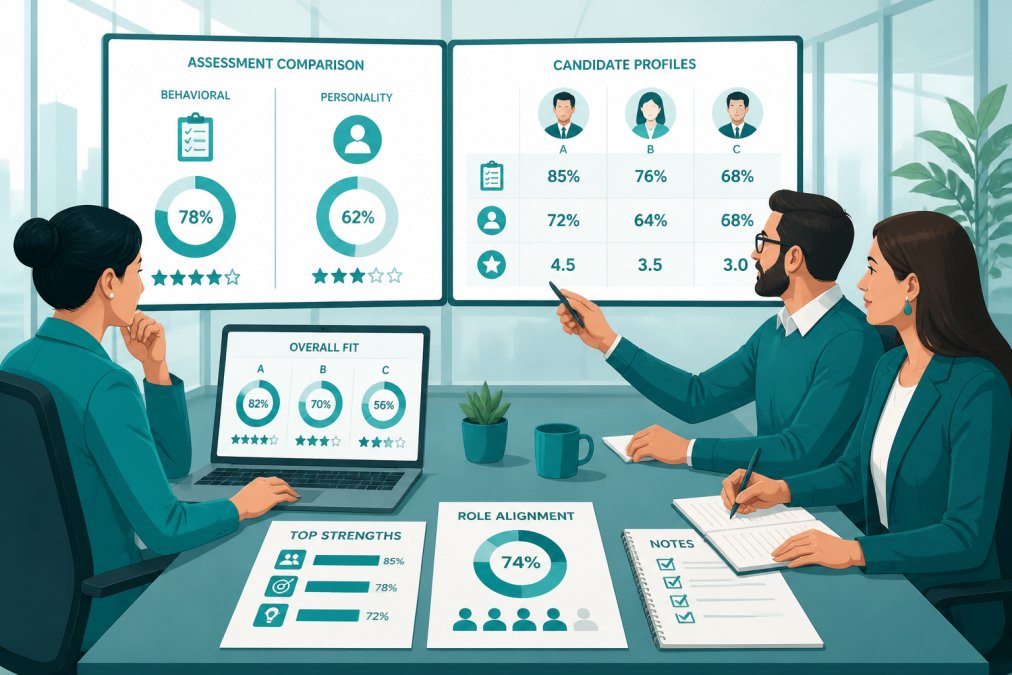
Alignment with Job Requirements: The assessment should measure behaviors specific to your role. A sales assessment should measure sales-relevant behaviors. Generic personality tools rarely align with specific job demands.
Predictive Validity Evidence: Ask vendors for research showing their assessment correlates with job performance in similar roles. Reputable vendors provide validation studies.
Ease of Administration: Consider whether your HR team can administer assessments independently. Some platforms offer self-service administration; others require vendor support.
Candidate Experience: Assessments that feel relevant and fair improve candidate experience. Candidates should understand why they’re taking the assessment and how results connect to job success.
Integration with Your Existing Systems: Does the assessment integrate with your ATS (Applicant Tracking System)? Integration reduces friction and improves efficiency.
Reporting and Actionability: Reports should clearly indicate which candidates meet behavioral requirements and which areas represent development opportunities. Reports should be understandable to non-technical hiring managers.
Cost and Scalability: Understand the pricing model. For high-volume hiring, per-assessment pricing becomes expensive. Ensure the pricing model aligns with your hiring volume.
Your Life’s Path offers official DiSC® assessments with specialized profiles designed for different roles and organizational contexts. The platform includes EPIC (Electronic Profile Information Center) sub-account administration, making it straightforward for HR teams to manage assessments independently. The DiSC framework’s focus on observable workplace behavior patterns aligns with predictive validity research, and the Catalyst platform provides flexible facilitation and learning tools that help organizations translate assessment insights into behavioral change.
Legal and Compliance Considerations
Pre-employment assessments are subject to employment law and regulatory oversight.
Validity and Job-Relatedness: Under Title VII of the Civil Rights Act, any assessment used in hiring must be job-related and validated as predictive of job performance. If an assessment cannot demonstrate predictive validity for your specific role, using it in hiring decisions exposes your organization to discrimination claims.
Adverse Impact Analysis: Assess whether your chosen tool produces different pass/fail rates across protected groups. If it does, you must have strong evidence that the assessment is job-related and predictive.
Disability Accommodations: Assessments must be accessible to candidates with disabilities. Your assessment process should include a mechanism for requesting accommodations.
Data Privacy and Security: Assessments collect sensitive personal data. You must comply with data privacy regulations and be clear about how data is stored, accessed, retained, and shared.
Transparency and Disclosure: Candidates should know they’re being assessed and understand the purpose. Your hiring process should clearly disclose that behavioral assessment is part of your evaluation.
Consistent Application: Use the same assessment and scoring criteria for all candidates in the same role. Inconsistent application creates discrimination risk.
The Equal Employment Opportunity Commission (EEOC) provides guidance on assessment validity and adverse impact. Organizations should review EEOC guidance on pre-employment testing to ensure compliance.
Choosing between behavioral and personality assessments comes down to your specific objective. If you’re hiring and need to predict job performance, behavioral assessments deliver superior predictive validity. If you’re focused on team dynamics and communication improvement, personality assessments provide valuable self-awareness. Many organizations use both: behavioral assessments during hiring, personality assessments during onboarding and team development.
Your Life’s Path’s DiSC® assessments are built on behavioral science principles, offering specialized profiles that measure job-specific behaviors and workplace preferences. With EPIC sub-account administration and the Catalyst platform for flexible facilitation, Your Life’s Path provides the infrastructure to implement assessments effectively across your organization. Take The Official DiSC® Assessment Online Now to understand your behavioral profile and start building a more cohesive, high-performing team.
Frequently Asked Questions
What is the fundamental difference between behavior and personality in assessment?
Personality assessments measure enduring characteristics and internal traits that remain relatively stable over time, such as introversion, conscientiousness, or risk tolerance. Behavioral assessments focus on observable conduct and job-specific behaviors that can adapt based on context, role demands, and workplace environment. Personality is about who you are; behavior is about what you do in response to specific situations.
Which assessment type is more predictive of job performance?
Behavioral assessments typically show stronger predictive validity for job performance because they directly measure the actions and conduct required for specific roles. Personality assessments predict broader workplace preferences and potential derailers, but behavioral assessments more directly correlate with measurable job outcomes. The most effective approach combines both: personality insights for team dynamics and behavioral assessments for role-specific competency mapping.
What are some behavioral assessment examples used in hiring?
Common behavioral assessment examples include structured behavioral interviews, work samples, situational judgment tests, and job simulation exercises. These measure how candidates respond to realistic workplace scenarios. The DiSC Workplace Profile, for instance, evaluates behavioral patterns in communication and decision-making. Other examples include role-playing exercises for customer-facing positions and technical simulations for specialized roles. These assessments reveal job-specific behaviors rather than general personality traits.
Are personality and behavioral assessments legally defensible under EEOC guidelines?
Both assessment types must demonstrate job-related validity and avoid disparate impact under EEOC guidelines. Personality assessments face higher legal scrutiny because they measure internal traits not directly tied to job performance. Behavioral assessments are more defensible when they assess observable, job-specific conduct. To ensure compliance, assessments should be validated for the specific role, regularly reviewed for bias, and administered consistently. Documentation of validity studies and fairness audits strengthens your legal position.
How do I know if a pre-employment assessment is actually valid and won't introduce bias?
Look for assessments backed by construct validity research and job-specific validation studies. The assessment provider should share data on predictive validity, adverse impact analysis, and fairness audits. Verify that the tool has been validated for your specific roles and industries. Red flags include vendors unable to provide validation documentation or assessments with significant score gaps across demographic groups. Third-party reviews and case studies from organizations similar to yours help confirm real-world effectiveness and fairness.
This article was written using GrandRanker