Table of Contents
- Why Soft Skills Training Belongs in Team Building
- Soft Skills Training Activities for Employees That Build Real Connection
- Using a DiSC Assessment for Team Building
- Best Practices for Team Development Workshops
- Designing Sessions That Match How Adults Actually Learn
- Measuring Whether the Training Changed Anything
- Common Mistakes That Kill Soft Skills Training
- Frequently Asked Questions
Last Updated: September 12, 2026
Why Soft Skills Training Belongs in Team Building
Integrating soft skills training into team building is the practice of pairing structured interpersonal development with group activities so that communication, collaboration, and leadership habits carry back into daily work. It matters because the demand for human skills is now outpacing demand for digital skills by 2.4x, according to Devlin Peck’s employee training statistics. At Your Life’s Path, we see the same pattern in how teams actually change: the activity opens the door, and the skill work is what walks through it.
The evidence for pairing the two is strong. According to CareerTrainer’s soft skills development report, 82% of businesses reported increased team collaboration after implementing structured soft skills training programs. A separate Federal Reserve Bank of Cleveland workforce development series notes that employers are prioritizing the soft skills gap with practical training methods rather than one-off events.
That distinction is the whole ballgame. A ropes course without a debrief is entertainment. A debrief without a skill framework is a nice conversation. Below, we’ll show you exactly how to combine them so the change survives past Friday afternoon.
Soft Skills Training Activities for Employees That Build Real Connection
The best soft skills training activities for employees share one trait: they force a real interaction and then make people examine how they handled it. Research from ScienceDirect on outing team-building training found that team-building experiences produced measurable gains in teamwork, communication, and leadership when paired with structured reflection.
Structured Debriefs After Group Challenges
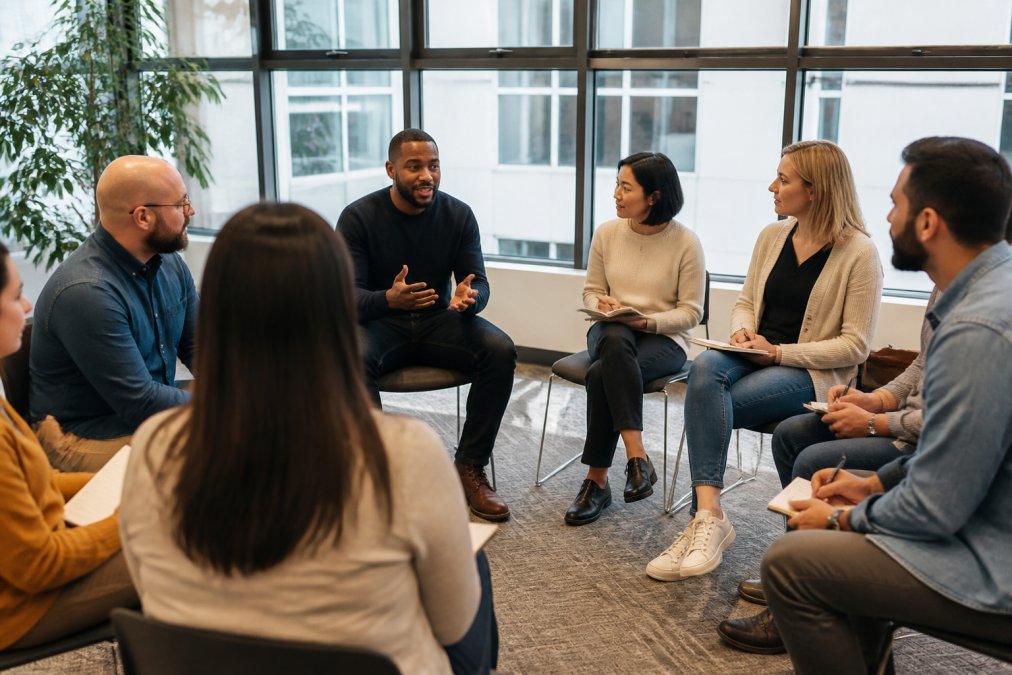
A structured debrief is a guided conversation immediately after an activity that connects what happened to how the team communicates. Ask three questions in order: What did you notice? What would you do differently? Where does this show up in your actual work? Keep it to 15 minutes. The third question is the one most facilitators skip, and it’s the one that transfers the lesson.
Peer Coaching Pairs and Role Reversal Exercises
Pair employees who rarely work together and have each explain the other’s job back to them. The reversal exposes assumptions about who does what and why. Rotate pairs each quarter so the exercise doesn’t calcify into the same two-person clique.
Record the debrief themes across sessions in one shared document. After three or four workshops, patterns emerge that tell you which communication gap is structural rather than personal.
Using a DiSC Assessment for Team Building
A DiSC assessment for team building measures how people approach tasks, people, pace, and procedure, then gives the group a shared vocabulary for those differences. It works because it replaces “you’re being difficult” with “you’re a C and I’m an i,” which is a far easier conversation to have.
The practical value shows up in conflict. Two people with opposite priorities can spend months misreading each other’s intent. A profile gives both of them a neutral explanation before the resentment sets in.
Your Life’s Path administers official DiSC® assessments through EPIC sub-accounts, which means an HR lead can set up a team, assign profiles, and pull results without chasing a vendor for every participant. The DiSC Workplace Profile covers general team dynamics, while the DiSC Management Profile targets the manager-report relationship specifically.
| Profile | Best For | Core Focus |
|---|---|---|
| Workplace | General team dynamics | Communication preferences |
| Management | New and mid-level managers | Directing and delegating |
| Sales | B2B sales teams | Buyer behavioral styles |
| Work of Leaders | Senior leadership | Vision, alignment, execution |
Best Practices for Team Development Workshops
The best practices for team development workshops come down to sequencing: assess first, discuss second, practice third. Running a workshop before anyone knows their behavioral style produces polite agreement and no behavior change.
Three rules that hold up in practice:
- Never exceed 25 participants per facilitator. Beyond that, the quiet half disengages.
- Schedule the follow-up before the workshop ends. A 30-day check-in is standard.
- Send profiles to participants 48 hours ahead so they arrive with context, not confusion.
Deloitte’s 2024 analysis found that adaptable soft skills are what elevate technical work and improve overall team performance, which is why the practice phase matters more than the presentation phase. A workshop that ends with a discussion is a lecture with chairs.
Designing Sessions That Match How Adults Actually Learn
Adults learn soft skills through repetition in real contexts, not through information delivery. A single session on active listening will not change how a team listens. Spaced practice over six to eight weeks will.
Take The Official DiSC® Assessment Online Now! →
Build the schedule around that reality:
- Week 1: Assessment and individual profile review
- Week 2: Group workshop on interpreting results
- Weeks 3-5: Applied exercises in real meetings
- Week 6: Debrief on what changed and what didn’t
- Week 8: Follow-up assessment to measure movement
Some research cautions that long-term retention depends heavily on whether these skills get folded into daily work habits rather than isolated sessions, per ScienceDirect research on soft skills retention. That finding should shape your calendar more than any activity choice.
Measuring Whether the Training Changed Anything
Measuring soft skills training means tracking behavior indicators before and after, not satisfaction scores. A post-workshop smiley sheet tells you people enjoyed themselves. It tells you nothing about whether they stopped interrupting each other.
Track four things:
- Meeting behavior: interruptions per meeting, decisions reached per meeting
- Communication volume: cross-department messages between previously siloed teams
- Conflict escalation: how many disagreements reach a manager versus get resolved peer to peer
- Retention: voluntary turnover within the trained team over 12 months
A 2026 study of employers found teamwork valued as a core competency by 55% and communication by 52%, well ahead of computer skills at 26%, according to TurnOnWork’s soft skills development research. If those are the skills employers say they need, those are the skills your measurement should reflect.
Don’t measure only the training cohort. Compare against an untrained team doing similar work, or you’ll attribute a seasonal improvement to your workshop and repeat a program that did nothing.
Common Mistakes That Kill Soft Skills Training
The most common mistake is treating the assessment as the finish line rather than the starting line. Teams take the profile, read their letters, laugh about them, and never reference the results again. That’s a personality quiz, not development.
Three more that show up repeatedly:
- Skipping the manager. If frontline managers don’t participate, their teams learn a vocabulary their boss doesn’t speak.
- Running it once. One workshop per year produces a spike and a decay. Quarterly reinforcement holds the gain.
- Ignoring the results. If the assessment reveals a communication gap and leadership changes nothing structural about how the team meets, people conclude the whole exercise was theater.
The fix for all three is the same: treat soft skills as an operating practice with a calendar, not an event with a budget line.
The assessment identifies the gap. The workshop names it. Only the follow-through changes it. Budget your time accordingly, roughly one part assessment to three parts reinforcement.
Soft skills training only pays off when it’s built into how your team operates, not bolted on as a quarterly event. Your Life’s Path provides official DiSC® assessments and workshops that give you the behavioral foundation to make that integration stick, including the DiSC Sales Profile for B2B teams, DiSC Catalyst for Teams for flexible facilitation, and free EPIC sub-account setup so your HR team can administer everything without adding headcount. Get started with Your Life’s Path and turn one workshop into a communication habit your team keeps.
Frequently Asked Questions
Why is soft skills training important in team building?
Team building without soft skills training is just an outing. Research shows 82% of businesses saw increased team collaboration after implementing structured soft skills programs (CareerTrainer.ai, 2026). Demand for human skills also outpaces digital skills by 2.4x in North America (Devlin Peck, 2026). When teams practice communication, conflict resolution, and empathy in a structured setting, those behaviors carry back to daily work and improve how projects get delivered.
How do you measure the effectiveness of soft skills training?
Measure before and after. Start with a baseline: pulse surveys on communication, conflict frequency, and team cohesion. Then track behavioral indicators like meeting participation, response times, and peer feedback scores. Research from ScienceDirect (2020) found that long-term retention depends on integrating skills into daily habits, not one-off sessions. Follow up at 30, 60, and 90 days. If behaviors aren’t shifting, the training needs reinforcement, not replacement.
How can a DiSC assessment for team building improve outcomes?
A DiSC assessment gives teams a shared language for behavior. Instead of guessing why a colleague is blunt or slow to decide, team members understand the drivers behind those patterns. This reduces friction and speeds up collaboration. Your Life’s Path offers official DiSC profiles including Workplace, Management, and Sales, each designed for specific team contexts. When combined with facilitated debriefs, the assessment becomes a working tool, not a one-time test.
What are the best activities for integrating soft skills into team building?
The most effective activities combine a challenge with a structured debrief. Examples include problem-solving simulations followed by guided reflection, peer coaching pairs where colleagues swap roles, and scenario-based role plays tied to real workplace situations. Research on outing team-building training (ScienceDirect, 2020) confirms measurable gains in teamwork, communication, and leadership when activities include reflection. The debrief is where the learning sticks.