
Table of Contents
- Why Large-Group Team Building Fails (And How to Fix It)
- How to Choose Creative Team Building Exercises by Group Size
- Team-Building Games for Large Groups That Scale Past 50 People
- Indoor Team-Building Activities for Large Groups When You’re Stuck Inside
- Remote Team-Building Activities for Large Groups Across Time Zones
- Team-Building Activities to Improve Communication and Trust
- Facilitator Instructions and Debrief Questions for Large Groups
- Accessibility, Inclusion, and Psychological Safety in Large Events
- Measuring Outcomes: How to Know Your Exercises Worked
- Frequently Asked Questions
Last Updated: October 4, 2026
Why Large-Group Team Building Fails (And How to Fix It)
Most large-group team building fails for one reason: the activities were designed for a room of twelve, then forced onto a room of eighty. At Your Life’s Path, we’ve watched this play out across organizations of every size. The fix isn’t more activities. It’s choosing creative team building exercises for large groups that were built to scale from the start.
Here’s the core problem. A team building session built on trust and interaction works well with ten people. With sixty, it becomes a slow-moving line and a bored audience. Large groups need activities with parallel participation, clear rules, and short rounds.
Three fixes work consistently:
- Split into small squads of 5-8 people
- Run stations in parallel, not one at a time
- Give every person a defined role
Research from PubMed Central’s 2024 study on team-building interventions shows that how an intervention is structured matters as much as the activity itself. Structure beats novelty. Below, we’ll show you exactly how to pick, run, and measure exercises that work past 50 people.
How to Choose Creative Team Building Exercises by Group Size
Choosing team building exercises is a matching problem, not a creativity problem. Match the activity to your headcount, your room, and your goal. Get that wrong and even a great game flops.
Start with three questions:
- How many people are in the room?
- How much space and time do you have?
- What outcome do you want: trust, communication, or problem-solving?
For groups over 50, avoid anything with a single focal point. One person talking, fifty people watching. That’s a lecture, not team bonding.
Group Size Limits, Duration, and Materials at a Glance
Use this table to pick fast. Each row maps a common objective to the right format, with the participant range, space, and facilitator ratio that make it runnable at scale.
|
Objective |
Best Format |
Ideal Squad Size |
Total Group Range |
Duration |
Space Needed |
Materials |
Facilitator Ratio |
|---|---|---|---|---|---|---|---|
|
Trust building |
Paired sharing rounds |
2 |
10-200+ |
15 min |
Seated, any room |
None |
1 per 40 |
|
Communication |
Drawing exercise |
6-8 |
12-120 |
20 min |
Tables with chairs |
Paper, pens |
1 per 30 |
|
Problem-solving |
LEGO or puzzle challenge |
5-7 |
15-100 |
25 min |
Table per squad |
Building kits |
1 per 25 |
|
Icebreaking |
Two Truths and a Lie |
6 |
12-150 |
10 min |
Seated, any room |
None |
1 per 50 |
|
Cooperation |
Human Knot |
8 |
16-80 |
15 min |
Open floor, 10 sq ft per squad |
None |
1 per 20 |
|
Creative thinking |
Improv prompt rounds |
4-6 |
12-90 |
20 min |
Open floor or circle |
Prompt cards |
1 per 30 |
|
Cross-team mixing |
Speed networking rotations |
2 |
20-300+ |
30 min |
Open floor, movable chairs |
Timer, name tags |
1 per 50 |
The pattern is simple. Keep squads small, keep rounds short, and keep materials cheap.
How to Divide a Large Group Fast
Splitting 80 people into squads is its own logistics problem. Three methods that work:
- Count off by number. Assign each person a number from 1 to 10, then send all the 1s to one corner, all the 2s to another. Fast, random, and fair.
- Pre-assigned color cards. Hand out colored cards at the door. Colors become squads. Best when you want to mix departments deliberately.
- Table assignments. For seated activities, pre-print table numbers. Zero setup time on the day.
Avoid letting people pick their own teams. Self-selection clusters friends together and defeats the cross-team purpose of a large-group event.
When to Run Parallel vs. Rotating Stations
Two formats scale past 50 people, and they solve different problems:
- Parallel stations. Every squad runs the same activity at the same time in its own space. Best for trust and communication work, where you want depth per squad.
- Rotating stations. Squads move through a circuit of short challenges on a timer. Best for energy and variety, and for events where you want everyone to meet more people.
A common pattern is a 90-minute block: 20 minutes of parallel trust work, 50 minutes of rotating challenges, 20 minutes of debrief. Adjust the ratios to your goal, but keep the debrief.
Team-Building Games for Large Groups That Scale Past 50 People
The best team-building games for large groups run in parallel, so nobody waits their turn. Scale comes from repetition across many small squads, not from one giant activity.
Three games that hold up past 50 people:
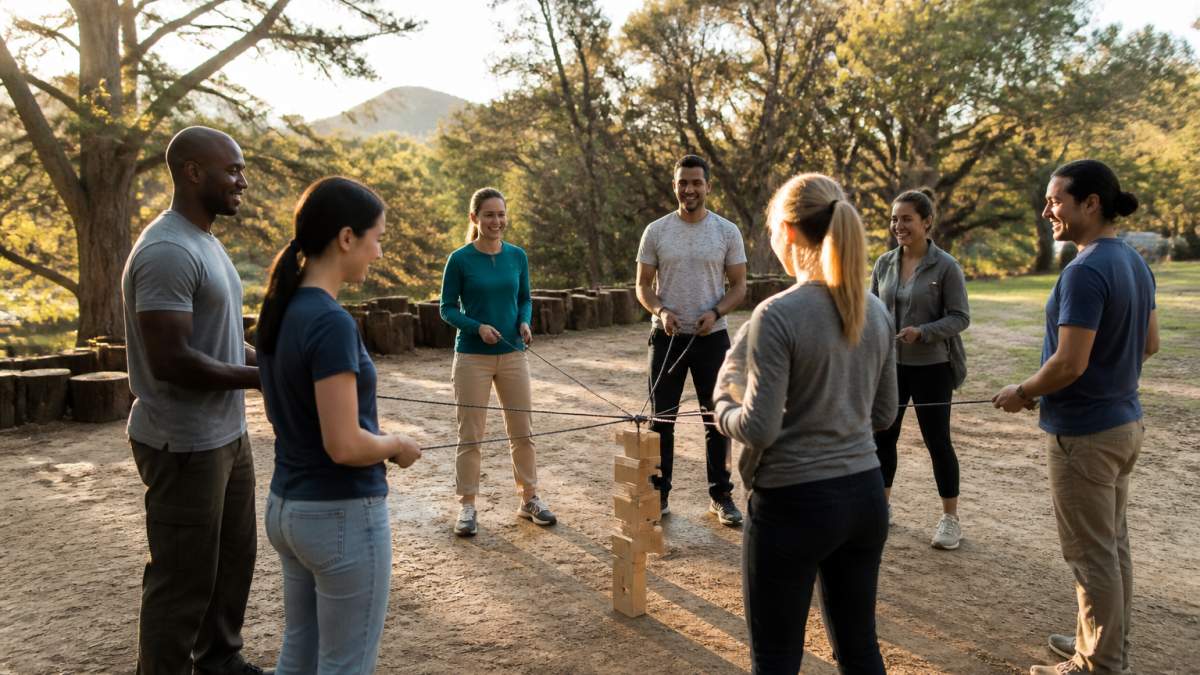
- Human Knot. Squads of 8 link hands and untangle without letting go. Fast, physical, and hilarious.
- Minute-to-Win-It challenges. Set up 6 stations. Teams rotate every 60 seconds. Keeps everyone moving.
- Trivia rounds. Tables of 6 compete. Mix work trivia with general knowledge to spark conversation.
A common mistake is running one game with the whole group. Split the room instead. Parallel play keeps energy high and lets quiet people participate.
Indoor Team-Building Activities for Large Groups When You’re Stuck Inside
Indoor team-building activities for large groups work best when they use the room’s layout, not just its floor space. A conference hall, a cafeteria, and a training room each call for a different setup. Adapting your spatial strategy to accommodate art-based team activities ensures that even the most sprawling venues foster genuine collaboration rather than mere proximity.
Try these when you can’t go outside:
- LEGO challenges. Give each squad the same bricks and a build brief. Compare results.
- Escape-room style puzzles. Print clue sets and run 5 rooms at once.
- Show-and-tell rounds. Each person shares one object that means something to them.
- Virtual coffee pairings. Rotate partners every 8 minutes for quick chats.
For big rooms, set stations around the perimeter. Keep the center open for movement. This cuts noise and keeps each squad focused.
Remote Team-Building Activities for Large Groups Across Time Zones
Remote team-building activities for large groups live or die on one thing: time zones. If half your team is asleep, the activity fails before it starts.
Plan around your people:
- Record async options for anyone in an off-hours zone
- Cap live sessions at 45 minutes
- Use breakout rooms of 4-5, not one big call
- Rotate meeting times so the same people aren’t always inconvenienced
Good remote formats include virtual trivia, online escape rooms, and AI-assisted icebreaker prompts that generate personal questions on the spot. Keep cameras optional. Forcing video on a 7 a.m. call kills engagement fast. If you’d rather not build these sessions from scratch, Virtual Workshops offer a ready-made way to run structured group sessions online.
Team-Building Activities to Improve Communication and Trust
Team-building activities to improve communication and trust need one ingredient: real talking. Games that skip conversation build fun, not trust.
Take The Official DiSC® Assessment Online Now! →
The drawing exercise is the clearest example. One person describes a shape. The other draws it without asking questions. Then they swap and allow questions. The difference in results shows how much communication depends on feedback.
Pair that with Two Truths and a Lie. It builds social skills and helps people read each other. For deeper work, use structured sharing rounds where each person answers one prompt.
Facilitator Instructions and Debrief Questions for Large Groups
A facilitator’s job in a large group is traffic control, not entertainment. Your role is to keep squads moving, rules clear, and time tight. The difference between a smooth event and a chaotic one is almost always the briefing and the debrief, not the activity itself.
The Four-Phase Run Sheet
Run every activity in four phases, and time each one on a visible clock:
- Brief the whole room in under 3 minutes. State the goal, the rules, and the time limit. Do not explain strategy.
- Split into squads and assign captains. Captains read the rules back to their squad so you don’t repeat yourself 10 times.
- Run the rounds with a visible timer. Call out the halfway mark and the final 60 seconds.
- Debrief each squad before rotating. Two to three minutes, no more.
Facilitator Scripts That Keep Large Groups Moving
Use short, repeatable lines so you don’t have to improvise under pressure:
- Opening the brief: “Here’s the goal, here are the three rules, you have 15 minutes. Captains, raise your hand if your squad is ready.”
- Starting the round: “Timer starts in 10 seconds. Go.”
- Mid-round nudge: “Five minutes left. If your squad is stuck, change one thing, not everything.”
- Closing the round: “Pens down. Stay with your squad. Debrief starts now.”
- Rotating: “Squad 3, move to station 4. You have 60 seconds to get there.”
Debrief Questions by Objective
Match the debrief to the goal of the activity. Generic questions get generic answers.
For trust activities:
- What did your partner do that made it easier to trust them?
- When did you hesitate, and what would have helped?
For communication activities:
- Where did the message break down between you?
- What did you assume that turned out to be wrong?
For problem-solving activities:
- What was your first plan, and why did you change it?
- Who led, and how did that happen?
For cross-team mixing:
- What surprised you about how another team approaches the same problem?
- What’s one thing you’d borrow from this squad?
Keep the debrief to 2-3 minutes. Long enough to land the point, short enough to keep energy up.
Common Facilitation Mistakes at Scale
- Over-explaining the rules. If the brief runs past 3 minutes, you’ve lost the room. Show, don’t tell.
- Letting one squad stall. Circulate. If a squad hasn’t started after 90 seconds, step in and reset them.
- Skipping the debrief to save time. The debrief is where the learning happens. Cut a round instead.
- Using one facilitator for 100 people. Plan on one facilitator per 25-40 participants, or recruit squad captains to fill the gap.
Accessibility, Inclusion, and Psychological Safety in Large Events
Inclusion in large events isn’t a nice-to-have. It’s what decides whether people show up to the next one.
Build it in from the start:
- Offer seated and standing versions of physical games
- Provide written instructions for anyone who needs them
- Let people opt out of anything physical without penalty
- Avoid activities that force personal disclosure
Psychological safety means no one is put on the spot. Skip games that single people out or reward the loudest voice. The goal is team spirit, not performance.
Measuring Outcomes: How to Know Your Exercises Worked
You can’t improve what you don’t measure. Track outcomes before and after, not just how people felt in the moment.
Simple measures that work:
- A short pulse survey before and after the event
- Team-level ratings on trust and communication
- Follow-up check-ins 30 days later
For deeper insight, behavioral assessments like DiSC® give you a baseline on how each person communicates and where friction tends to appear. Your Life’s Path provides official DiSC® assessments, and our Catalyst platform for teams lets facilitators run exercises and debriefs around real behavioral data. That turns a one-off event into something you can track over time.
Creative team building exercises for large groups only stick when the format fits the room and the follow-up is real. Most teams run one great event, then let it fade. Your Life’s Path helps you keep the momentum with official DiSC® assessments, easy EPIC sub-account administration, and the Catalyst platform for ongoing facilitation. Start with a free EPIC sub-account setup, then build activities and debriefs around what your team actually needs. Get started with Your Life’s Path and turn a single event into lasting team cohesion.
Frequently Asked Questions
What are some creative team-building exercises for large groups?
Creative team building exercises for large groups include Human Knot variations, LEGO challenges, escape room simulations, minute-to-win-it contests, and trivia rounds. For groups over 50, use parallel stations or breakout teams of 8-12. Activities like Two Truths and a Lie and drawing exercises also work well. The key is choosing exercises with clear instructions and minimal materials so facilitators can manage multiple teams at once.
How do you keep a large group engaged during a team-building activity?
Keep a large group engaged by using short, high-energy activities (10-15 minutes), rotating teams between stations, and assigning co-facilitators to each breakout group. Build in friendly competition with scoreboards. Use clear verbal cues and visual aids. For remote teams, use breakout rooms and interactive polls. Always debrief after each activity to connect the experience to workplace communication and trust.
How long should a team-building exercise last?
Most team-building exercises for large groups should run 15-30 minutes, including a 5-minute debrief. Complex simulations like escape rooms may take 45-60 minutes. For all-hands meetings, schedule 2-3 shorter activities rather than one long one. Always allow buffer time for group transitions, especially with 50+ participants. The debrief is where most learning happens, so never skip it.
How can you adapt team-building activities for remote or hybrid teams?
Adapt team-building activities for remote or hybrid teams by using video breakout rooms, shared digital whiteboards, and online trivia platforms. Choose activities that don’t require physical proximity, like virtual coffee chats, online escape rooms, or collaborative drawing games. For hybrid teams, ensure remote participants have equal roles and use a shared screen to include everyone. Keep sessions shorter and send materials in advance.