

Table of Contents
- Why Team Building Exercises for Rebuilding Trust Are Different
- Match the Exercise to the Trust Breakdown
- Trust-Building Activities for Work: 5 Exercises That Repair Damage
- Team-Building Questions to Build Trust in Any Session
- Team-Building Exercises After Conflict
- Virtual Trust-Building Activities for Teams
- Psychological Safety and Consent Safeguards
- How to Measure Whether Trust Is Improving
- Sustaining Trust After the Exercises End
- Frequently Asked Questions
Last Updated: October 16, 2026
Why Team Building Exercises for Rebuilding Trust Are Different
Trust repair is not the same as trust building. That distinction matters more than most facilitators admit. Team building exercises for rebuilding trust address damage that already exists, while standard icebreakers and social games assume a neutral starting point. At Your Life’s Path, we see this confusion constantly: a manager books a fun afternoon, the team laughs, and nothing changes.
Researchers writing in building trusting relationships in teams to support evidence implementation describe trust as something built through the quality, mutuality, and reciprocity of interactions among team members. Damage to those interactions requires different work than creating them from scratch.
Marie-Claire Ross has argued that team-building exercises fail to build trust when they focus on getting people to like one another. She is right, and the failure mode is worse after a breach.
Below, we break down how to match an exercise to the actual breakdown, five activities that do real repair work, and the facilitator moves that keep a session from backfiring.
Match the Exercise to the Trust Breakdown
Choosing an activity before diagnosing the cause is the most common mistake we see. Trust breaks in different ways, and each cause calls for a different format.
Identify the Cause and Severity First
Start with two questions. What broke, and how badly?
- Competence trust (someone missed commitments or shipped poor work) responds well to structured commitments and follow-through tracking.
- Interpersonal trust (a conflict, a harsh exchange, a perceived betrayal) needs facilitated conversation, not games.
- Systemic trust (layoffs, reorganizations, broken promises from leadership) rarely improves through activities alone.
Severity matters too. A single missed deadline is a different repair job than a public conflict that split a team into camps.
When Activities Are Not Enough
Some damage sits beyond the reach of a workshop. If leadership broke a promise, if someone was terminated unfairly, or if harassment is involved, an exercise will read as tone-deaf.
In those cases, address the structural issue first, then bring in facilitated work.
Trust-Building Activities for Work: 5 Exercises That Repair Damage
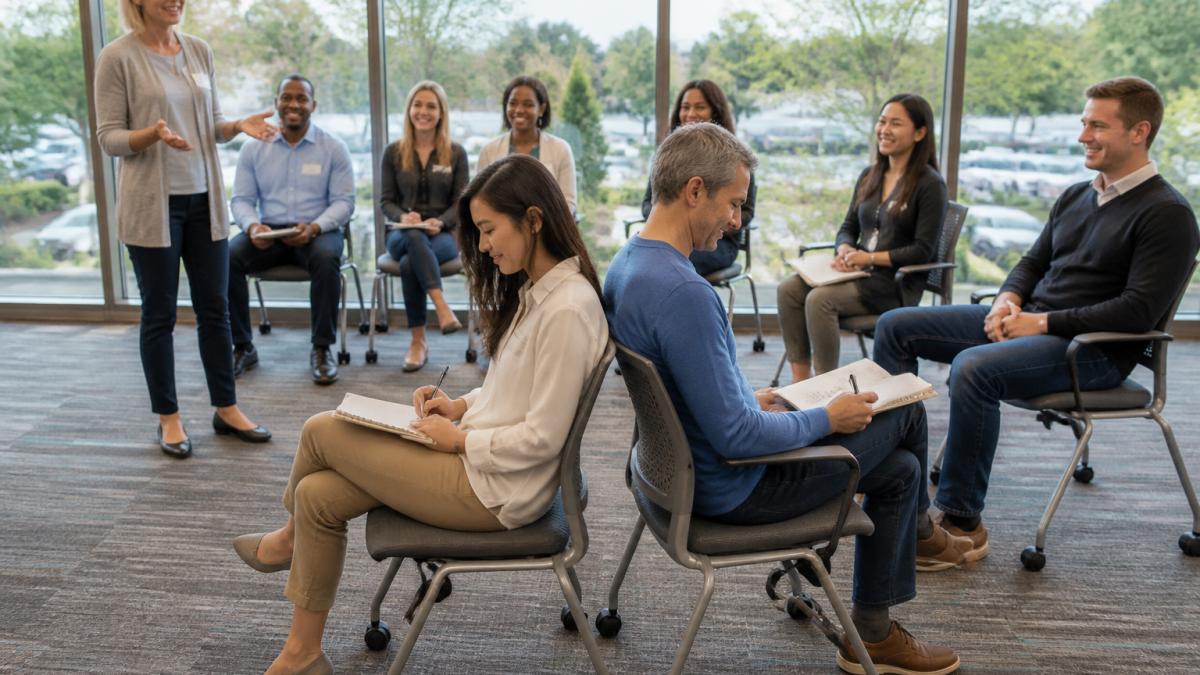
These five trust-building activities for work target repair rather than introduction. Each one requires a facilitator, clear ground rules, and a debrief. The structure below follows the format most team-building blogs use for runnable exercises: purpose, setup, facilitator script, debrief questions, and a remote variant. If you are borrowing exercises from other team-building blogs, keep that structure intact; it is what separates a repair session from a game.
1. The Commitment Exchange
Purpose: Rebuild reliability after missed commitments.
How to run it:
- Each person writes down one commitment they dropped in the past quarter.
- They state what they will do differently, in specific, checkable terms.
- A partner records the commitment and agrees to check in weekly.
- The facilitator collects all commitments and schedules a 30-day review.
Facilitator script: “We are not here to assign blame for what slipped. We are here to make the next commitment visible and checkable. Write one thing you dropped, then write what you will do differently in terms someone else could verify.”
Debrief questions:
- What made this commitment harder to keep than you expected?
- What would have helped you flag the slip earlier?
- What does your partner need from you to make the weekly check-in useful?
Remote variant: Use breakout pairs in your video tool, with a shared commitment doc that both partners can edit. The facilitator visits each room once to confirm the commitment is specific enough to check.
Time: 45 minutes. Best for: competence trust.
2. Back-to-Back Drawing
Purpose: Surface communication gaps without blame.
Two partners sit back-to-back. One holds a simple image; the other holds a blank page. The first describes it; the second draws. No questions allowed in round one. Round two allows questions.
Facilitator script: “Round one, the describer cannot answer questions. Round two, questions are allowed. Notice what changes in your drawing and in your frustration level.”
Debrief focus: Where did assumptions fill in for missing information? This is the same dynamic that erodes trust in day-to-day work. Ask: “Which round felt more like our normal project communication, and why?”
Remote variant: The describer shares a simple image on screen; the drawer uses a shared whiteboard tool. Keep the no-questions rule in round one by muting the drawer.
3. The Assumption Exchange
Purpose: Clear out the stories people tell themselves about each other.
Each person writes two assumptions they hold about a teammate’s motives or work style. The teammate responds with what is actually true. The facilitator enforces curiosity over defensiveness.
Facilitator script: “You are not defending yourself here. You are correcting a story. Say what is actually true, then ask what would help your teammate update the assumption.”
Debrief questions:
- Which assumption was closest to true, and which was furthest off?
- What information were you missing when you formed that story?
- What will you ask directly next time instead of assuming?
Remote variant: Collect assumptions in a shared doc before the session, then run the exchange in pairs over video. Written input first lowers the heat for teams still raw from conflict.
4. Working With Me Maps
Purpose: Give teammates a user manual for each other.
Each person creates a one-page map: how I prefer feedback, what stresses me, how I make decisions, what I need when I am struggling. Maps get shared and stored where the team can reference them.
Facilitator script: “Write this for the teammate who has never worked with you closely. Be specific enough that someone could act on it tomorrow without asking you.”
Debrief questions:
- What surprised you about a teammate’s map?
- Where do two maps conflict, and how will you handle that in practice?
- What is one thing you will change in how you approach a teammate this week?
Remote variant: Have each person submit their map asynchronously before the session, then review highlights live. Store the maps in a shared drive the whole team can access.
5. The Project Origin Story
Purpose: Rebuild shared narrative after a failed project.
The team reconstructs what happened, in sequence, without assigning blame. The facilitator captures decision points where information was missing or misread. The output is a shared account everyone can live with.
Facilitator script: “We are building one timeline, not competing ones. Facts first, feelings second, blame never. If you disagree on a fact, we note it and move on.”
Take The Official DiSC® Assessment Online Now! →
Debrief questions:
- Where in the timeline did the team lose shared information?
- What decision would you make differently with what you know now?
- What is one early warning sign we agree to name next time?
Remote variant: Use a shared timeline doc or whiteboard, with one facilitator rotating between small groups to keep each timeline honest. Bring the groups back together to merge timelines into one account.
If your team has no internal facilitator, we recommend hiring a certified DiSC expert to run an in-person or virtual facilitation. An outside facilitator can hold the room in ways an internal manager cannot, especially when the manager is part of the conflict.
Team-Building Questions to Build Trust in Any Session
The right questions do more repair work than the right activity. Team-building questions to build trust should move from low-risk to high-risk, and the facilitator should model vulnerability first.
A workable sequence:
- What is one thing you need from this team that you are not getting?
- When did you last feel genuinely supported here?
- What is something you have held back saying, and why?
- What would need to change for you to raise a hard issue in a meeting?
- What is one commitment you are making to this team this month?
Stop at the first sign of real distress. A question that opens a wound without a plan to close it does more harm than good.
Team-Building Exercises After Conflict
Sessions after an open conflict need a different shape than general trust work. Team-building exercises after conflict should start with acknowledgment, not activity.
Begin with a facilitated acknowledgment: what happened, who was affected, and what the team agrees to do differently. Only then move into an exercise. Working With Me Maps and the Commitment Exchange tend to land best here.
Facilitator Scripts and Debrief Questions
A simple opening script:
“We are not here to relitigate what happened. We are here to rebuild how we work together. Each of you will have a turn to speak without interruption. I will keep time and I will not take sides.”
Debrief questions that work after conflict:
- What did you hear that you did not expect?
- What is one thing you are willing to let go of?
- What is one thing you need from this group going forward?
- What will you do differently starting tomorrow?
If your team has no internal facilitator, we recommend hiring a certified DiSC expert to run an in-person or virtual facilitation. An outside facilitator can hold the room in ways an internal manager cannot, especially when the manager is part of the conflict.
Virtual Trust-Building Activities for Teams
Virtual trust-building activities for teams work when they preserve the elements that make in-person repair effective: paired conversation, structured commitments, and follow-through. They fail when they become another video call where everyone watches one person talk. Most competitors cover in-person repair and skip the remote mechanics entirely, so this section focuses on what actually changes when the room is a screen. Moving beyond the digital interface to incorporate physical movement and shared environments can provide a necessary reset for fractured dynamics, much like the collaborative potential found in team building activities on water.
What Changes on Video
Three things shift when repair work moves online, and each one needs a deliberate counter-move.
- Silence reads as disengagement. On video, a pause looks like a frozen connection or a distracted participant. Counter it by naming the pause: “I am going to give everyone 30 seconds to think before we speak.”
- Side conversations disappear. In person, a quiet exchange after a hard moment can repair a small rupture. Online, that channel is gone. Counter it with structured breakout pairs and a short open room at the end.
- The facilitator loses the room’s temperature. You cannot read the back row on a grid of thumbnails. Counter it with a quick reaction check (thumbs up, sideways, down) after each high-risk question.
Adaptations That Hold Up
- Breakout pairs for the Commitment Exchange, with a shared doc for recording commitments. Assign pairs in advance so no one is picked last on screen.
- Screen-shared drawing for Back-to-Back Drawing, using a whiteboard tool. Mute the drawer in round one to preserve the no-questions rule.
- Async Working With Me Maps, submitted before the session and reviewed live. Written input first lowers the heat for teams still raw from conflict.
- Small-group Project Origin Stories, with a facilitator rotating between rooms. Cap each room at four people so every voice gets airtime.
Pacing and Session Shape
Many teams find that virtual sessions work best in shorter blocks. Two 45-minute sessions a week apart beat one 90-minute marathon. A workable shape:
- Session one (45 minutes): ground rules, one low-risk exercise, and a commitment to return.
- Between sessions: async Working With Me Maps and a short pulse check.
- Session two (45 minutes): one higher-risk exercise, debrief, and a 30-day follow-through plan.
Keep cameras optional but ask people to say their name before speaking so the facilitator can track who has not been heard. Rotate the speaking order so the same two voices do not carry every debrief.
Hybrid Rooms
Mixed in-person and remote teams need one rule above all: the remote participants are not an audience. Give every remote person a named in-room partner who repeats questions and brings them into side moments. Run all exercises in mixed pairs or small groups, never in-person versus remote. If the room has one screen and one microphone, test the audio before the session; a facilitator who cannot hear the remote half cannot hold the room.
For teams that want a structured virtual format, our virtual workshops pair the DiSC Workplace profile with facilitated sessions built around these exercises. If your team does not have an internal facilitator, we recommend hiring a certified DiSC expert to run an in-person or virtual facilitation; the remote mechanics above are easier to hold when someone is not also managing the conflict.
Psychological Safety and Consent Safeguards
Psychological safety is the shared belief that a team is safe for interpersonal risk-taking, and it is the precondition for any exercise that asks people to be vulnerable. Without it, trust work becomes performance.
Three safeguards we insist on:
- Opt-in, not opt-out. Anyone can pass on any question or activity without explanation.
- No forced disclosure. Participants share what they choose, not what the facilitator asks for.
- Clear boundaries up front. State what will be shared with managers and what stays in the room.
How to Measure Whether Trust Is Improving
Trust is measurable if you define it. We use four signals:
- Follow-through rate on commitments made in the session.
- Disagreement frequency in team meetings (too low is as concerning as too high).
- Time-to-raise-issues, tracked through manager check-ins.
- Repeat conflicts, logged by theme rather than by individual.
A short pulse survey before and after the session series gives you a baseline. Ask three questions: I can raise a hard issue here. I trust my teammates to follow through. I feel safe disagreeing in meetings. Score each one to five. Compare at 30 and 90 days.
|
Signal |
What It Measures |
How to Track |
Review Cadence |
|---|---|---|---|
|
Follow-through rate |
Reliability |
Commitment log |
Weekly |
|
Disagreement frequency |
Psychological safety |
Meeting notes |
Monthly |
|
Time-to-raise-issues |
Comfort with conflict |
Manager check-ins |
Monthly |
|
Repeat conflicts |
Unresolved patterns |
Conflict log by theme |
Quarterly |
If the numbers do not move after 90 days, the exercises are not the problem. The structural issue is.
Sustaining Trust After the Exercises End
The session is the easy part. What happens in the following 90 days determines whether the repair holds.
We recommend three structural supports. First, a recurring 30-minute commitment check-in, kept on the calendar. Second, a shared Working With Me Map library that new team members can read. Third, a quarterly review of the trust signals above, with the team, not just leadership.
The most useful tool we have found for keeping the language consistent is the official DiSC assessment used for team workshops. The DiSC Workplace profile gives teams a shared vocabulary for how each person communicates, decides, and handles conflict. That vocabulary does not fix trust on its own, but it makes the repair conversations far less personal.
Our DiSC Workplace profile is the version we use most often for team repair work. For managers leading the rebuild, the DiSC Management profile adds a layer on delegation and feedback.
Rebuilding trust after a breach is slow, uncomfortable work, and most teams try to skip straight to the fun part. They book an afternoon, run an icebreaker, and wonder why nothing changed. The teams that recover are the ones that diagnose the cause, choose the exercise to match it, and hold the follow-through for months, not days. Your Life’s Path supports that work with official DiSC assessments, free EPIC sub-account setup for administrators, and the Catalyst platform for flexible facilitation, so your team has a shared language for the conversations that actually repair trust. Take the official DiSC assessment online now and start with the profile that fits your team.
Frequently Asked Questions
How do you build trust with your team members after it has been broken?
Start by naming what happened and who was affected, then choose exercises that match the specific breach. The PMC research on building trusting relationships in teams recommends strengthening the quality, mutuality, and reciprocity of everyday interactions rather than relying on a single event. Pair structured activities like the Commitment Exchange with visible follow-through on small promises. Trust rebuilds through consistent behavior over weeks, not one workshop.
Can virtual trust-building activities for teams work as well as in-person ones?
Yes, when they are designed for the format. Virtual game nights and structured video sessions give distributed teams a shared experience. Avoid exercises that depend on physical proximity or reading body language. Pair virtual sessions with a DiSC Workplace profile so teammates understand each other’s behavioral drivers before the harder conversations happen.
What are effective team-building exercises after conflict?
The Assumption Exchange and the Project Origin Story work well because they surface the stories people told themselves during the conflict. Back-to-back drawing also helps by forcing precise communication without visual cues. Run these with a certified DiSC expert who can hold the room when emotions surface. Marie-Claire Ross warns that trust does not come from getting people to like each other, so skip the icebreakers and go straight to structured dialogue.
How long does it take to rebuild trust on a team?
There is no fixed timeline, and anyone quoting one is guessing. What matters is the pattern: how quickly people admit mistakes, how reliably commitments are kept, and whether concerns get raised without retaliation. Track those signals in short pulse surveys every two to four weeks. If the breach involved leadership, expect the process to take longer and plan multiple sessions rather than one.
When should a team hire a facilitator for trust-building exercises?
Bring in outside help when the breach involves a manager, when the team is split into factions, or when previous attempts have failed. A certified DiSC expert can run an in-person or virtual session using the official DiSC Workplace assessment, which gives everyone a neutral vocabulary for behavior instead of blame. Your Life’s Path offers virtual workshops and free EPIC sub-accounts to administer profiles before the session begins.