

Table of Contents
- How to Mediate Conflict Between Coworkers: The Core Process
- Workplace Conflict Resolution Scripts and Real Examples
- Examples of Workplace Conflict Mediation in Action
- Best Practices for Conflict Resolution in the Workplace
- When to Involve HR in Employee Conflict
- Managing Power Imbalances and Remote Mediation Scenarios
- Common Mistakes to Avoid When Mediating Conflict
- Post-Mediation Follow-Up and Prevention
How to Mediate Conflict Between Coworkers: The Core Process
Workplace conflicts drain productivity and damage team morale if left unaddressed. When two employees can’t resolve a disagreement independently, a structured mediation process becomes essential. Learning how to mediate conflict between coworkers is one of the most valuable skills a manager can develop, it transforms friction into understanding and rebuilds working relationships.
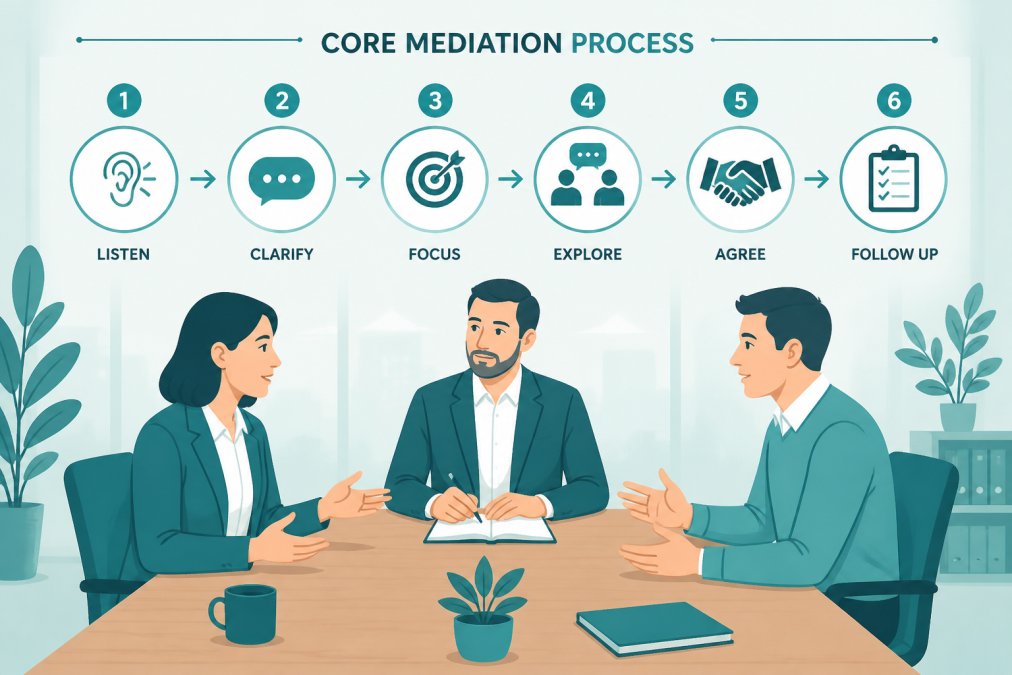
The core mediation process follows a predictable framework: preparation, facilitated dialogue, and follow-up.
This guide walks you through each step of mediating conflict between coworkers, from initial preparation through post-resolution monitoring. We’ll cover specific scripts, common mistakes to avoid, and when to escalate to HR. These techniques work across remote, hybrid, and in-office environments.
Prepare Before the Meeting
Your preparation determines whether mediation succeeds or fails. Start by meeting each person individually before bringing them together. This accomplishes three things: you gather facts, signal that both perspectives matter, and establish psychological safety.
During one-on-one conversations, ask open-ended questions about what happened, how it’s affecting their work, and what resolution looks like to them. Listen without judgment. Your goal is to understand each person’s reality, not determine who’s right.
Document key facts and emotions from each conversation, noting the root cause as each person sees it. Choose neutral territory for the joint meeting, a conference room, not your office or either person’s desk. Schedule mid-morning when both parties have completed urgent work and emotions aren’t highest.
Send a brief calendar invitation framing the meeting professionally: "I’d like to meet with both of you to discuss how we can work together more effectively moving forward." This signals collaborative problem-solving, not punishment.
Conduct the Mediation Session
The mediation session follows a specific structure: establish ground rules, guide each person to share their perspective, then move into joint problem-solving.
Open by restating the purpose: "I’ve asked you both here because I want to help us move past this conflict and rebuild a working relationship that benefits the whole team." Establish ground rules immediately: speak respectfully, focus on impact rather than personal attacks, avoid interrupting, and stay committed to finding a solution.
Invite the first person to share their view in five to seven minutes while the other listens without responding. When they finish, reflect back what you heard: "So from your perspective, the issue started when X happened, and it affected you by Y. Is that accurate?" This confirms understanding and signals that their perspective was heard.
Repeat the same process with the second person, giving equal time and attention. Now identify the root cause together by asking: "What do you think actually caused this situation?" Often, the surface conflict masks a deeper issue, unclear expectations, competing priorities, or feeling disrespected. Finding that deeper issue makes resolution stick.
Workplace Conflict Resolution Scripts and Real Examples
Having specific language ready removes the pressure of improvising in emotionally charged moments.
Opening Statement Script
"I appreciate you both being here. I know this situation has been frustrating. My role isn’t to decide who’s right or wrong, it’s to help us understand what happened and find a way forward that works for everyone. I believe you’re both committed to this team, and I want to help us get back to a place where you can work together effectively. I’m going to ask each of you to share your perspective without interruption, and then we’ll work together on solutions. Does that approach work for both of you?"
This script validates the difficulty, clarifies your neutral role, emphasizes shared commitment, sets behavioral expectations, and invites buy-in.
Active Listening and Reflection Script
After each person speaks, use this structure:
"Let me make sure I understand. You experienced [specific situation] and it made you feel [emotion] because [impact]. You’ve tried [action they took] to address it, but [what happened instead]. Is that right? What am I missing?"
This shows genuine listening, separates the person from the behavior, and invites clarification.
Problem-Solving Script
Once both perspectives are on the table:
"Given what we’ve talked about, what would need to happen for you both to feel like this is resolved? [Listen to suggestions.] I’m hearing that you need [specific outcome] and you need [specific outcome]. Are there ways we can meet both of those needs? What would that look like?"
This shifts focus from past to future and invites collaborative problem-solving.
Examples of Workplace Conflict Mediation in Action
Example 1: Miscommunication Between Team Members
Sarah and Marcus work on the same project. Sarah believes Marcus missed a deadline without communicating the delay. Marcus believes Sarah’s instructions were unclear and that he did communicate via email.
In the joint mediation, Sarah shares that she felt blindsided and worried about her credibility with the client. Marcus shares that he felt his work wasn’t valued and that Sarah didn’t trust him.
The root cause isn’t the deadline, it’s about communication channels and trust. Sarah expects synchronous communication (Slack or calls). Marcus prefers email.
The solution: "For this project, we’ll use Slack for time-sensitive updates. Marcus will send a message the day before a deadline if anything is at risk. Sarah will check Slack daily before 10 a.m. We’ll both confirm receipt of important messages."
Example 2: Credit and Recognition Disputes
Jordan and Alex co-led a project. The executive presentation highlighted Alex’s contribution but barely mentioned Jordan’s work. Jordan feels invisible; Alex feels caught in the middle.
The root cause is a process problem: nobody clarified who would be credited before the presentation.
The solution: "For future projects, we’ll document contributions in writing as we go. Before any presentation to leadership, we’ll review together to ensure everyone’s work is represented accurately."
Best Practices for Conflict Resolution in the Workplace
Establish Ground Rules and Behavioral Expectations
Set clear behavioral expectations at the start: speak respectfully with no name-calling, avoid interrupting, focus on specific behaviors and impact rather than personality judgments, work toward solutions, and keep conversations confidential.
Take The Official DiSC® Assessment Online Now! →
State these matter-of-factly as "how we do this together," not as a threat. When someone violates a rule, pause gently: "I want to make sure we stay focused on the behavior and its impact. Can we reframe that without the personal criticism?"
Identify Root Cause and Depersonalize the Issue
Most surface conflicts mask deeper issues. Dig for the root cause by asking: "What was really bothering you about this situation?" Once identified, depersonalize it. Instead of "Marcus is unreliable," the issue becomes "We don’t have a clear process for communicating deadline changes." This shift allows both people to work on it together.
Focus on Future Solutions, Not Past Blame
Your job isn’t to judge the past, it’s to build a better future. Use this language: "I understand how we got here. Now let’s focus on what needs to happen going forward." Redirect every conversation toward solutions. If someone brings up past wrongs, acknowledge it briefly, then pivot: "That’s important context. What would prevent that from happening again?"
When to Involve HR in Employee Conflict
Not every conflict requires HR involvement. Involve HR immediately if:
- Discrimination or harassment is alleged. If someone mentions race, gender, age, religion, disability, or sexual orientation as a factor in how they’ve been treated, this moves beyond mediation into legal territory.
- Physical aggression or threats occurred. Mediation assumes both parties can work together safely.
- Retaliation is suspected. If the conflict started because someone reported a policy violation or raised a safety concern, retaliation laws apply.
- A power dynamic makes fair mediation impossible. If one person directly supervises the other or there’s a significant power imbalance, mediation can feel coercive.
- The same conflict keeps recurring. If you’ve mediated this twice without sustained change, there’s a bigger issue.
- The conflict involves substance abuse, mental health crisis, or safety concerns. These require professional resources beyond mediation.
Managing Power Imbalances and Remote Mediation Scenarios
Handling Power Imbalance Dynamics
A power imbalance exists when one person has formal authority over the other or significantly more seniority. The less powerful person may agree to solutions they don’t actually support just to appease authority.
If mediating between a supervisor and their direct report, don’t do it alone. Bring HR into the room or facilitate from a position of clear neutrality. Use language that explicitly invites the less powerful person to be honest: "I want to make sure you feel comfortable speaking openly. If there’s anything you’d rather discuss without [the other person] present, we can do that."
Consider private follow-up conversations after the joint mediation. Document the agreement in writing and ensure both people understand the expectations.
Remote and Hybrid Mediation Considerations
Remote mediation changes the dynamic. You lose body language cues, but people often express themselves more freely when not face-to-face.
Establish technical expectations upfront: request cameras stay on, disable chat to prevent side-messaging, and use waiting rooms to meet with each person separately before the joint session. Keep remote joint mediation to 45 minutes maximum. For hybrid situations, bring the in-office person to a conference room alone to level the perceived power dynamic.

Common Mistakes to Avoid When Mediating Conflict
Mistake 1: Taking sides. If you signal that you believe one person over the other, the mediation ends. Stay neutral with both people.
Mistake 2: Trying to solve the problem yourself. Your job is to facilitate problem-solving, not impose a solution. Ask "What would need to happen for you both to feel this is resolved?" and let them answer.
Mistake 3: Letting one person dominate the conversation. Manage time actively: "I want to make sure we hear from both of you equally. [Person A], I’m going to ask you to hold that thought so [Person B] can share their perspective."
Mistake 4: Focusing on blame instead of impact. "You did X wrong" triggers defensiveness. "When X happened, it affected the team by Y" invites reflection.
Mistake 5: Accepting vague solutions. "We’ll just try to get along better" isn’t a solution. Push for specific, behavioral commitments: "What specific action will you take?"
Mistake 6: Skipping the follow-up. Mediation creates a moment of clarity that fades without follow-up. Schedule check-ins at one week and 30 days.
Post-Mediation Follow-Up and Prevention
Within 24 hours of mediation, send a brief email to both people summarizing the agreements. Use neutral language and focus on specific commitments: "In our meeting yesterday, we agreed that [Person A] would [specific action] and [Person B] would [specific action]. We’ll check in on [date] to see how things are going."
One week after mediation, meet with each person individually for five minutes. Ask: "How’s it going with [the other person]? Are the agreements working? What’s going well? What’s challenging?" Listen for early warning signs that the conflict is reigniting.
At 30 days, do a quick check-in with both people together or separately. Acknowledge progress and address any backsliding immediately.
Look for patterns in conflicts. If you’re mediating the same type of conflict repeatedly, there’s a systemic issue. Use conflict data to improve your team’s systems and processes.
| Mediation Step | Timeline | Key Actions | Success Indicator |
|---|---|---|---|
| Preparation | 1-2 days before | Individual meetings, fact-gathering, logistics setup | Both parties feel heard; you understand root cause |
| Joint Mediation | Day of | Opening, perspective-sharing, root cause discussion, problem-solving | Agreement on specific behavioral commitments |
| First Follow-up | 24 hours | Email summary of agreements | Confirmation both parties understood same thing |
| Check-in Meeting | 1 week | Individual conversations about progress | Early warning signs caught; adjustments made if needed |
| Progress Review | 30 days | Joint or individual check-in | Sustained behavior change; conflict resolved |
Conclusion
Learning how to mediate conflict between coworkers transforms your effectiveness as a manager. The process, preparation, structured dialogue, and follow-up, creates conditions where people can move past blame and toward solutions.
The biggest mistake most managers make is assuming good intentions are enough. Structure matters. Language matters. Follow-up matters. When you apply these principles consistently, conflicts that seemed intractable resolve, team cohesion improves, and people actually want to work together again.
If your team struggles with communication or interpersonal friction, consider going deeper than mediation alone. Tools like the DiSC Workplace Profile help team members understand their behavioral styles and how they interact with others, preventing many conflicts from escalating in the first place. You can also explore Virtual Workshops focused on workplace communication and conflict resolution. By building that foundation of self-awareness and mutual understanding, you create a team culture where people communicate more effectively and resolve disagreements before they become serious problems.
Frequently Asked Questions
What is the role of a mediator in workplace conflict?
A mediator is a neutral third party who facilitates dialogue between conflicting employees without taking sides. Your role is to establish ground rules, ensure both parties feel heard, identify the root cause of the dispute, and guide them toward mutually beneficial solutions. Mediators do not make decisions for the employees; instead, they help them reach their own resolution through collaborative problem-solving and active listening.
How do you remain neutral when mediating a dispute?
Neutrality requires separating the person from the problem and avoiding judgment. Listen to both perspectives without interrupting, use open-ended questions to encourage perspective taking, and refrain from assigning blame. Acknowledge both employees' concerns equally, avoid body language that signals favoritism, and focus the conversation on behaviors and impacts rather than character judgments. If you have a prior relationship with one party, consider whether recusal is appropriate.
When should a manager escalate conflict to HR instead of mediating?
Escalate to HR immediately if the conflict involves harassment, discrimination, threats, violence, or violations of company policy. Also involve HR when there are significant power imbalances (supervisor-subordinate), legal liability concerns, or if previous mediation attempts have failed. If the conflict impacts performance significantly or involves multiple departments, HR can provide compliance guidance and ensure organizational culture standards are upheld.
How can I prevent conflict from recurring after mediation?
Schedule a follow-up meeting 1-2 weeks after mediation to check progress and reinforce agreements. Monitor interactions between the employees and address small tensions early before they escalate. Help both parties rebuild trust through collaborative projects or shared goals. Consider using behavioral assessment tools like the DiSC Workplace Profile to help employees understand their communication styles and prevent future misunderstandings rooted in personality differences.
This article was written using GrandRanker