
Table of Contents
- Understanding Dominant Personality Types at Work
- Scripts for Dealing With Dominant Managers
- Communicating With D-Style Personalities
- Setting Boundaries and Giving Feedback
- Conflict Resolution With High-Dominance Individuals
- Building Stronger Team Dynamics Across All Personality Styles
- Conclusion
Last Updated: August 7, 2026
Understanding Dominant Personality Types at Work
Dominant personality types drive results, make quick decisions, and push teams toward measurable outcomes. Understanding how to communicate with them means recognizing their behavioral patterns and adapting your approach without losing your own voice.
The challenge isn’t that dominant personalities are difficult, it’s that most people respond reactively instead of strategically. The real skill is learning to speak their language while maintaining boundaries.
What Defines a Dominant Personality
A dominant personality is characterized by directness, decisiveness, and a focus on results over relationships. These individuals prioritize efficiency, competition, and control. They measure success in concrete outcomes: revenue, deadlines met, problems solved.
Dominant personalities typically exhibit these traits:
- High assertiveness: They state opinions directly and expect the same from others
- Results-focused: Every conversation circles back to outcomes and metrics
- Impatient with process: They want the shortest path from problem to solution
- Competitive drive: They see situations as win-or-lose scenarios
- Low tolerance for ambiguity: They prefer clear goals and measurable progress
This behavioral style isn’t inherently negative. Dominant personalities often become leaders because they move fast, take ownership, and hold teams accountable.
Dominant personalities aren’t trying to be difficult, they’re optimized for speed and results. When you understand this, you stop taking their directness personally and start using it to your advantage.
How Dominant Styles Show Up in the Workplace
In meetings, dominant personalities dominate the conversation and interrupt because they’re already thinking ahead. They make decisions quickly, sometimes before all information is gathered, because momentum matters more than perfection to them.
With direct reports, they set aggressive targets and expect progress updates, not excuses. Feedback is blunt and focused on what needs improvement. In cross-functional work, they can seem dismissive of other departments’ constraints because they prioritize efficiency over process.
The key insight: dominant personalities operate from a different set of values. Speed, autonomy, and measurable results matter more than process, consensus, or relationship-building.
Scripts for Dealing With Dominant Managers
Working for a dominant manager requires a shift in how you communicate. These scripts give you concrete language for common situations.

When Your Manager Makes Rapid Decisions
Dominant managers often decide before you feel ready. Your job isn’t to slow them down, it’s to ensure they have the information they need.
Script for providing input before the decision:
"I know you’re moving fast on this. Here’s what I need you to know: [specific constraint or risk]. Given that, here’s my recommendation: [clear choice with one sentence rationale]."
This respects their speed while demonstrating strategic thinking. You’re not asking permission or creating delay.
Script for when you disagree with the decision:
"I understand the call. Before we execute, can I flag one thing? [specific risk or unintended consequence]. How do you want to handle that?" Then stop talking.
Dominant managers respect people who speak up once and then commit.
When Your Manager Demands Results Immediately
Script for setting realistic expectations:
"Here’s what I can deliver this week: [specific output]. Here’s what we’ll see next week: [next milestone]. To hit the aggressive timeline you want, I need [one specific resource or decision from you]."
This demonstrates you’re serious about the deadline while being honest about constraints.
Script for when the timeline is genuinely impossible:
"I could cut corners and deliver something by Friday, but it won’t solve the problem. It’s better to give you something solid by Tuesday that actually works. Which matters more, speed or quality here?"
Never use phrases like “I’ll try” or “I’ll do my best” with a dominant manager. Instead, commit to specific deliverables by specific dates, or explain why you can’t.
Communicating With D-Style Personalities
D-style personalities (using DiSC behavioral assessment language) are the most direct and results-focused. They’re driven by the need for control, achievement, and measurable progress. They become frustrated when conversations lack purpose, when decisions are delayed, or when people focus on feelings instead of facts.
Adapting Your Tone and Pace
D-styles respond to speed and directness. Slow, careful communication feels like stalling to them.
What to do:
- Lead with the bottom line. Start with your conclusion or recommendation. "We should switch vendors because it cuts costs by 20% and speeds up delivery" beats lengthy background.
- Use data, not feelings. "The data shows this approach has a 15% higher success rate" lands better than emotional appeals.
- Be concise. One clear paragraph beats three that say the same thing.
- Match their pace. If they’re moving fast, keep up. Don’t slow them down with unnecessary context.
- Respect their time. Come prepared with key points and move efficiently through them.
What to avoid:
- Emotional language or appeals to feelings
- Long stories or unnecessary context
- Hedging language like "maybe," "possibly," or "I think"
- Dwelling on problems without offering solutions
D-styles want to move from problem to action. Come with a problem and a recommendation.
Presenting Ideas Effectively to D-Styles
D-styles evaluate ideas based on whether they’ll move the needle on results.
Structure for presenting to D-styles:
- State the outcome: "This will reduce processing time by 30% and free up two people for higher-value work."
- Explain the mechanism: "We automate the data entry step, which currently takes 40% of the cycle time."
- Address the cost: "It costs $15K to implement and $3K per month. We’ll break even in the first month based on labor savings."
- Get agreement: "Should I move forward with implementation, or do you need different information?"
Don’t present five options and ask them to choose. Present your top recommendation with one alternative if there’s a genuine trade-off.
D-style personalities respect people who are clear, fast, and results-focused. When you communicate in their language, they see you as competent and efficient, which builds trust and influence.
Setting Boundaries and Giving Feedback
Dominant personalities can steamroll boundaries if you let them. The key is setting limits clearly and early, without being defensive.
How to Say No Without Damaging the Relationship
Saying no to a dominant personality requires confidence. Hesitation signals weakness, which invites them to push harder.
Script for declining a request:
"I can’t take that on right now because [specific reason]. Here’s what I can do instead: [alternative that moves toward their goal]."
You’re not apologizing. You’re stating a fact and offering a workaround.
Script when they push back:
"I understand the priority. My concern is that if I take this on, [specific consequence]. What should I deprioritize to make room for this?"
Take The Official DiSC® Assessment Online Now! →
This puts the decision back on them.
Script for protecting your time:
"I’m available for urgent issues anytime. For non-urgent items, I’m most responsive Tuesday through Thursday afternoons."
Dominant personalities respect clear boundaries.
Delivering Constructive Feedback That Lands
Dominant personalities want to know what went wrong and how to fix it. Sugarcoating feels patronizing.
Script for giving feedback:
"I want to flag something I noticed: [specific behavior or outcome]. Here’s the impact: [concrete consequence]. Here’s what I’d suggest instead: [clear alternative]. Does that land?"
This is direct without being harsh. You’re describing observable facts, explaining consequences, and offering a solution.
What not to do:
- Don’t say "Some people felt…" Own your observation.
- Don’t focus on their intention. They care about impact, not intent.
- Don’t ask permission to give feedback. Just be honest.
- Don’t soften the message with excessive praise.
After giving feedback to a dominant personality, move on. Don’t linger on the conversation. They’ll process it and move forward.
Conflict Resolution With High-Dominance Individuals
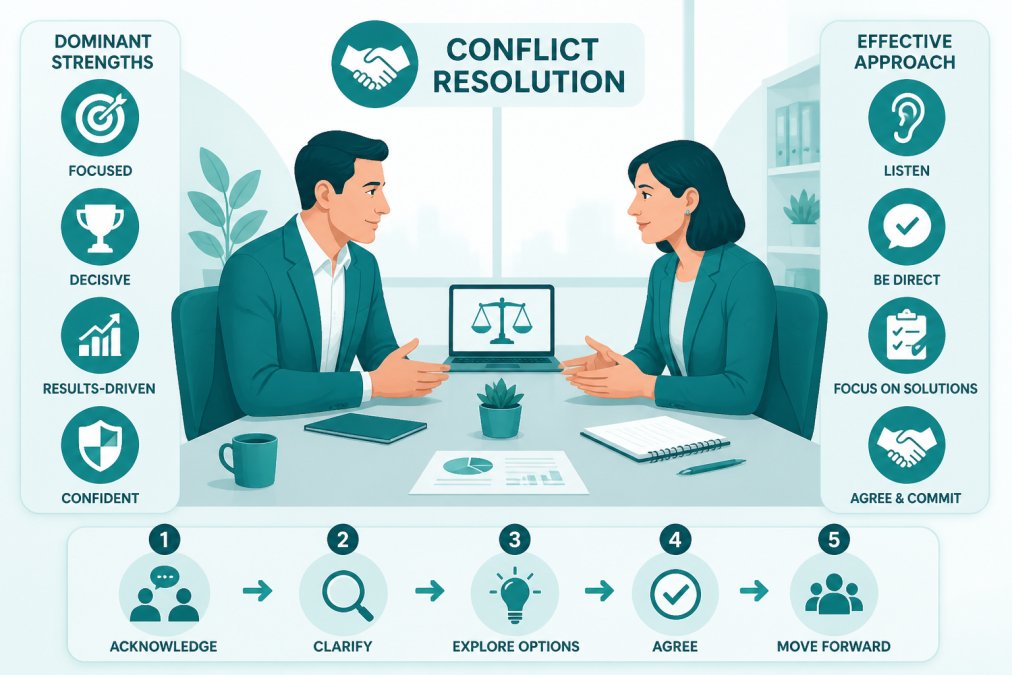
Conflict with dominant personalities can escalate quickly if you approach it wrong. The path forward is finding solutions where both parties win on what matters most.
(/blog/2026/08/03/how-to-use-behavioral-assessments-for-conflict-resolution/) With High-Dominance Individuals]
De-escalation Techniques That Work
When conflict is heating up, shift from emotional reactivity to problem-solving mode. They’ll de-escalate if they see a path to winning.
Technique 1: Acknowledge their position without agreeing.
"I hear that you see this as the fastest path forward. I’m not disagreeing with your goal, I’m raising a concern about the approach."
Technique 2: Reframe as a shared problem.
"We both want this to succeed. The question is how to get there without [specific negative outcome]. How do you want to handle that?"
Technique 3: Propose a test or timeline.
"Let’s try your approach for two weeks and measure X. If we hit the target, we keep going. If not, we adjust."
Technique 4: Appeal to their self-interest.
"If we do X your way, we’ll hit the deadline but probably lose the client relationship. If we do X my way, we hit the deadline and keep the client. Which matters more for your goals?"
Finding Common Ground in Disagreements
Dominant personalities care about winning on outcomes that matter. Finding common ground means identifying what outcome you both actually want.
Script for finding common ground:
"We disagree on how to get there, but I think we both want [shared outcome]. Is that right? Given that, what matters most to you in the approach?"
This identifies shared goals and shows respect for their priorities.
What to avoid:
- Don’t try to win through emotion or appeal to fairness.
- Don’t compromise on something you both care about.
- Don’t bring up past conflicts.
- Don’t involve third parties to pressure them.
The goal is to find a solution where both of you get what matters most.
Building Stronger Team Dynamics Across All Personality Styles
Dominant personalities aren’t the only style in your workplace. Real team effectiveness comes from understanding how different styles interact and creating systems that work for everyone.
Tools like the DiSC assessment become valuable when your entire team understands behavioral styles. When people understand why their colleague communicates differently, friction decreases and collaboration increases. A dominant personality stops seeing a conscientious colleague as slow and starts seeing them as thorough.
Teams that understand behavioral dynamics waste less energy on conflict and more energy on work. Managers spend less time mediating personality clashes and more time developing talent. This compounds over time.
If your team is struggling with dominant personalities creating friction, consider a structured approach. Help people see how their style shows up, what strengths it brings, and where it can create blind spots. Then give them language and frameworks for working across styles.
Conclusion
Dominant personalities drive results and push organizations forward, but only when they’re working within healthy communication structures. Speaking their language, setting clear boundaries, and finding solutions where both parties win work because they respect how dominant personalities think while protecting your own interests.
The real breakthrough comes when you stop seeing dominant personalities as difficult and start seeing them as differently motivated. They’re not trying to make your life harder. They’re trying to achieve outcomes as fast as possible. When you understand that, you can work with them instead of against them.
To build this capability across your entire team, consider using the DiSC Workplace Profile from Your Life’s Path. Understanding behavioral styles across your organization creates a shared language for communication and builds stronger team dynamics. Take the official DiSC assessment online now to start understanding your own style and how it shows up at work.
Frequently Asked Questions
What are the characteristics of a dominant personality type at work?
Dominant personality types are direct, results-oriented, and decisive. They value efficiency, take charge quickly, and prefer to focus on outcomes over process. In the DiSC framework, these are called D-styles. They tend to be competitive, assertive, and comfortable with confrontation. Dominant individuals often speak their minds, make fast decisions, and expect others to keep pace with their intensity and drive.
How do you deal with a boss who has a dominant personality?
The key is directness and results. Come prepared with facts, be concise in your communication, and focus on what matters most to them: outcomes and efficiency. Avoid lengthy explanations or small talk. Show respect for their time, demonstrate competence, and deliver on commitments. Use scripts that acknowledge their goals while clearly stating your position or needs, and always frame discussions around business impact.
What's the best way to give feedback to a dominant personality?
Be direct, specific, and focused on results. Dominant types appreciate honest feedback delivered without emotion or lengthy preamble. Frame feedback in terms of impact and performance, not personal feelings. Use concrete examples and suggest practical solutions. Avoid softening language or excessive politeness, which they may perceive as insincerity. Schedule feedback promptly after the incident, and keep it brief but substantive.
How can understanding communication styles improve team performance?
When teams understand their own and each other's communication styles, they reduce misunderstandings and conflict. Dominant personalities often clash with more cautious or collaborative styles because of pace and directness differences. Tools like DiSC assessments help teams recognize these differences as strengths, not flaws. This awareness allows teams to adapt their approach, set clearer expectations, and work together more effectively, ultimately improving collaboration and reducing the productivity loss that stems from communication breakdowns.
This article was written using GrandRanker