

Table of Contents
- Why Communication With Direct Reports Matters
- Active Listening Techniques for Leaders
- How to Give Constructive Feedback to Employees
- One-on-One Meeting Templates for Managers
- Best Practices for Team Check-Ins
- Building Trust and Psychological Safety
- Measuring Communication Effectiveness
- Conclusion
Why Communication With Direct Reports Matters
Effective communication with direct reports is the foundation of strong leadership. When managers prioritize clear, open dialogue with their teams, organizations see measurable improvements in employee engagement, retention, and performance. Without intentional communication strategies, misunderstandings multiply, trust erodes, and talented people leave.
A manager who excels at improving communication with direct reports creates an environment where employees feel heard, valued, and motivated to contribute their best work. Understanding how your team members process information, their communication preferences, stress responses, and natural strengths transforms how you interact with them.
Poor communication costs organizations time, money, and talent. Strong communication multiplies it. Here’s how to build it.
Active Listening Techniques for Leaders
Active listening is the most underutilized tool in management. It’s not passive hearing, it’s the deliberate practice of fully concentrating on what your direct report is saying, understanding their perspective, and responding in ways that show you genuinely care.

Most managers listen while planning their response. Real active listening requires you to pause your agenda and enter your employee’s world. Here are the core techniques:
Focus completely on the speaker. Remove distractions. Put your phone away. Make eye contact. When your direct report speaks, they should feel like they’re the only thing that matters in that moment.
Avoid interrupting or planning your response. Let them finish their thought completely. Many employees just need to be heard before they’re ready to problem-solve.
Ask clarifying questions. Instead of assuming you understand, probe deeper. "Help me understand what you mean by that" or "Can you give me an example?" These questions uncover the real issue beneath the surface complaint.
Reflect back what you heard. Summarize their point in your own words. "So what I’m hearing is that you feel overwhelmed by the project scope. Is that right?" This confirms understanding and shows you were listening.
Validate their feelings without necessarily agreeing with their conclusions. You can acknowledge emotion while maintaining your own perspective. "I hear that you’re frustrated with the timeline. That makes sense given the constraints" validates the person without committing to change.
Watch your body language. Open posture, nodding, and leaning slightly forward signal engagement. Crossed arms or looking at your watch signal disinterest.
Active listening means you gather better information, build stronger relationships, and make better decisions because you actually understand what’s happening with your team.
How to Give Constructive Feedback to Employees
Constructive feedback is the most direct way to improve performance and help employees grow. The difference between feedback that lands and feedback that backfires comes down to clarity, timing, and intent.
Be specific about the behavior, not the person. Don’t say "You’re disorganized." Say "The last three project deliverables were missing the cost breakdown. Going forward, I need you to include that section before sending anything to the client." Specific behavior can be changed. Character judgments trigger defensiveness.
Explain the impact. Connect the behavior to real consequences. "When the cost breakdown is missing, the client has to ask for it, which delays their approval process and makes us look unprepared."
Offer concrete next steps. "I’d like you to use this checklist before submitting deliverables" or "Let’s walk through the format together so you know exactly what I’m looking for."
Time it appropriately. Give feedback soon after the behavior, but not in the heat of the moment. A few hours later, in a private setting, works better than immediately after a meeting.
Listen to their perspective. After you’ve delivered feedback, ask "How does that land with you?" Sometimes there are context or resource issues you’re not aware of.
Follow up. Check in after a week or two. "How’s it going with the checklist? Do you have what you need?" This shows you care about the outcome, not just the correction.
The goal of constructive feedback is growth, not punishment. When your direct reports experience feedback as an investment in their development, they become more receptive and more likely to actually change.
One-on-One Meeting Templates for Managers
One-on-one meetings are where real communication happens. They’re the space where your direct reports feel safe raising concerns, discussing career development, and getting clarity on expectations. Consistency matters, regular one-on-ones signal that you value the relationship.
Here’s a template that creates structure without feeling rigid:
Opening (5 minutes): Start with a human question. "How are you doing?" or "What’s on your mind this week?" This is an invitation to share what’s actually happening in their world.
Performance and projects (10 minutes): Ask about progress on current work. "What’s going well with the campaign launch?" and "Where are you stuck?" This keeps you informed and gives your direct report a chance to surface blockers early.
Development and growth (5 minutes): Ask about their professional development. "What skills are you working on?" or "Is there something new you’d like to learn?" This signals that you see them as more than their current role.
Feedback exchange (5 minutes): Ask for feedback on your own leadership. "How am I doing as your manager? What could I do differently?" This models vulnerability and shows you’re committed to improving.
Closing (5 minutes): Recap action items and confirm next steps. Clarity prevents misunderstandings.
Total time: 30 minutes. Consistency matters more than length. A 20-minute meeting every week beats a 90-minute meeting every three months. Document key decisions, concerns, and development areas to create continuity.
Best Practices for Team Check-Ins
Team check-ins are different from one-on-ones. They’re shorter, more frequent, and focused on immediate priorities and blockers. They keep your whole team aligned and catch problems early.
Keep them short and frequent. Fifteen minutes, three times a week works better than an hour once a week.
Use a consistent format. Ask each person: "What did you accomplish this week? What are you working on next? Where are you blocked?" This consistency makes meetings predictable.
Take The Official DiSC® Assessment Online Now! →
Focus on blockers and dependencies. Team check-ins surface obstacles that require group coordination. "Sarah, I heard you’re waiting on data from Marketing. Let’s solve that right now."
Make it safe to admit problems. If people feel judged for being stuck, they’ll hide blockers until they become crises. Create an environment where saying "I’m stuck" gets you help, not criticism.
Document decisions and action items. Write down commitments so there’s no confusion later.
Vary who talks. Don’t let the same person dominate. Ask quieter team members directly. Psychological safety means everyone gets heard.
Team check-ins aren’t about micromanagement. They’re about creating transparency and catching problems before they cascade.
Building Trust and Psychological Safety
Trust is the currency of leadership. Psychological safety, the belief that you can take interpersonal risks without fear of negative consequences, is what allows trust to actually function.
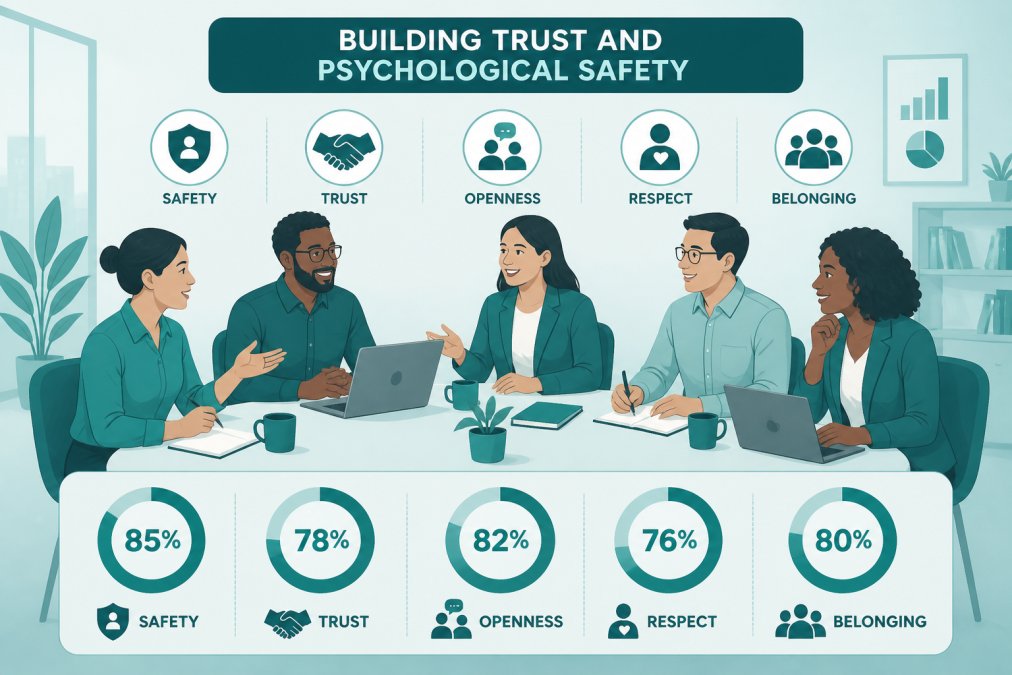
When employees feel psychologically safe, they speak up about problems early, admit mistakes, share ideas, and ask for help. Without it, they hide problems and miss opportunities.
Admit your own mistakes openly. When you make an error, acknowledge it directly. "I made the wrong call on that timeline. Here’s what I’m doing differently next time."
Ask for input and actually use it. If you ask for feedback but ignore it, you’ve destroyed trust. If you don’t use an idea, explain why.
Separate the person from the problem. When something goes wrong, investigate without assuming bad intent. "Walk me through your thinking on this" invites explanation. "Why did you do this?" invites defensiveness.
Be consistent. If you’re supportive one day and critical the next, people will be cautious around you. Consistency builds predictability, which builds trust.
Follow through on commitments. If you say you’ll help with something, do it. Small promises kept build trust. Small promises broken destroy it.
Create space for non-work connection. Knowing your people as humans creates connection that translates to better communication at work.
Psychological safety doesn’t mean avoiding accountability. It means holding people accountable in ways that assume good intent and create opportunity for growth.
Measuring Communication Effectiveness
You can’t improve what you don’t measure. Here are ways to track whether your communication improvements are actually working:
Employee engagement surveys. Ask direct questions about communication. "I feel my manager understands my perspective" or "I know what’s expected of me." Track these over time.
Retention rates. People leave managers, not companies. If your team’s turnover drops after you improve communication, that’s a real signal.
One-on-one frequency and consistency. Track whether you’re actually having the meetings you committed to. Calendar discipline is a leading indicator of communication culture.
Feedback frequency. How often are you giving constructive feedback? Teams that receive regular feedback perform better.
Project velocity and quality. When communication improves, work often moves faster because there are fewer misunderstandings and rework cycles.
Psychological safety scores. Use brief pulse surveys. "I feel safe admitting mistakes at work" or "I would speak up if I saw a problem." These short questions, asked monthly, give you real-time data.
Direct feedback from your team. In one-on-ones, ask directly. "How’s our communication? What could I do better?" Listen to patterns.
The point isn’t to obsess over metrics. It’s to have concrete signals that your communication improvements are making a real difference.
Improving communication with direct reports isn’t a one-time project. It’s an ongoing practice that compounds over time. The managers who stand out aren’t the ones with perfect communication skills. They’re the ones genuinely committed to understanding their people and being understood in return.
Your Life’s Path offers tools like the DiSC Management Profile that help you understand your team’s behavioral styles and communication preferences. When you know how your direct reports actually process information and respond to feedback, you can adapt your approach accordingly. Combined with active listening, constructive feedback, regular check-ins, and psychological safety, you’ll create a communication culture where people thrive. Start with one practice this week, maybe scheduling consistent one-on-ones, asking clarifying questions, or admitting a mistake you’ve been avoiding. Small changes, practiced consistently, reshape how your team experiences working with you. Take the official DiSC Assessment online now to understand your own communication style and how it lands with your team.
Frequently Asked Questions
How can I improve communication with direct reports if they seem hesitant to speak up?
Create psychological safety by responding to bad news without anger, asking non-directive questions instead of giving immediate answers, and acknowledging their perspective before offering guidance. When direct reports see that speaking up leads to coaching rather than criticism, they become more willing to share concerns. Start with low-stakes conversations to build trust, then gradually tackle more complex topics. Consistency matters more than perfection, regular check-ins signal that you genuinely want to hear from them.
What's the best way to give constructive feedback to employees without damaging morale?
Focus on specific behaviors and outcomes, not personality. Describe what you observed, explain the impact, and ask questions to understand their perspective before offering guidance. Frame feedback as coaching for growth rather than criticism. Use the 'sandwich' approach sparingly, instead, lead with clarity about what happened and why it matters, then collaborate on solutions. Regular feedback prevents surprises and makes difficult conversations feel like natural parts of your ongoing dialogue rather than formal reprimands.
How often should I have one-on-one meetings with my direct reports?
Weekly one-on-one meetings of 30-60 minutes are the standard for most manager-employee relationships. This frequency allows you to stay informed, address issues early, and provide coaching without the meetings feeling burdensome. If your team is large or remote, consistency matters more than duration, a brief 20-minute weekly check-in beats an occasional hour-long meeting. Use a structured template to keep conversations focused on priorities, feedback, and professional development rather than status updates that could happen via email.
Can behavioral assessments like DiSC help improve how I communicate with my team?
Yes. Understanding your communication style and your direct reports' styles reveals why certain conversations feel strained and how to adapt your approach. DiSC assessments identify whether team members prefer direct guidance or collaborative problem-solving, detailed explanations or quick summaries, and frequent check-ins or autonomy. This insight allows you to tailor your feedback delivery, meeting frequency, and dialogue style to each person's preferences, which strengthens clarity and reduces misunderstandings. Many organizations use these assessments alongside coaching to create lasting behavioral change.
This article was written using GrandRanker