
Table of Contents
- Why Traditional Team Building Falls Short
- Alternative 1: Gamification and Digital Engagement
- Alternative 2: Corporate Social Responsibility Team Initiatives
- Alternative 3: DiSC Assessment for Teams
- Workplace Communication Strategies That Stick
- Hybrid Approaches: Combining Methods for Maximum Impact
- Conclusion
Why Traditional Team Building Falls Short
The return on investment for effective team building can reach as high as 400% through increased productivity and reduced turnover (Careertrainer.ai, 2026). Yet most organizations rely on tired playbooks: trust falls, icebreakers, and ropes courses that employees dread and forget by Monday morning.
The real problem isn’t lack of value, it’s that traditional approaches have become predictable, disconnected from actual workplace challenges, and fail to address communication barriers that undermine team performance. When 63% of companies now use gamification in team building to enhance engagement and learning (Careertrainer.ai, 2026), the shift is clear: teams want experiences that feel relevant, rewarding, and tied to real outcomes.
At Your Life’s Path, we’ve analyzed what separates high-performing teams from those stuck in communication gridlock. The answer rarely involves ropes courses. Instead, it involves behavioral insights, purposeful engagement, and communication strategies grounded in how people actually work together. Below, we’ll explore three alternatives to traditional team building that deliver measurable results.
Alternative 1: Gamification and Digital Engagement
Gamification transforms workplace interactions by introducing game mechanics, points, badges, leaderboards, and progressive challenges, into everyday tasks and team activities. This approach taps into intrinsic motivation far more effectively than a one-off offsite event. Organizations using virtual team-building activities witnessed a 25% increase in employee engagement metrics over six months (Gartner, cited by Zogby Analytics, 2024).

The mechanics work because they create immediate feedback loops. When an employee completes a collaborative task and earns points toward a team milestone, they see progress in real time. Virtual escape rooms and online game-based activities have seen a 150% increase in corporate bookings since 2020 (Careertrainer.ai, 2026), demonstrating that teams actively seek these alternatives.
How Gamification Works in the Workplace
Gamification starts with identifying the behaviors or outcomes you want to encourage, cross-departmental collaboration, faster project completion, or improved customer response times. You then layer game elements on top of existing workflows.
A practical structure includes:
- Define clear objectives (e.g., "Improve inter-team communication on project X")
- Assign point values to collaborative actions (attending meetings, sharing ideas, completing milestones)
- Create visible leaderboards that celebrate progress without fostering unhealthy competition
- Reward milestone achievements with team perks or recognition
The Protein Chef implemented gamification by rewarding employees with free protein bars for reaching health goals, which increased punctuality, engagement between teams, and overall productivity (Gamify). This simple reward structure worked because it was tangible, tied to behavior, and celebrated as a team effort.
The most effective gamification avoids making competition personal. Focus on team-level milestones and shared rewards rather than individual rankings, which can breed resentment.
Measurable Results from Gamified Team Building
The data on gamification is compelling. 90% of employees find gamification boosts their productivity (Missions Team, 2026). Organizations report concrete improvements in project timelines, reduced silos, and higher employee retention.
UBS Financial Services Group gamified their six-week online training program for new hires by assigning game points for completing modules and quizzes, which improved employee morale and productivity (Gamify). Gamification works across different contexts because it speaks to how humans respond to feedback and progress.
| Gamification Element | Impact | Timeline |
|---|---|---|
| Points and badges | Immediate motivation boost | Days |
| Leaderboards (team-based) | Increased collaboration | 2-4 weeks |
| Progressive challenges | Sustained engagement | Ongoing |
| Milestone rewards | Team cohesion improvement | 6-12 weeks |
Alternative 2: Corporate Social Responsibility Team Initiatives
When team building is tied to a purpose beyond the organization itself, something shifts. Employees feel they’re contributing to something meaningful while strengthening bonds with colleagues. 40% of organizations integrate team building with corporate social responsibility (CSR) initiatives (Careertrainer.ai, 2026), reflecting a fundamental change in what teams expect from their workplace.
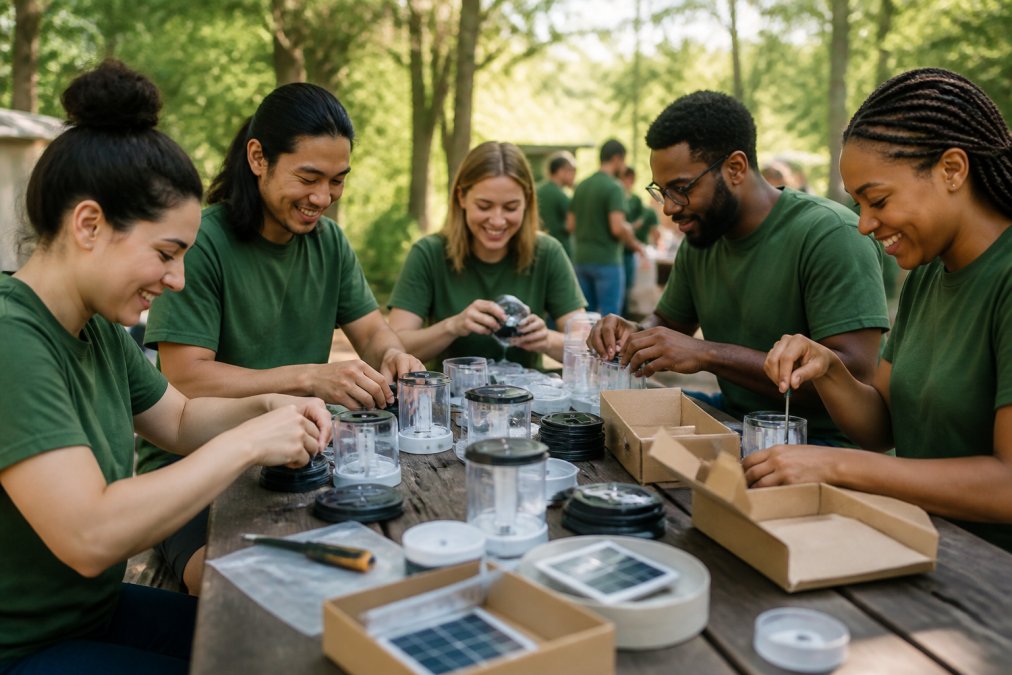
When a team builds something for a cause, assembling solar lights for children in energy poverty or constructing bikes for a local nonprofit, they experience genuine collaboration without the artificiality of traditional icebreakers. The work itself becomes the team-building mechanism.
Building Teams While Making Community Impact
CSR-based team building works because it replaces awkwardness with purpose. Strayboots Elite ran an "Hour of Power" initiative where teams assembled solar lights shipped to children living in energy poverty, which enhanced teamwork, improved collaboration and communication, and fostered a deeper sense of purpose (Strayboots).
The structure is straightforward:
- Partner with a nonprofit aligned with your company values
- Schedule a team event (2-4 hours typically) where groups work on a specific project
- Debrief afterward to connect the experience to workplace collaboration
- Follow up with impact metrics (items completed, lives affected, dollars raised)
The beauty of this approach is that it’s inherently engaging, people want to participate because the cause resonates.
CSR-based team building generates loyalty and purpose in ways traditional activities cannot. Employees remember the experience and develop stronger connections with colleagues who worked alongside them toward something meaningful.
Alternative 3: DiSC Assessment for Teams
Understanding behavioral differences is where real communication breakthroughs happen. DiSC assessments reveal how individuals prefer to communicate, make decisions, and handle conflict, insights that transform how teams interact. Rather than assuming everyone processes information the same way, teams armed with DiSC profiles can adapt their communication to match how colleagues actually work.
Understanding Behavioral Drivers for Better Collaboration
DiSC categorizes behavior into four primary styles: Dominance (results-focused, direct), Influence (people-focused, expressive), Steadiness (process-focused, supportive), and Conscientiousness (detail-focused, analytical). When team members understand their own profile and their colleagues’, they stop taking communication differences personally.
A high-D manager who prefers quick decisions can recognize that their high-C colleague needs time to analyze data before committing. A high-I team member who thrives on brainstorming can appreciate why their high-S colleague prefers structured one-on-one check-ins. These aren’t personality flaws, they’re behavioral preferences that, when understood, become assets rather than friction points.
Your Life’s Path offers specialized DiSC profiles, including the DiSC Workplace Profile, DiSC Management Profile, and DiSC Sales Profile, designed to address specific team contexts. The Workplace Profile helps general teams improve communication and collaboration. The Management Profile targets leaders struggling with delegation and employee motivation. The Sales Profile addresses the unique dynamics of sales teams where competitive drive and relationship-building must coexist.
The practical application unfolds like this:
- Each team member completes their DiSC assessment (typically 15-20 minutes)
- Results are shared in a group session with a facilitator
- Teams discuss how different styles show up in meetings, decision-making, and conflict
- Establish norms that respect behavioral diversity (e.g., "We’ll give C-styles 48 hours to review proposals before decisions")
When teams understand behavioral drivers, they stop wasting energy on miscommunication and start using their differences as strengths.
DiSC assessments only work if followed by structured conversation and application. Taking the test and filing results away accomplishes nothing. Plan for facilitated group sessions where teams actively discuss how to adapt communication based on profile differences.
Workplace Communication Strategies That Stick
The three alternatives above all hinge on one foundation: better communication. Yet communication barriers persist even when teams understand gamification, embrace CSR initiatives, or complete DiSC assessments. Language proficiency gaps, unconscious bias, cultural norms, high-context versus low-context communication styles, non-verbal cue misinterpretation, time zone challenges, power distance dynamics, and direct versus indirect feedback preferences all require deliberate strategies to address.
Addressing Communication Barriers Directly
Most workplace communication problems stem from assumptions. You assume your colleague understood your email. They assume you were frustrated by their response. Neither of you addressed the actual barrier.
Take The Official DiSC® Assessment Online Now! →
Start by naming barriers explicitly. In diverse or distributed teams, language proficiency differences are real. Rather than pretending everyone has equal fluency, create space for clarification: "I want to make sure I understood correctly. Can you walk me back through that?"
Unconscious bias shapes communication too. Team members from underrepresented groups often self-censor to avoid triggering stereotypes. Combat this by establishing explicit norms: "We value all perspectives, and we’ll actively seek input from quieter team members."
Cultural norms around directness vary widely. Some cultures view direct feedback as respectful honesty; others see it as rude. Address this head-on: "In our team, we aim for direct, specific feedback delivered with respect."
Non-verbal cues carry different meanings across cultures and contexts. In virtual settings, these cues are further obscured. Establish team agreements: "We’ll use video when possible to pick up on tone. We’ll avoid assuming tone in written messages."
Time zone and geographical distance introduce asynchronous communication challenges. According to Pew Research Center on remote work trends, 14% of employed adults now work remotely full-time, with 53% in hybrid arrangements. Teams spread across zones must document decisions and create communication windows where real-time collaboration is possible.
Power distance affects who speaks up in meetings. Create psychological safety by explicitly inviting dissent: "I want to hear if anyone sees a problem with this approach. Speak up."
Creating Psychological Safety for Real Connection
Psychological safety is the belief that you can take interpersonal risks without fear of embarrassment or punishment. Teams with high psychological safety communicate more openly, share mistakes faster, and innovate more effectively.
Build it through consistency and modeling. When a leader admits uncertainty, they signal that not knowing is safe. When mistakes are discussed as learning opportunities, people share problems earlier when they’re easier to fix.
Establish norms explicitly:
- "We assume good intent and ask clarifying questions before interpreting offense"
- "Mistakes are learning opportunities; we focus on solutions, not blame"
- "All questions are welcome"
- "We respect different communication styles and will adapt to each other"
Emotional intelligence, the ability to recognize and manage emotions in yourself and others, underpins all of this. Teams where members can read the room and adjust their tone based on others’ reactions communicate more effectively.
Hybrid Approaches: Combining Methods for Maximum Impact
The most effective teams don’t choose one alternative. They combine approaches strategically. A team might use DiSC profiles to understand behavioral differences, implement gamification to drive engagement on specific projects, and volunteer together for a CSR initiative to build shared purpose.
68% of managers believe that digital tools have made it easier to conduct quick, impactful team building exercises than traditional methods (Careertrainer.ai, 2026). This suggests teams are increasingly comfortable blending digital gamification with in-person CSR work and behavioral assessment frameworks.
Here’s a practical 90-day approach:
- Month 1: Administer DiSC assessments and facilitate group debrief sessions focused on communication norms
- Month 2: Launch a gamified project that requires cross-functional collaboration, with points and milestones tied to team goals
- Month 3: Organize a CSR team event tied to a cause aligned with company values
By month 3, team members have understood their behavioral differences and practiced collaborating under new norms. They’ve experienced the motivation boost of gamification. They’ve contributed to something meaningful together. The combination reinforces each element.
75% of organizations use a mix of in-person and virtual team building activities for hybrid teams (Careertrainer.ai, 2026). This flexibility is key. Gamification works equally well for distributed teams. CSR initiatives can be virtual (fundraising, mentoring) or in-person. DiSC assessments are completed individually but discussed in group settings, either in-person or via video.
Companies that invest in team development programs report 2.5 times higher revenue growth (Careertrainer.ai, 2026). The ROI flows from reduced turnover, faster decision-making, better cross-departmental collaboration, and employees who actually want to show up.
Traditional team building has earned its reputation for being forgettable. But the alternatives, gamification, CSR initiatives, and behavioral assessments like DiSC, address real communication barriers and create genuine engagement. Your Life’s Path’s DiSC assessments and facilitation tools, including the Free EPIC Sub-Accounts platform and Catalyst learning system, provide a structured foundation for understanding behavioral drivers and improving team dynamics. Whether you’re implementing one alternative or combining all three, the shift from surface-level activities to meaningful, purpose-driven team development delivers measurable results. Take The Official DiSC® Assessment Online Now to start building teams that actually communicate with Your Life’s Path.
Frequently Asked Questions
Why do traditional team building activities often fail to create lasting change?
Traditional team building activities like icebreakers and ropes courses often lack follow-up and don't address root causes of communication gaps. Employees participate once, then return to the same patterns. Modern alternatives, gamification, CSR initiatives, and DiSC assessments, create sustained engagement by integrating into daily work, rewarding ongoing behavior change, and building psychological safety. Research shows 63% of companies now use gamification specifically because it delivers measurable results, while traditional one-off events fade quickly without reinforcement.
How can a DiSC assessment for teams improve communication and reduce misunderstandings?
DiSC assessments reveal individual behavioral styles, Dominance, Influence, Steadiness, and Conscientiousness, so team members understand how each person prefers to communicate, make decisions, and handle conflict. When a team knows these patterns, they can adapt their approach: a high-D person appreciates direct feedback; a high-S person values stability and reassurance. This reduces misinterpretation, builds cultural intelligence, and creates a shared language. Teams using DiSC report stronger cohesion because they stop assuming bad intent and start recognizing different communication styles as strengths.
What ROI should we expect from investing in modern team building alternatives?
Organizations investing in effective team building report up to 400% ROI through increased productivity and reduced turnover. Virtual team-building activities deliver 12% higher ROI at 75% lower cost than in-person events. Companies with highly engaged employees, often a result of team-focused initiatives, outperform low-engagement competitors by 147% in earnings per share. When you combine gamification, CSR, and behavioral assessments, you're addressing multiple barriers simultaneously: engagement, purpose, and communication clarity. The key is measuring outcomes: track retention, productivity metrics, and engagement scores before and after implementation.
Are these alternatives suitable for small companies, or are they designed for large enterprises?
These alternatives work at any scale. Gamification platforms offer flexible pricing and can be rolled out to 50 or 5,000 employees. CSR team activities adapt to group size, a small team can assemble solar lights for a nonprofit just as effectively as a large group. DiSC assessments are administered individually, so you pay per person and scale as you grow. Small and medium-sized enterprises are projected to increase team building spending by 10% annually through 2026, recognizing that behavioral insights and engagement tools deliver measurable returns regardless of company size.
How do workplace communication strategies address the specific barriers that traditional team building misses?
Traditional team building doesn't tackle root barriers like unconscious bias, high-context vs. low-context communication styles, or power distance issues. Modern workplace communication strategies address these directly: psychological safety frameworks encourage candid feedback; cultural intelligence training reduces misinterpretation; and asynchronous communication tools help bridge time zone gaps for remote teams. When combined with tools like DiSC assessments, these strategies create a framework where team members understand not just *what* to communicate, but *how* to communicate effectively with different styles, reducing conflict and improving collaboration.
This article was written using GrandRanker