Table of Contents
- Why Personality Tests in Recruitment Create Legal Exposure
- Pre-Employment Personality Tests Legal Issues Under Federal Law
- Employment Assessment Discrimination Risks: Disparate Impact and Adverse Impact
- What Makes Job-Related Selection Tests Defensible
- State Laws, AI Screening Tools, and Candidate Consent
- Using PXT Select for Recruitment and Selection Without the Legal Risk
- A Practical Compliance Checklist for Hiring Assessments
- Frequently Asked Questions
Last Updated: October 13, 2026
Why Personality Tests in Recruitment Create Legal Exposure
Personality tests recruitment sits in a strange spot: popular with hiring teams, risky with regulators. Employers use them to predict fit, but the law treats some of these tools very differently from a standard interview or work sample.
The legal risks of personality tests recruitment usually come from three places: how the test is built, when it is given, and who it screens out. Get any of those wrong, and a routine hiring step can turn into a discrimination claim.
This guide from Your Life’s Path breaks down the federal rules that matter, the state laws and AI screening issues most guides skip, and how to structure a defensible hiring process.
Here is the good news: a well-validated assessment, used at the right stage, is far safer than most employers assume. The danger is in the shortcuts.
The Difference Between Assessment and Medical Examination
A personality assessment measures normal workplace behavior. A medical examination looks for physical or mental impairment.
That line decides everything. Under the Americans with Disabilities Act, a test counts as a medical examination when it is designed to reveal a mental health condition or disability. Standard workplace style assessments usually are not built for that.
But some personality tests blur the line. A test that screens for anxiety, depression, or abnormal personality traits can be treated as a medical exam. That changes when you can legally use it.
Pre-Employment Personality Tests Legal Issues Under Federal Law
Pre-employment personality tests legal issues usually trace back to two federal laws: Title VII of the Civil Rights Act and the ADA. Both apply to employers with 15 or more workers, a threshold that covers most hiring teams but leaves the smallest businesses outside Title VII’s reach.
The U.S. Equal Employment Opportunity Commission enforces both statutes. Its guidance treats selection tests as covered employment practices, which means they must be job-related and consistent with business necessity. That standard is not optional. If a test affects who gets hired, you may need to defend it.
Title VII and Protected Classes
Title VII bars discrimination based on race, color, religion, sex, or national origin. A personality test can violate it in two ways.
The first is intentional: using a test to screen out a protected class on purpose. That is rare and obvious.
The second is subtler. A neutral test that still pushes out one group more than others can be illegal if it is not job-related. This is where most claims start.
How the EEOC Evaluates Adverse Impact
When the EEOC or a plaintiff challenges a selection test, the first question is usually statistical. Investigators apply the four-fifths rule, a rule of thumb from the EEOC’s Uniform Guidelines on Employee Selection Procedures. If the selection rate for a protected group is less than 80 percent of the rate for the highest-scoring group, the test may show adverse impact.
A simple example: if 60 percent of one group passes a screening and only 40 percent of another group does, the ratio is 0.67, below the 0.80 threshold. That does not automatically make the test illegal, but it shifts the burden to the employer to prove the test is job-related and consistent with business necessity.
ADA Timing Rules for Medical Examinations
The ADA splits hiring into two phases: before an offer and after an offer.
Before an offer, you cannot run a medical examination. After a conditional offer, you can, as long as you apply the same rule to everyone in the same job category.
The U.S. Equal Employment Opportunity Commission guidance on pre-employment tests confirms that tests which meet the ADA definition of a medical exam must wait until after the offer. Personality tests that do not diagnose a condition sit outside that rule, which is exactly why the design of the test matters so much.
The Business Necessity Defense
If a test produces adverse impact, the employer’s main defense is business necessity. That means showing the test predicts performance in the specific role, not just that it feels relevant. Courts look for validation evidence, a documented link between test scores and job outcomes, and a consistent process applied to all candidates.
A test that cannot clear that bar is a liability, no matter how popular it is with hiring managers.
Employment Assessment Discrimination Risks: Disparate Impact and Adverse Impact
Employment assessment discrimination risks come down to one question: does your test screen out a protected group at a higher rate, even without intent?
That pattern is called disparate impact, sometimes labeled adverse impact. It does not require anyone to be biased. A neutral test can still produce an uneven result.
When that happens, the employer carries the burden. You must show the test is job-related and consistent with business necessity. If you cannot, the practice can be found unlawful even though you meant no harm.
A few familiar traps:
- A test that rewards one communication style over another
- Questions that assume a shared cultural background
- Scoring that penalizes candidates with disabilities
The EEOC’s overview of disparate impact in employment explains how these cases are evaluated. The short version: intent is not the test. Effect is.
What Makes Job-Related Selection Tests Defensible
Job-related selection tests earn their name through evidence, not marketing. The employer has to show the test actually predicts success in the specific role.
That proof comes from validation studies. A validation study connects test scores to real job performance, measured in a fair, documented way.
There are three common approaches:
- Criterion-related validity: test scores line up with performance ratings or output
- Content validity: the test measures skills the job clearly requires
- Construct validity: the test measures a trait tied to job success
Validation Studies and Predictive Validity
Predictive validity is the strongest defense. It means the test predicted performance before you knew the outcome, not after.
Take The Official DiSC® Assessment Online Now! →
A vendor that publishes validation research gives you something to stand on. A vendor that cannot show any is a liability you are borrowing.
Ask two questions before you buy any assessment:
- Is there published research linking scores to job performance?
- Does the test avoid questions that could reveal a disability?
If the answer to either is no, the tool is not ready for hiring decisions.
State Laws, AI Screening Tools, and Candidate Consent
Federal law is only the floor. States add their own rules, and they vary widely. Most articles stop at Title VII and the ADA. The state layer is where the real exposure sits for employers who use modern assessment tools.
State Privacy Laws That Touch Hiring Data
California’s privacy framework, the CCPA as amended by the CPRA, gives job applicants the right to know what personal information a business collects, the right to delete it, and the right to opt out of certain uses. Personality test results, response patterns, and AI-generated scores are personal information under that framework. If you operate in California or hire California residents, your assessment vendor is likely a service provider under the law, and you need a contract that limits how they use candidate data.
Other states have followed with their own comprehensive privacy statutes, and several require notice at collection. The practical takeaway is the same: candidates in some states have a legal right to see and challenge what your assessment produced about them.
AI Hiring Laws You Should Know
Illinois was early here. Its Artificial Intelligence Video Interview Act requires employers to notify candidates before using AI to analyze a video interview, explain how the AI works, and obtain consent. It also limits sharing the video with third parties.
New York City’s Local Law 144 takes a different approach. It requires an annual bias audit of automated employment decision tools, publication of a summary of the audit results, and notice to candidates who are subject to the tool. Maryland and Colorado have enacted their own AI hiring provisions, and more states are moving in this direction each legislative session.
These laws target automated decision systems, not just video. If your personality test scores candidates with an algorithm, it may fall inside their scope.
Why AI Personality Tests Raise Unique Legal Risk
AI-driven assessments score candidates on patterns a human reviewer would never see. That scale cuts both ways. A biased rule encoded once can screen out thousands of applicants before anyone notices.
Three failure modes show up repeatedly:
- Proxy discrimination. The model learns from historical hiring data and reproduces past bias, even when protected traits are removed from the inputs.
- Disability screening. Speech, tone, or response-time analysis can flag candidates with disabilities in ways that resemble a medical exam.
- Opacity. If you cannot explain how the tool reached a score, you cannot defend it under the business necessity standard.
Candidate Consent and Transparency in Practice
Consent is not a checkbox. It is a document that should survive a challenge. A defensible consent process covers four things:
- What the tool measures. Plain language, not vendor marketing.
- How the score is used. Whether it screens, ranks, or only informs a human reviewer.
- Who sees the data. Internal team, vendor, or both.
- How long it is kept. A defined retention period, not “as long as needed.”
Get consent in writing before any automated analysis runs. Keep the signed form with the candidate file, separate from interview notes.
Auditing for Bias Before a Regulator Does
A bias audit compares outcomes across demographic groups. You do not need a data science team to start. Pull pass rates by group, apply the four-fifths rule, and document what you find. If a tool cannot produce group-level outcome data, that is itself a red flag.
Document the audit, the date, and any corrective action. If a state regulator or plaintiff asks, that record is your first line of defense.
Using PXT Select for Recruitment and Selection Without the Legal Risk
If you want to use an assessment in hiring, use PXT Select for recruitment and selection, not a general personality test. PXT Select is built for job fit and validated for selection. DiSC is a team and communication tool, and we do not recommend it for hiring decisions.
That distinction matters legally. PXT Select measures how a candidate fits a specific role, using a job profile you build first. The tool compares the person to the role, not to an abstract ideal.
DiSC, by contrast, describes how someone prefers to work and communicate. It is excellent for team development, coaching, and management training. It is not designed to predict job performance, so using it to screen candidates invites the exact legal risk this article warns about.
Here is how we would set it up:
- Build a job profile for the role before you post it
- Give PXT Select only after a conditional offer, alongside other job-related steps
- Apply the same process to every candidate for that role
- Keep results confidential and separate from the interview file

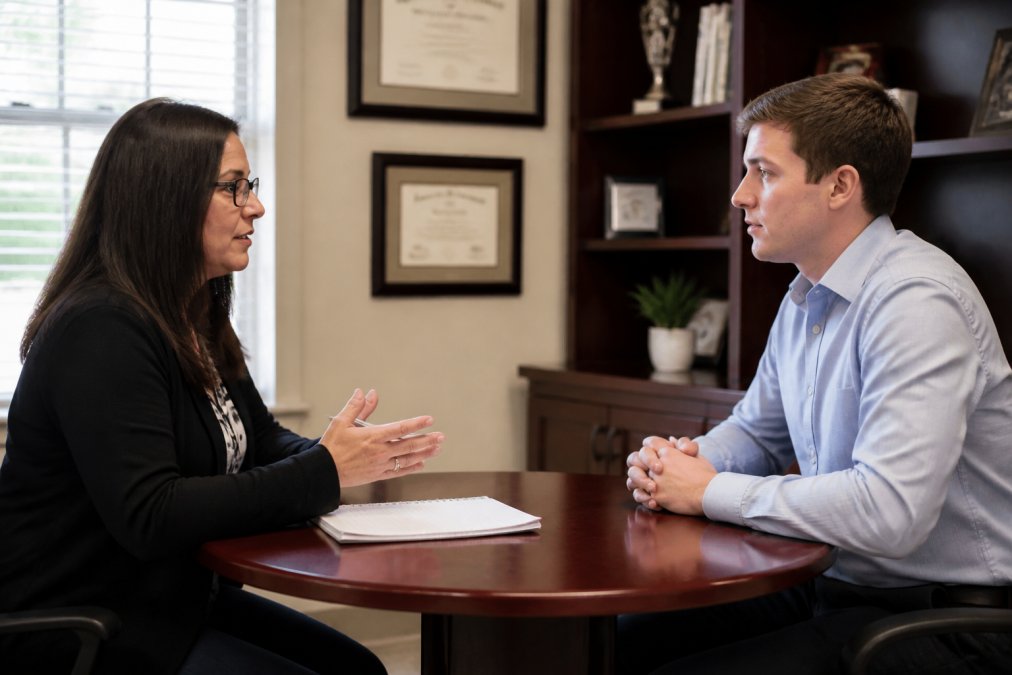
HR team analyzing personality tests recruitment data and candidate assessment reports in a conference room
For team development, we use DiSC through Your Life’s Path profiles like DiSC Workplace and DiSC Management. For hiring, we point clients to PXT Select. Keeping the two tools in their lanes is the whole game.
A Practical Compliance Checklist for Hiring Assessments
Use this checklist before you add any assessment to your hiring process. It covers the steps that keep you on the right side of the law.
- Confirm the test is job-related for the specific role
- Check for published validation and predictive validity research
- Verify the test is not a medical examination under the ADA
- Place any medical-style exam after a conditional offer
- Apply the same steps to every candidate in the same job
- Review results for disparate impact across protected classes
- Get written candidate consent for AI or automated screening
- Disclose what data you collect and how you store it
- Train hiring managers on what they can and cannot ask
- Keep assessment results separate from interview notes
- Recheck state law before rolling out a new tool
- Document your process so you can defend it later
|
Risk Area |
Common Mistake |
Safer Practice |
|---|---|---|
|
Timing |
Testing before an offer |
Test after a conditional offer |
|
Design |
Using a medical-style test |
Use a job-fit assessment |
|
Impact |
Ignoring group outcomes |
Audit for disparate impact |
|
AI tools |
No candidate notice |
Get written consent |
|
Records |
Mixing data with interviews |
Keep files separate |
Pair this checklist with the Society for Human Resource Management’s guidance on assessment selection and your state’s labor office. When a test is challenged, documentation is your best defense.
Frequently Asked Questions
Is it legal to use personality tests in hiring?
Yes, with conditions. The U.S. Office of Personnel Management states that personality tests meeting the ADA definition of a medical examination may be administered only after an offer of employment. Tests must also comply with Title VII of the Civil Rights Act, meaning they cannot create disparate impact on protected classes unless the employer can show job-relatedness and business necessity. Many personality tests have not been validated as job-predictive, which increases legal risk. Safer options like PXT Select are built for selection and backed by validation research.
What are the disadvantages of using personality tests in the hiring process?
The main disadvantages include legal liability under Title VII and the ADA, lack of predictive validity in many off-the-shelf tests, and the risk of disparate impact on protected classes. Many personality tests have not been validated as job-predictive and may be legally risky if they correlate with protected-group differences. There is also the risk that candidates perceive the process as unfair, which can damage your employer brand. Using validated job-related selection tests reduces these risks.
How can employers reduce bias in pre-employment assessments?
Start by choosing assessments with published validation studies that demonstrate job-relatedness and predictive validity. Administer any medical-type assessments only after a conditional offer, consistent with ADA regulations. Document your business necessity rationale for every assessment used in screening. Review adverse impact data regularly by protected class. Use tools designed specifically for selection, such as PXT Select, which includes validation research and supports fair hiring practices. Train hiring managers on consistent scoring and interpretation.
What makes a hiring assessment job-related and defensible?
A defensible assessment must be job-related and consistent with business necessity under EEOC guidelines. This means the test measures traits or abilities that directly predict success in the specific role. You need validation studies showing predictive validity, a clear link between what the test measures and job performance, and documentation that no less discriminatory alternative exists. PXT Select for recruitment and selection is designed with this framework, offering job-related selection tests that support legal defense if a hiring decision is challenged.
Hiring teams face real pressure to pick the right person fast, and the legal rules around assessments only add to it. Your Life’s Path helps you separate the tools that belong in hiring from the ones that belong in team development. We offer official DiSC assessments for communication and leadership, and we recommend PXT Select for recruitment and selection. Take the official DiSC assessment online now and build a hiring process you can defend.