

Last Updated: November 2, 2026
Quick Summary
To facilitate a disc workshop for employees, set clear objectives, have participants complete their assessment at least 48 hours in advance, and build the session around interactive exercises rather than lecture. Use the DiSC Workplace profile for general staff and debrief results with questions, not scores, so people share only what they choose.
- Frame DiSC as a snapshot of behavior, not a personality test that labels people.
- Choose the DiSC Workplace profile for general staff sessions and match other reports to the audience.
- Run the style sort exercise for 15 minutes with the whole room to surface friction points.
- Give the skeptic an observer role during role-play swap instead of arguing with them.
- Run virtual sessions in 90-minute blocks with a change of pace every 10 to 12 minutes.
Table of Contents
- What the DiSC Model Actually Measures
- Setting Workshop Objectives Before You Book the Room
- Preparing Employees for the DiSC Workshop
- DiSC Workshop Activities That Keep People Engaged
- Debriefing the Assessment Results Without the Awkwardness
- Handling Resistant Participants and Group Conflict
- DiSC Facilitator Training: What You Need Before You Lead
- EPIC Sub-Account Management for Multi-Session Rollouts
- Running Virtual and Hybrid DiSC Sessions
- Measuring Whether the Workshop Changed Anything
- Frequently Asked Questions
What the DiSC Model Actually Measures
DiSC is a behavioral assessment tool that measures how people approach work, communication, and conflict. It sorts behavior into four styles: Dominance, Influence, Steadiness, and Conscientiousness. At Your Life’s Path, we use this model because it gives teams a shared language fast.
Most facilitators get this wrong from the start. They treat DiSC as a personality test that labels people. It is not. A DiSC workshop works best when you frame it as a snapshot of behavior, not a verdict on character.
The Four Behavioral Styles at a Glance
- D (Dominance): direct, decisive, results-first
- I (Influence): enthusiastic, collaborative, people-focused
- S (Steadiness): patient, reliable, calm under pressure
- C (Conscientiousness): analytical, precise, quality-driven
Every person carries a blend of all four. Most people lean on one or two. That blend explains why two employees can hear the same instruction and act in completely different ways.
For team workshops, we recommend the DiSC Workplace profile for all employees. It is the most universal and popular report we offer, and it speaks to every role, not just managers. For an extra layer of understanding, add DiSC Catalyst so team members can revisit their results and compare styles between sessions.
Setting Workshop Objectives Before You Book the Room
Before you book a room or a video link, write down what success looks like. A workshop without a goal turns into a personality quiz with snacks. That wastes everyone’s time.
A common approach is to pick one or two outcomes and build everything around them. Ask yourself:
- What problem are we solving? (Missed deadlines? Tense meetings?)
- Who needs to be in the room?
- What should people do differently the week after?
- How will we know it worked?
Vague goals kill momentum. “Improve communication” is too broad. “Cut cross-team email confusion in the sales-to-service handoff” gives you something you can measure and discuss.
Preparing Employees for the DiSC Workshop
Preparation starts before the session. The DiSC Personality Test recommends asking employees to complete their assessment at least 48 hours before the workshop so the facilitator can start the results debrief on time using DiSC workshop facilitation guidance. That buffer also gives you time to spot missing profiles.
Here is how we would run prep:
- Send a short email explaining what DiSC is and what it is not.
- Set a firm deadline for completing the assessment.
- Tell people their results are a starting point, not a label.
- Share the agenda so no one walks in blind.
Watch out: if you skip the pre-brief, some employees will assume this is a test they can fail. That fear creates resistance you then have to manage in the room.
Choosing the Right Profile for Your Group
Match the report to the audience. The DiSC Workplace profile fits general staff sessions. Sales teams get more from the DiSC Sales profile. New managers benefit from DiSC Management. Senior leaders do well with DiSC Work of Leaders. Picking the right report is half the battle, and it keeps the content relevant to the work people actually do.
DiSC Workshop Activities That Keep People Engaged
Engagement comes from activity, not slides. A DiSC workshop that runs on lecture alone loses the room within 20 minutes. Build in movement, small groups, and real scenarios. The difference between a good activity and a wasted one is the facilitation around it: clear instructions, a time limit, and a debrief that connects the exercise back to the work people actually do.
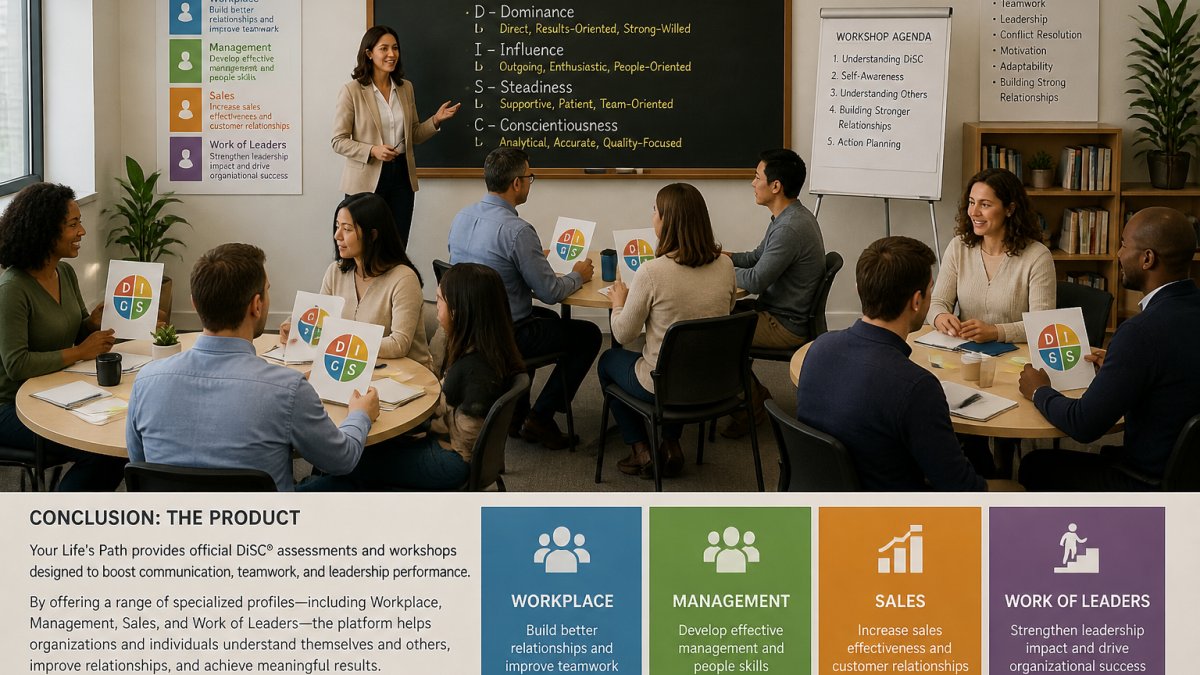
Facilitator leads a diverse team in a DiSC workshop with group discussions and assessment profiles.
Interactive Exercises for Mixed Styles
Mix the exercises so every style has a comfortable entry point. Some people love the spotlight. Others need a moment to think first. The table below gives you timing, group size, and the debrief question that makes each exercise land.
|
Exercise |
Time |
Group Size |
Setup |
Debrief Question |
|---|---|---|---|---|
|
Style sort |
15 min |
Whole room |
Post four style labels on walls or in a shared board |
“What frustrates you most about the styles that are not yours?” |
|
Role-play swap |
20 min |
Pairs |
Give each pair a real workplace scenario |
“What changed when you responded in a style that is not your default?” |
|
Speed rounds |
12 min |
Pairs, rotating |
Two-minute prompts on feedback, deadlines, or meetings |
“Which prompt was hardest to answer, and why?” |
|
Scenario cards |
25 min |
Groups of four |
Hand out tricky situations and ask groups to plan a response using all four styles |
“Which style was easiest to overlook, and what did you miss?” |
Style sort works best when you ask people to stand by their primary style and then pair with someone from a different style to discuss a real friction point. Keep the discussion to five minutes per pair. The physical movement resets attention and gives you a read on the room’s energy.
Role-play swap is the highest-value exercise for behavior change, but it fails if the scenario is abstract. Use a situation the team has actually faced in the last 30 days. Give each pair a card with the scenario and two prompts: “Respond in your own style” and “Respond in your partner’s style.” After the swap, ask each pair to name one adjustment they would actually make.
Speed rounds are the easiest exercise to run with a resistant group because the time limit removes the pressure to perform. Set a visible timer and call the switch out loud. Prompts that work: “How I like to receive feedback,” “What I need before a big decision,” and “How I show up when I am stressed.”
Scenario cards give you the most control over relevance. Write four to six cards based on real team friction: a missed handoff, a meeting that ran long, a project that stalled in review. Ask each group to plan a response that uses all four styles, then have one person from each group read the plan aloud. The debrief question is where the learning happens: “Which style was easiest to overlook, and what did you miss?”
Handling the Skeptic in the Room
Every workshop has at least one person who thinks this is a waste of time. Do not argue with them. Give them a role. Ask the skeptic to be the observer during the role-play swap and report back on which style was hardest to read. Resistance often fades when the skeptic has a job that uses their critical eye.
Watch out: if you let one dominant voice take over the debrief, the quieter styles will shut down. Use a round-robin format for the first debrief question so everyone speaks once before open discussion begins.
The goal is self-awareness and adaptability, not winning the exercise. Close the activity block by asking each person to name one adjustment they will try in the next week, and write those commitments down so you can follow up.
Debriefing the Assessment Results Without the Awkwardness
The debrief is where a DiSC workshop either lands or falls flat. People get nervous when results go on display. Your job is to keep it safe and useful.
Start with the general model before anyone’s individual profile. Then let people share only what they choose to share. Never read someone’s results aloud without permission. That single mistake can sour the whole session.
Focus the conversation on questions, not scores:
Take The Official DiSC® Assessment Online Now! →
- What does your style need from teammates?
- Where do your style and a colleague’s style clash?
- What is one adjustment you could make next week?
If you want a deeper walkthrough on explaining scores and styles clearly, our guide on how to interpret DiSC results for team workshops covers the debrief step by step.
Handling Resistant Participants and Group Conflict
Resistance is normal. Expect at least one person who thinks this is a waste of time. Meet it head-on instead of pretending it is not there.
A common mistake is to argue with the skeptic. Do not. Ask what would make the session useful to them, then connect the content to that answer. Resistance often fades once people see practical value.
When conflict flares between two styles, slow down and name the dynamic without blame. “It sounds like one of you wants a fast decision and the other wants more detail. Both are valid.” For concrete techniques on using styles to defuse tension, our article on resolving conflict using DISC styles gives you scripts and scenarios you can run in the room.
DiSC Facilitator Training: What You Need Before You Lead
You can run a decent session with a solid facilitator guide. You cannot run a great one without practice. DiSC facilitator training teaches you how to pace the room, handle tough questions, and keep the focus on behavior.
Before you lead, know the model cold. Practice the debrief out loud. Prepare for the three questions you are most likely to get: “Is this a test?”, “Can my score change?”, and “Why does my manager’s result look different from mine?”
If you are building facilitator capability across a team, our guide on DiSC training for managers walks through structuring a program from scratch. Certification helps too, and it gives you confidence when a session goes sideways.
EPIC Sub-Account Management for Multi-Session Rollouts
Rolling DiSC out across a large organization means managing many assessments at once. That is where EPIC sub-account management earns its keep. EPIC, the Electronic Profile Information Center, lets you administer assessments, track completion, and organize results by team or cohort.
Here is how we would set it up:
- Create a sub-account for each department or cohort.
- Assign the right profile to each group.
- Track who has completed and who needs a nudge.
- Pull results before each session.
Your Life’s Path offers free EPIC sub-account setup, which removes a common barrier for trainers running multiple sessions. If you are managing a rollout, start with a free EPIC sub-account and organize your cohorts before the first session.
Running Virtual and Hybrid DiSC Sessions
Virtual and hybrid DiSC workshops fail for a predictable reason: facilitators treat them as in-person sessions with a screen in the middle. The fix is not more energy. It is more structure.
A workable virtual agenda runs in 90-minute blocks with a change of pace every 10 to 12 minutes. Here is a pattern that works across common video platforms:
- 0-10 min: Welcome and framing. Restate the objective and the one behavior you want people to leave with.
- 10-25 min: Model overview. Share a single slide with the four styles and one sentence per style. Keep individual results private.
- 25-40 min: Breakout room exercise. Assign three to four people per room and give each room a specific prompt (for example, “Describe a recent meeting where your style clashed with a teammate’s. What would you adjust?”).
- 40-50 min: Debrief. Bring one insight from each room back to the main session. Use a shared document or whiteboard so remote voices are visible.
- 50-65 min: Scenario practice. Pairs role-play a real workplace situation using the style-swap technique.
- 65-80 min: Commitment round. Each person types one adjustment they will try next week into the chat or a shared form.
- 80-90 min: Close and follow-up. Confirm the 30-day check-in date.
Hybrid is the hardest format because the room and the screen compete for attention. A common pattern is for remote participants to go silent after the first 20 minutes. Assign a co-facilitator whose only job is to monitor the chat, repeat remote comments aloud, and call on remote participants by name. If you cannot staff a co-facilitator, run the session fully virtual rather than hybrid. A half-attended hybrid session damages trust more than a rescheduled one.
Tool mechanics matter more than most facilitators admit. Use breakout rooms with pre-assigned groups so people do not waste time sorting themselves. Keep the main slide deck short. Use a shared digital whiteboard or the platform’s native board for the style-sort exercise so remote participants can place their names in a style column. For the commitment round, use a simple form so responses are captured and can be sent back to participants as a reminder.
Watch out: if you ask remote participants to keep cameras on without explaining why, some will read it as surveillance. Frame it as a request for engagement, not a requirement, and give people a way to participate fully with cameras off.
Accessibility deserves a line in your plan. Share slides and the agenda at least 24 hours ahead so participants who use screen readers or need extra processing time can prepare. Captioning should be on by default in the platform settings. For the style-sort exercise, offer a text-based alternative (a shared document where people type their style) so no one is forced to speak first.
For a fuller set of techniques, our guide on virtual workshop engagement strategies covers the details.
Measuring Whether the Workshop Changed Anything
A DiSC workshop is only worth repeating if behavior shifts. Measure it, or you are guessing.
Skip the smile-sheet-only approach. Track a few concrete signals:
- Pre- and post-session survey on team communication
- Follow-up check-ins at 30 and 90 days
- Manager observations on specific behaviors
- Reassessment after a set period to see if styles or self-awareness shifted
Ready-made questions save time. Our post-workshop survey questions for employees give you a starting set you can adapt. The point is not a perfect score. It is evidence that people are using what they learned.
|
What to Measure |
How |
When |
|---|---|---|
|
Communication clarity |
Pre/post survey |
Before and after session |
|
Behavior change |
Manager check-in |
30 and 90 days |
|
Self-awareness |
Reassessment |
3-6 months |
|
Team conflict |
Pulse survey |
Quarterly |
Frequently Asked Questions
What is the DiSC model and how does it work?
DiSC sorts behavior into four styles: Dominance, Influence, Steadiness, and Conscientiousness. Most people show a blend, with one or two styles dominating. The assessment produces a profile that describes how someone tends to communicate, make decisions, and respond to pressure. In a DiSC workshop, the profile is the starting point, not the finish line. Participants use it to name their own preferences, recognize where colleagues differ, and practice adjusting their approach. The DiSC Workplace profile is the most universal and popular report for team workshops because it speaks to everyday collaboration rather than job-specific tasks.
How long should a DiSC workshop for employees last?
A half-day session of three to four hours covers the model, the individual profiles, and one or two DiSC workshop activities with a full debrief. Full-day formats leave room for role-playing, conflict scenarios, and action planning. For virtual delivery, split the content into two 90-minute sessions rather than one long block, since screen fatigue cuts into group engagement. Whatever length you pick, send assessments at least 48 hours ahead so participants arrive with results in hand and you can start the debrief on time.
What are the best DiSC workshop activities for employee engagement?
Style-mixed small groups work best. Try a communication preference sort where each table ranks what they need from a colleague, then compare across styles. Follow with a role-playing exercise built on a real friction point from your team, such as a handoff between sales and operations. A timed action-planning round closes the loop: each participant names one behavior they will adjust with a specific coworker. Keep activities to 15-20 minutes each and always debrief what people noticed, or the exercise becomes entertainment rather than learning.
Do I need an EPIC sub-account to run assessments for my team?
An EPIC sub-account is how you administer DiSC assessments at scale. It lets you order profiles, assign them to participants, track completion, and access reports from one dashboard instead of managing individual purchases. Your Life’s Path sets up EPIC sub-accounts at no charge, which matters if your HR team is already stretched thin. For a single workshop you could order profiles one by one, but once you plan repeat sessions or a full rollout, EPIC sub-account management saves hours of administrative work and keeps records in one place.
Running a DiSC workshop that actually changes behavior takes planning, the right profile, and a facilitator who can handle the room. That is the work Your Life’s Path supports every day. Start with the DiSC Workplace profile for your whole team, add DiSC Catalyst so people can keep exploring their results between sessions, and set up a free EPIC sub-account to manage your rollout cleanly. Get started with Your Life’s Path and turn one workshop into lasting change across your teams.
