

Last Updated: November 13, 2026
Quick Summary
Employee communication skills assessment tools work when they score observable behaviors rather than personality labels, and when results convert into a development plan. A communication skills assessment is most reliable when you combine methods, such as self-assessment with peer feedback, instead of trusting a single instrument.
- A review identified 10 distinct communication assessment tools, and six measured whole-team performance rather than individual behavior.
- Pair a behavioral style profile with peer feedback: the profile explains friction, the feedback shows whether it costs anything.
- Ask vendors for validity evidence, not testimonials, and check whether the instrument scores behavior or labels people.
- Run the self-assessment first, then the peer version, and treat the gap between scores as the most valuable number.
- Set a baseline before training, re-test with the same instrument after, and give behavior time to change before measuring again.
Table of Contents
- Why Employee Communication Skills Assessment Tools Matter More Than Ever
- What Communication Skills Assessment Tools Actually Measure
- Comparing Assessment Methodologies: A Side-by-Side Look
- Employee Communication Skills Assessment Tools for Managers
- Building a Communication Skills Assessment Questionnaire
- The Communication Skills Self Assessment Questionnaire: What It Reveals
- Validity, Reliability, and Fairness in Communication Assessment
- How to Select the Right Assessment for Your Team Dynamics
- Measuring Improvement After Training
- Start With a DiSC Assessment to Improve Communication and Productivity
- Frequently Asked Questions
Why Employee Communication Skills Assessment Tools Matter More Than Ever
Most communication problems at work are invisible until they cost money. A team that nods along in meetings and then executes in five different directions is not a team with a personality clash; it is a team with an unmeasured communication gap. That is where employee communication skills assessment tools earn their place: they turn vague complaints about “poor communication” into specific, observable patterns you can actually work on.
Managers often arrive convinced they know their team’s communication style, and a structured assessment can show something different. Research from Rehim et al.’s review of communication assessment tools identified 10 distinct tools, and six of them measured whole-team performance rather than individual behavior. That split matters more than most buyers realize. A tool that scores one person tells you about that person. A tool that scores the team tells you where the handoffs break.
Below, we break down what these assessments measure, how the methodologies compare, and how to choose one that produces change rather than a report nobody reads.
What Communication Skills Assessment Tools Actually Measure
Communication assessment is the structured evaluation of how people send, receive, and interpret information at work. It typically scores observable behaviors, not personality alone: clarity, listening accuracy, tone, and written precision. Most tools combine self-report questionnaires with observer ratings or scenario-based exercises.
The measurement problem is real. The British Council’s guidance on assessing communication frames communication as a genuinely hard-to-measure skill and recommends combining several methods rather than trusting a single instrument. That is the honest starting point.
Verbal, Nonverbal, and Written Communication
Verbal communication covers word choice, pacing, and how clearly someone states a position. Nonverbal communication and body language cover eye contact, posture, and the signals that contradict the words. Written communication covers email clarity, documentation, and whether a message survives without the sender in the room.
A practical meeting tip: when you facilitate a group with mixed communicators, state the decision and the owner out loud before anyone leaves. If you want more on running those sessions well, see our guide to facilitating productive meetings for diverse communicators.
Active Listening and Interpersonal Skills
Active listening is the practice of confirming understanding before responding, and it is the skill most assessments score lowest. Interpersonal communication covers empathy, conflict resolution, and persuasion. When difficult conversations are on the horizon, our piece on facilitating difficult conversations using personality insights walks through the prep work.
Comparing Assessment Methodologies: A Side-by-Side Look
No single method wins on every criterion, and the right choice depends on whether you are assessing an individual, a team, or a specific friction point. The table below compares the main approaches teams evaluate, organized around the employee use case each one serves.
|
Methodology |
Typical Format |
Best Employee Use Case |
What It Captures |
Strength |
Limitation |
|---|---|---|---|---|---|
|
Self-assessment questionnaire |
15-30 item online survey, 1-5 scale |
Baseline before development |
Self-perception of skills |
Fast, low-friction to deploy |
Blind spots go unmeasured |
|
Peer feedback |
Structured 360-style ratings with open comments |
Existing teams with trust |
How others experience the person |
Surfaces real gaps |
Requires anonymity safeguards |
|
Manager or trainer rating |
Behaviorally anchored rating scales |
Performance conversations |
Observed performance |
Grounded in evidence |
Rater bias creeps in |
|
Behavioral style profile |
Forced-choice or ipsative questionnaire |
Cross-functional friction |
Communication preferences |
Explains why friction happens |
Not a skill score |
|
Situational judgment test |
Scenario prompts with ranked responses |
Roles with high-stakes decisions |
Decision-making under ambiguity |
Mirrors real tasks |
Harder to design well |
|
Live role-play exercise |
Facilitated scenario with observer rubric |
Customer-facing and leadership roles |
Applied behavior |
Reveals actual skill |
Time-intensive to run |
|
Written communication sample |
Timed email or memo exercise |
Documentation-heavy roles |
Clarity under real constraints |
Objective artifact to score |
Narrow slice of skill |
The British Council’s four-method framework maps closely to the top rows: trainer assessment, self-assessment, peer feedback, and online tools. Situational judgment tests, writing samples, and live role-play add options that mirror actual tasks rather than asking people to describe themselves.
A useful pattern is to pair a behavioral style profile with peer feedback. The profile explains why two people clash; the feedback tells you whether the clash is costing anything. If you only have budget for one method, choose peer feedback for existing teams and a behavioral profile for newly formed ones.
Watch out: mixing methods without a shared scoring rubric can produce a report that contradicts itself, and managers may stop trusting the results.
Employee Communication Skills Assessment Tools for Managers
Managers need something different from what trainers need. They need a tool that produces a conversation, not a score. The best employee communication skills assessment tools for managers give a shared language for describing behavior, so a one-on-one stops being “you need to communicate better” and becomes “you tend to lead with results and skip the context your team needs.”
Behavioral style instruments fit this job well. A validated soft-skills instrument can inform targeted development programs, according to research published in the National Library of Medicine on assessing key soft skills in organizational contexts. That is the outcome to buy: targeted development, not a ranking.
Watch out: managers often treat the assessment result as a verdict. It is a description of preference, not a measure of worth, and presenting it as the latter damages trust fast.
Building a Communication Skills Assessment Questionnaire
A useful communication skills assessment questionnaire takes about 20 minutes and scores a small number of behaviors honestly. Keep it short, specific, and tied to observable actions.
- I restate the other person’s point before responding
- I confirm deadlines and owners in writing after verbal agreements
- I adjust detail level based on who is in the room
- I ask clarifying questions when instructions are ambiguous
- I give feedback on behavior, not personality
- I notice when someone has gone quiet and draw them in
- I keep written messages short enough to act on
- I check that my tone lands as intended in email
Use a 1-5 scale per item. Score yourself, then have two colleagues score you. The gap between the two sets of scores is the most valuable number on the page.
The Communication Skills Self Assessment Questionnaire: What It Reveals
Self-assessment reveals intent; it rarely reveals impact. That gap is the whole point. A communication skills self assessment questionnaire tells you how someone believes they show up, which is useful only when compared against how others experience them. Comparing perceived intent with observed impact makes communication easier to assess consistently, and K9 REVOLUTION offers a useful next step in thinking about the tasks that put those skills into practice.
Pairing self-assessment with trainer assessment and peer feedback helps address this gap. Used alone, self-report tends to flatten.
Run the self-assessment first, then the peer version. The debrief writes itself.
Validity, Reliability, and Fairness in Communication Assessment
Validity asks whether a tool measures communication at all, or something adjacent like extroversion. Reliability asks whether it produces the same result twice. Fairness asks whether it disadvantages people for reasons unrelated to the skill.
Recent work in BMJ Open on validity evidence for communication skills assessment treats assessment as tied to competency, educational practice, and regulatory compliance, which raises the bar: a tool used to inform development decisions should have documented evidence behind it.
Two practical tests before you buy. First, ask the vendor for validity evidence, not a testimonial page. Second, check whether the instrument scores behavior or labels people. Labels feel satisfying and change nothing.
How to Select the Right Assessment for Your Team Dynamics
Start with the problem, not the product. If the issue is cross-department friction, you need a team-level instrument. If the issue is a struggling new manager, you need an individual profile plus coaching. Matching the tool to the actual friction is the entire decision.
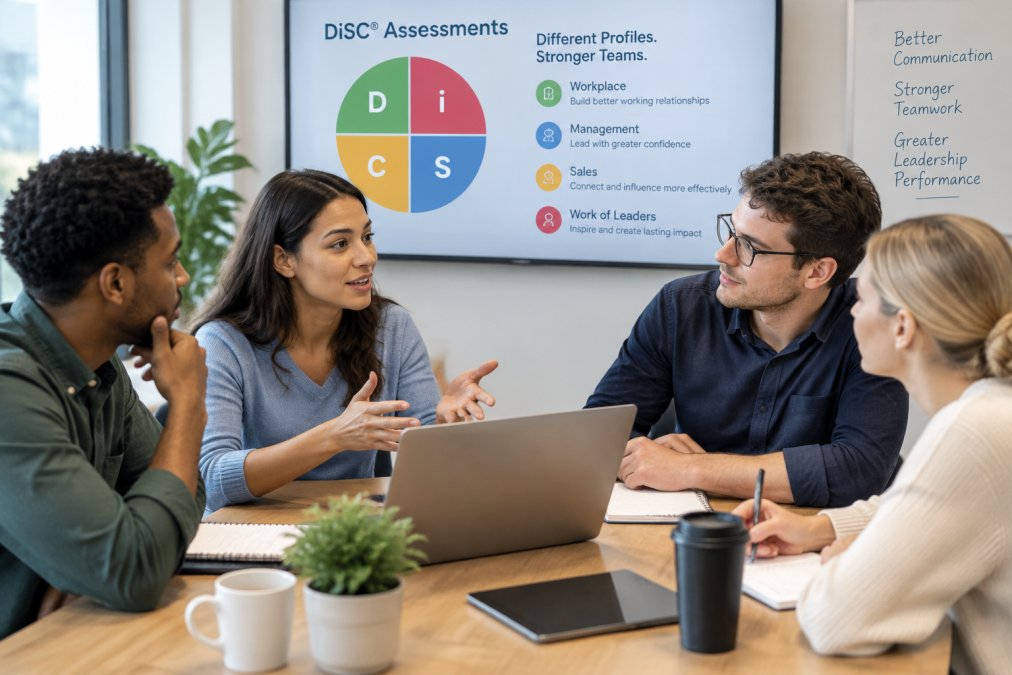
Diverse team analyzing communication skills assessment results during a collaborative office meeting
A short selection sequence we recommend:
- Name the specific communication breakdown in one sentence
- Decide whether the unit of analysis is the person or the team
- Check validity evidence and data handling practices
- Confirm how results convert into a development plan
- Pilot with one team before rolling out
That fourth step is where most purchases stall. An assessment without a follow-on plan is an expensive personality quiz.
Three criteria competitors rarely surface but buyers should weigh before signing:
Validity and fairness. Ask the vendor for validity evidence, not a testimonial page. A tool used to inform development decisions should document that it measures communication rather than an adjacent trait like extroversion, and that it does not disadvantage people for reasons unrelated to the skill. Check whether the instrument scores behavior or labels people; labels feel satisfying and change nothing.
Privacy and data handling. Confirm who can see individual results, how long data is retained, and whether employees consent to peer feedback being shared. A common pattern is that results are aggregated to team level before managers see them, which reduces defensiveness and improves honesty. Ask for the retention policy in writing.
Accessibility and language. Communication assessments can confuse language proficiency or cultural communication norms with skill deficits. Confirm the instrument offers accommodations, is available in the languages your team actually uses, and does not penalize direct versus indirect communication styles as a deficit. A tool that scores a non-native speaker low on “clarity” may be measuring fluency, not communication skill.
Watch out: skipping the pilot and rolling out to the whole organization at once makes it impossible to separate tool problems from team dynamics.
Measuring Improvement After Training
Improvement is measurable if you set the baseline first. Score the team before training, run the same instrument after, and compare the specific behaviors you targeted. Vague satisfaction surveys will not tell you whether listening improved.
Demonstrated performance and realistic practice are generally preferred over self-report when measuring training impact. For a fuller method, our article on evaluating the business value of interpersonal skills training covers how to build the case with numbers your finance team will accept.
Watch out: re-testing too soon inflates results. Give behavior time to change before you measure again.
Start With a DiSC Assessment to Improve Communication and Productivity
If you want a starting point that produces usable language fast, begin with a behavioral style assessment. DiSC is the one we recommend, and we recommend it for a specific reason: it describes communication preference in plain terms people can repeat without a facilitator in the room. If you are ready to put results to work, see our guidance on interpreting DiSC results for team workshops.
Your Life’s Path offers official DiSC® assessments, with free EPIC sub-account setup available. The DiSC Workplace Profile gives teams a shared vocabulary for how they prefer to communicate and where friction is likely. The DiSC Catalyst platform offers flexible learning tools that can support learning after the initial session. And our team building sessions turn the profiles into working agreements rather than filed reports.
For managers, the DiSC Management Profile focuses the same insight on directing and delegating. For leadership teams, the DiSC Work of Leaders Profile applies it to vision, alignment, and execution.
Pair the profile with peer feedback and you have both halves of the picture: what someone prefers, and how that preference lands on the people around them. For the bigger picture, read about using DiSC assessments to build high performing teams.
The gap between what a team believes about its communication and what is actually happening is where most productivity loss hides. Close it with a structured assessment, a follow-on plan, and a shared language everyone can use.
Get started with Your Life’s Path and give your team the official DiSC® Workplace Profile, Catalyst learning, and team building sessions that turn assessment results into daily practice.
Frequently Asked Questions
What are the 5 C’s of communication skills?
The 5 C’s are clarity, conciseness, coherence, consistency, and compassion. Clarity means the message is easy to understand; conciseness keeps it brief; coherence ensures logical flow; consistency maintains the same message across channels; compassion considers the listener’s perspective. A communication skills assessment can measure how well employees demonstrate each of these in practice, and DiSC profiles help teams understand why some people naturally prioritize clarity while others focus on compassion.
How can I evaluate an employee’s communication skills?
Use a mix of methods rather than a single test. Combine a communication skills assessment questionnaire with peer feedback, self-assessment, and observed role-play exercises. Trainer assessment, self-assessment, peer feedback, and online tools can be used together. For behavioral insight, a DiSC Workplace Profile gives managers a structured way to discuss communication preferences and skill gaps.
How do communication style assessments help teams work together?
Communication style assessments like DiSC reveal how each team member prefers to give and receive information, handle conflict, and make decisions. When teams understand these differences, they can adapt their approach instead of misreading intent. Your Life’s Path offers a DiSC Catalyst for Teams and teambuilding sessions that turn assessment results into shared language and practical collaboration habits.
Can a communication assessment help improve team productivity?
Yes, when results lead to action. Because communication is hard to measure consistently, combining assessment with follow-up training is generally advisable. A communication skills assessment identifies specific gaps, such as unclear written updates or weak active listening, and targeted workshops address them. Your Life’s Path pairs DiSC assessments with virtual workshops and Catalyst learning tools to help teams apply insights on the job.
