

Table of Contents
- Understanding the Four Main Communication Styles
- How to Identify Communication Styles in Others
- Communication Styles Examples for Managers
- Active Listening Techniques for Leaders
- Conflict Resolution Communication Scripts
- Adapting Your Style to Different Audiences
- Communication Style Assessment Tools
- Building Team Cohesion Across Communication Styles
How to Manage Different Communication Styles
Last Updated: August 3, 2026
Understanding how to manage different communication styles is one of the most valuable skills a leader can develop. When team members communicate in fundamentally different ways, some direct and fast-moving, others thoughtful and detail-oriented, friction emerges naturally. Miscommunication costs organizations time, damages relationships, and stalls projects. The solution isn’t forcing everyone into the same mold. It’s learning to recognize communication patterns and adapting your approach accordingly.
The real problem isn’t that people communicate differently. It’s that most leaders treat all team members the same way and expect different results. Recognizing and adapting to communication styles is what separates average managers from exceptional ones.
Understanding the Four Main Communication Styles
Four distinct communication patterns show up consistently across workplaces. These aren’t personality types, they’re behavioral preferences that shape how people prefer to receive information, make decisions, and interact under pressure.
Dominant (D) Style communicators are direct, fast-paced, and results-focused. They want the bottom line first, minimal small talk, and clear ownership of decisions. When managing someone with this style, give them autonomy, respect their time, and lead with business impact. They respond well to competition, challenge, and measurable goals.
Influence (I) Style communicators are enthusiastic, people-focused, and big-picture oriented. They build relationships easily and want recognition, involvement in decisions, and connection to the "why" behind the work. When managing someone with this style, give them visibility, involve them in team initiatives, and celebrate their contributions publicly.
Steadiness (S) Style communicators are patient, supportive, and process-oriented. They value stability and team harmony, preferring clear expectations and advance notice of changes. When managing someone with this style, provide clear procedures and acknowledge their loyalty and reliability.
Conscientiousness (C) Style communicators are analytical, detail-focused, and quality-driven. They need data, specifications, and time to verify information before committing. When managing someone with this style, provide detailed information upfront and respect their need for verification.
:::pro
Most workplaces skew toward one or two dominant patterns. A sales team might be 60% Influence, 30% Dominant, 10% split between Steadiness and Conscientiousness. Understanding your team’s distribution helps you anticipate friction points before they emerge.
:::
How to Identify Communication Styles in Others
Recognizing communication styles requires observation, not assumption. Watch how people behave under pressure, how they make decisions, and what they prioritize when stressed.
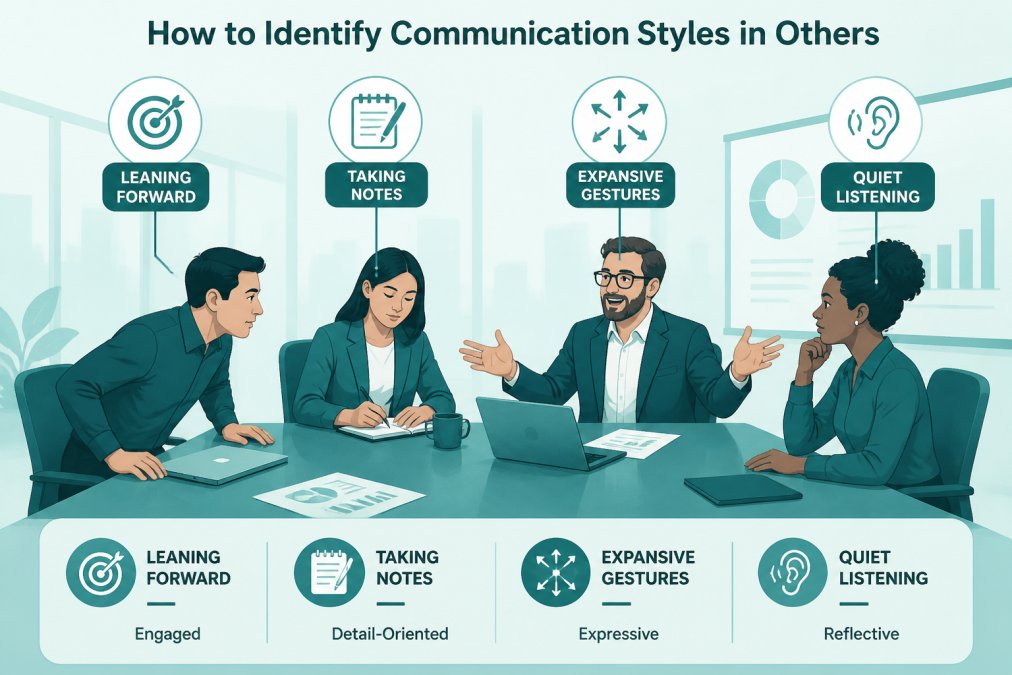
Dominant styles talk over others, steer conversations toward decisions, and show visible impatience with process. They lean forward, make direct eye contact, and use commanding gestures. In emails, they’re blunt and brief.
Influence styles remember personal details about colleagues, initiate conversations, and redirect meetings toward relationship-building. Their body language is open, they smile frequently, and use expansive hand gestures.
Steadiness styles are harder to spot because they blend into the background. Watch for consistency: they follow through on commitments, show up reliably, and maintain stable relationships. Their body language is calm, and they rarely interrupt.
Conscientiousness styles stand out through their precision. They ask detailed questions, request documentation, and flag potential problems. Their body language is controlled, they take notes, and maintain focused attention.
A practical approach: ask your team to take an official assessment. Formal communication style assessments like DiSC profiles help teams move beyond guessing. Informal observation works too, pay attention for one week to how each person responds to deadlines and handles disagreement.
Don’t assume someone’s style based on their job title or seniority. Watch individuals, not roles.
Communication Styles Examples for Managers
Managing different communication styles means adjusting your approach to each person. Here’s how this plays out in real scenarios.
Scenario 1: Project Deadline Pressure
Your Dominant team member is pushing to launch early. Your Conscientiousness team member is requesting more time for quality checks. Your Influence team member is worried about team morale. Your Steadiness team member is quietly stressed about the timeline change.
With the Dominant communicator, lead with business impact: "Launching early gives us competitive advantage, but if we miss quality standards, we lose customer trust."
With the Conscientiousness communicator, provide data: "Here’s the quality checklist. These five items are critical; these three can be verified post-launch."
With the Influence communicator, involve them in the solution: "We need to keep team energy high. What if you led a daily standup to celebrate what we’re shipping?"
With the Steadiness communicator, provide reassurance: "Here’s the new timeline, and here’s what won’t change. I’ll check in daily to make sure you have support."
Scenario 2: Giving Critical Feedback
Tell your Dominant communicator directly: "Your communication in the client meeting was too aggressive. It damaged the relationship. Here’s what needs to change."
Tell your Influence communicator privately: "I value your energy. In the client meeting, your enthusiasm came across as dismissive of their concerns. Let’s talk about how to channel that energy differently."
Tell your Steadiness communicator gently: "I’ve noticed some hesitation in your contributions lately. Is everything okay? I want to make sure you feel supported."
Tell your Conscientiousness communicator with data: "Here are three specific examples where quality didn’t meet our standard. Here’s the impact. Here’s the process we need to follow going forward."
Active Listening Techniques for Leaders
Active listening is the foundation of managing different communication styles. It means understanding the underlying need, priority, and concern beneath what someone is saying.
Reflect back what you hear. After someone explains something, summarize it: "So what I’m hearing is that you’re concerned about timeline pressure affecting quality. Is that right?"
Ask clarifying questions before responding. A Dominant communicator might say "This process is too slow." Before you respond, ask: "What specifically feels slow?"
Notice what isn’t being said. A Steadiness communicator might say "I’m fine with the change" in a tone that suggests otherwise. Acknowledge the gap: "You said you’re fine, but I’m sensing some concern. What’s worrying you?"
Validate emotion before solving the problem. An Influence communicator venting about a difficult client needs acknowledgment: "That sounds frustrating. You care about that relationship, and it’s not going the way you hoped."
Pause longer than feels natural. After someone finishes speaking, wait three full seconds before responding. This signals you’re thinking about what they said, not waiting for your turn to talk.
Record yourself in a meeting (with permission) and count how many times you interrupt or start formulating your response before the other person finishes. This data is your baseline for improvement.
Conflict Resolution Communication Scripts
Conflict between different communication styles is inevitable. The key is having a framework that respects both styles.

(/blog/2026/08/03/how-to-use-behavioral-assessments-for-conflict-resolution/)]
Script 1: Dominant vs. Steadiness Conflict
Opening: "I see you both want what’s best for the team, but you’re approaching it differently. [Dominant person], you’re focused on speed and impact. [Steadiness person], you’re focused on stability and team confidence. Both matter."
For the Dominant communicator: "Here’s why speed matters: [business reason]. Give the team a clear timeline for the change and stick to it."
For the Steadiness communicator: "Here’s why this change is necessary: [business reason]. I’ll communicate every step clearly and check in with you regularly."
Resolution: "Let’s set a weekly check-in. [Dominant person], you drive progress. [Steadiness person], you flag concerns early."
Script 2: Influence vs. Conscientiousness Conflict
Opening: "I appreciate both perspectives. [Influence person], your enthusiasm is why we’re considering this. [Conscientiousness person], your rigor is why we won’t fail."
For the Influence communicator: "I love the vision. Work with [Conscientiousness person] to document the specifics. Your job is to keep the energy high."
For the Conscientiousness communicator: "Identify which risks are real versus which are unknowns we can manage. Your job is to make the plan bulletproof, not to kill the idea."
Resolution: "You’re going to collaborate on a detailed plan. [Influence person] leads the vision, [Conscientiousness person] leads the verification."
Script 3: Dominant vs. Dominant Conflict
Opening: "You both want to win. Here’s how we decide: [clear decision-making framework]. Let’s look at the data."
For both: "I’m making the final call. Here’s my reasoning. Once the decision is made, I need you both fully committed. Disagreement is healthy; undermining the decision isn’t."
Adapting Your Style to Different Audiences
You can’t change your natural communication style, but you can expand your range. Adapting means meeting people where they are.
If you’re naturally Dominant, slow down your pace for Steadiness communicators. Instead of "Here’s what we’re doing," try "Here’s what we’re doing, here’s the timeline, and here’s how I’ll keep you informed."
If you’re naturally Influence, provide structure for Conscientiousness communicators. Instead of "This is going to be amazing," try "This is going to be amazing, and here’s the detailed plan showing how we’ll execute it."
If you’re naturally Steadiness, move faster for Dominant communicators. Instead of "Let me think about this and get back to you," try "Here’s my initial thinking. What’s your priority?"
If you’re naturally Conscientiousness, be more decisive for Influence communicators. Instead of "Here are all the considerations," try "Here’s the recommendation based on the data, and here’s why it’s the right move."
Adapting isn’t about being inauthentic. It’s about recognizing that communication is a two-way street. The best communicators read the room and adjust in real time.
Communication Style Assessment Tools
Formal assessments create a shared language for your team. When everyone understands their own style and each other’s styles, communication improves immediately.
According to research on behavioral assessments in the workplace, organizations that use structured communication assessments see measurable improvements in team cohesion and conflict resolution.
The most widely used framework is the DISC model. Official assessments provide personalized reports that explain your style, how it shows up under stress, how you make decisions, and how you prefer to be managed. Your Life’s Path offers the DiSC Workplace Profile and specialized profiles like the DiSC Management Profile designed specifically for leaders navigating team dynamics.
After the assessment, schedule a workshop where people share their results. A Dominant communicator explaining their results creates understanding. When they say "I’m direct because I’m focused on outcomes," the Steadiness communicator stops taking their bluntness personally.
The assessment is the starting point, not the destination. Real change requires ongoing reinforcement, regular check-ins, accountability, and deliberate practice applying the framework.
Building Team Cohesion Across Communication Styles
Teams with diverse communication styles are stronger than homogeneous ones. Diversity creates balance, if you manage it well.
Create multiple channels for input. A Dominant communicator speaks up in meetings. A Steadiness communicator prefers email. A Conscientiousness communicator wants time to prepare. Offer all three.
Assign roles that match styles. Let Dominant communicators lead sprints and push for decisions. Let Influence communicators build relationships. Let Steadiness communicators create stability and support. Let Conscientiousness communicators own quality and process improvement.
Establish clear decision-making processes. Define how you’ll make decisions: "For decisions under $X, the team lead decides. For decisions between $X and $Y, we get input from all stakeholders. For decisions over $Y, we involve leadership."
Celebrate complementary strengths. In team meetings, highlight how different styles contributed to success. "We launched quickly because [Dominant person] pushed for speed, and we didn’t miss anything because [Conscientiousness person] caught the edge cases."
Address conflict quickly. Small conflicts between different styles snowball fast. When you notice tension, address it immediately.
Invest in relationships across styles. Create opportunities for informal interaction. A virtual coffee chat between a Dominant and Steadiness person builds understanding that prevents future conflict.
The ultimate goal is psychological safety, the feeling that you can be yourself, contribute your perspective, and disagree without fear of retribution. Teams with psychological safety outperform teams without it on nearly every metric.
Managing different communication styles isn’t a one-time training, it’s an ongoing practice that compounds over time. Leaders and organizations that master this skill see dramatic improvements in team cohesion, faster decision-making, and lower turnover. Start with the DiSC Workplace Profile from Your Life’s Path to understand your team’s communication landscape, then use the insights to adapt how you lead, resolve conflict, and build a culture where all communication styles are valued.
Frequently Asked Questions
What are the four main communication styles and how do I identify them?
The four communication styles are Dominant (direct, results-focused), Influence (expressive, people-focused), Steadiness (supportive, relationship-focused), and Conscientiousness (analytical, detail-focused). You can identify them by observing how people make decisions, respond to change, interact with others, and handle conflict. Dominant communicators speak quickly and decisively; Influence communicators are animated and enthusiastic; Steadiness communicators listen carefully and avoid confrontation; and Conscientiousness communicators ask detailed questions and prefer written communication. Official assessments provide precise profiles for your team.
How can I adapt my communication style to manage different personality types effectively?
Start by identifying each team member's primary style, then adjust your approach accordingly. With Dominant communicators, be direct and results-oriented; skip small talk and focus on outcomes. With Influence communicators, be enthusiastic and collaborative; share the bigger vision. With Steadiness communicators, be patient and supportive; provide reassurance and stability. With Conscientiousness communicators, be precise and data-driven; provide detailed information in writing. This flexibility builds trust and reduces miscommunication across your team.
What are the most common communication barriers between different styles?
Dominant and Steadiness styles often clash because one pushes for speed while the other values harmony. Influence and Conscientiousness styles may conflict when one prioritizes relationships while the other demands accuracy. Miscommunication happens when a direct communicator seems harsh to a sensitive one, or when a detail-oriented person frustrates someone focused on the big picture. Understanding these natural tensions helps you bridge gaps through intentional feedback loops and collaborative problem-solving rather than assuming conflict is personal.
How do active listening and emotional intelligence improve communication across different styles?
Active listening means fully focusing on what someone says without planning your response, which builds social awareness and cognitive empathy. Emotional intelligence helps you recognize how different styles experience stress, process information, and prefer feedback. When you listen actively, you gather information about someone's actual needs rather than assuming based on their style. This creates a feedback loop where people feel heard, trust increases, and your adaptability improves. Both skills reduce defensive reactions and open space for genuine understanding.
This article was written using GrandRanker