

Table of Contents
- Why Team Dynamics Suffer After Conflict
- Step 1: Assess the Root Causes of the Conflict
- Step 2: Create Psychological Safety Before Moving Forward
- Step 3: Use Conflict Resolution Scripts for Managers
- Step 4: How to Facilitate a Team Debrief After Conflict
- Step 5: Implement Team Building Activities for Divided Teams
- Step 6: Establish Clear Roles, Accountability, and Shared Goals
- Step 7: Monitor Progress and Prevent Future Conflict
Why Team Dynamics Suffer After Conflict
Conflict doesn’t end when the argument stops. The aftermath, the tension, the broken trust, the fractured communication, often lingers far longer than the disagreement itself. When teams experience significant conflict, the damage extends beyond the immediate participants. Psychological safety deteriorates, collaboration becomes guarded, and productivity suffers as people invest energy in self-protection rather than shared work.
The real challenge in learning how to improve team dynamics after conflict is that most organizations treat resolution as a one-time event. A manager steps in, the immediate issue gets addressed, and then everyone is expected to move forward. But unresolved emotional residue creates an invisible barrier. Team members become hesitant to speak up, cross-functional work stalls, and what could have been a learning moment instead becomes a scar that shapes future behavior.
Research shows that teams recovering from conflict need a structured, intentional approach. The process involves more than apologies or team-building exercises. It requires creating conditions where psychological safety can be rebuilt, roles can be clarified, and shared purpose can be reestablished. Below, we’ll walk you through seven concrete steps to help your team move past conflict and emerge stronger.
Step 1: Assess the Root Causes of the Conflict
Before you can fix team dynamics, you need to understand what actually caused the breakdown. Many managers skip this step, assuming they already know the source. But conflict rarely stems from a single cause. Surface disagreements, a missed deadline, a miscommunication, a perceived slight, usually mask deeper issues: unclear accountability, competing priorities, personality clashes, or unmet expectations.
Start by gathering information from multiple perspectives. Talk individually with people involved in the conflict, not in a blame-seeking way, but to understand their experience. Ask open questions: What led to this situation? What were you trying to accomplish? What did you need that you didn’t get? Listen for patterns. Often, the real issue emerges when you hear the same concern from different people.
Document what you find. Look for recurring themes: Was accountability unclear? Did people lack information they needed? Were communication channels broken? Did someone felt disrespected or excluded? Understanding the root cause, not just the symptom, determines what intervention will actually work. A conflict rooted in unclear roles requires a different fix than one rooted in personality friction or poor communication channels.
This assessment phase also signals to your team that you take the situation seriously and are committed to genuine resolution, not just moving on.
Step 2: Create Psychological Safety Before Moving Forward
Psychological safety, the belief that you can speak up, take interpersonal risks, and be yourself without fear of embarrassment or retaliation, is the foundation for any team recovery. Without it, your team will go through the motions of reconciliation while remaining guarded and disconnected.
After conflict, psychological safety is damaged. People worry: Will speaking up make things worse? Will my perspective be used against me? Can I trust the people I work with? Your job as a leader is to rebuild that safety deliberately.
Start by acknowledging the conflict explicitly. Don’t pretend it didn’t happen or minimize its impact. Say something like: "We’ve had a rough patch. I know that’s created tension and uncertainty. I want to rebuild trust and get us back on track, and that requires all of us." This simple acknowledgment signals that the conflict is real, addressable, and not something people need to hide.
Next, model vulnerability. Share your own perspective on what happened, including what you could have done differently. Admit uncertainty where it exists. When leaders show they can acknowledge mistakes without defensiveness, team members feel safer doing the same.
Finally, establish ground rules for how you’ll move forward together. These might include: We listen without interrupting. We assume good intent. We focus on understanding, not winning. We commit to confidentiality about what’s discussed. These rules create a container where people can speak honestly without fear.
Step 3: Use Conflict Resolution Scripts for Managers
When emotions are high and trust is fragile, structured conversations prevent things from escalating. Conflict resolution scripts for managers provide a framework that keeps discussions focused, fair, and productive.

A simple but effective script follows this pattern:
Opening: "I want to talk about what happened between [situation]. I care about our working relationship and want to understand what occurred from your perspective."
Listen: Ask clarifying questions without judgment. "Help me understand what you were experiencing." "What did you need in that moment?" Let them speak fully before responding.
Acknowledge: Reflect back what you heard. "It sounds like you felt [emotion] because [reason]. Is that right?" This shows you’re listening and often defuses defensiveness.
Share perspective: "From my perspective, I observed [specific behavior]. My concern was [impact]." Use "I" statements. Avoid accusations.
Collaborative problem-solving: "What would help prevent this from happening again?" or "What do you need from me moving forward?" Invite their ideas before proposing solutions.
Commit to action: Agree on specific next steps. "I’m going to [action]. You’re going to [action]. We’ll check in on [date]."
The key is staying calm and focused on understanding, not proving who was right. When people feel genuinely heard, defensiveness drops and resolution becomes possible.
Step 4: How to Facilitate a Team Debrief After Conflict
Once individual conversations have happened, bring the team together for a structured debrief. This signals that the conflict is being addressed openly and gives everyone a chance to reset shared expectations.
A team debrief after conflict works best when it’s facilitated carefully. Start by setting the tone: This isn’t about rehashing blame. It’s about understanding what happened and moving forward together.
Walk through these elements:
What happened: Provide a brief, neutral summary of the situation. Avoid language that assigns blame. "We experienced a breakdown in communication around [topic] that affected our ability to work together."
Impact: Name the real effects. "This created tension, made collaboration harder, and slowed our progress on [project]." People need to know their experience was real and recognized.
What we learned: Ask the team: What can we take from this? What will we do differently? This reframes conflict as a learning opportunity, not just a failure.
Shared commitments: Establish how you’ll work together going forward. What communication practices will improve? What will you hold each other accountable for? Write these down and refer back to them.
Take The Official DiSC® Assessment Online Now! →
Moving forward: Close with a clear statement about the future. "We’re moving past this. I’m confident we can rebuild trust because [specific reason]. Here’s what that looks like…"
A debrief that includes the whole team prevents hidden resentment and creates collective ownership of the recovery process.
Step 5: Implement Team Building Activities for Divided Teams
Team building activities for divided teams aren’t about forced fun. They’re about creating low-stakes opportunities for people to interact differently, rebuild connection, and remember shared purpose.
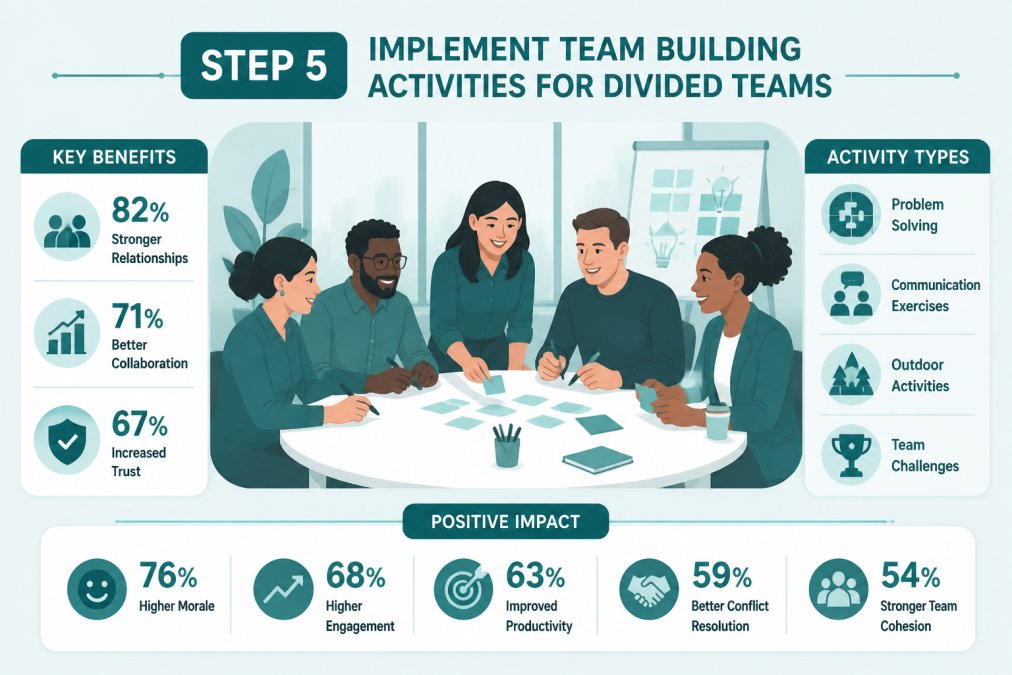
The most effective activities after conflict share these characteristics: They’re voluntary (no one forced to participate). They’re structured around a shared goal or task. They create moments of genuine connection, not awkward icebreakers. They’re relevant to how the team actually works.
Consider activities like:
- Problem-solving challenges: Small groups work together on a puzzle, escape room scenario, or business case. Success requires collaboration and listening. The task itself, not the socializing, creates bonding.
- Skill-sharing sessions: Team members teach each other something valuable. This builds respect for different expertise and creates informal interaction in a purposeful context.
- Volunteer work: Teams work together on a community project. Shared purpose outside the workplace often dissolves workplace friction.
- Retrospectives: If your team works on projects, run a structured retrospective focused on what went well and what you’d improve. This channels conflict energy into improvement.
The key is that activities feel genuine and connected to how the team works, not like an HR mandate to "have fun together."
Step 6: Establish Clear Roles, Accountability, and Shared Goals
Many conflicts persist because people don’t have clarity about who’s responsible for what. When roles overlap, when decision-making authority is unclear, or when goals conflict, friction becomes inevitable.
Use this step to rebuild structural clarity. Document:
Roles: What is each person responsible for? What decisions do they own? What’s outside their scope? Make this explicit, not assumed.
Accountability: How will you measure success? What happens if someone doesn’t deliver? What support do they get if they’re struggling? Clear accountability prevents the resentment that builds when expectations are vague.
Shared goals: What are you collectively trying to achieve? How does each person’s work contribute? When people see how their effort connects to shared purpose, they’re more willing to collaborate and less likely to get stuck in conflict.
Decision-making: Who decides what? What’s the process? Do decisions require consensus, or does someone have final say? Clarity here prevents the power struggles that fuel ongoing tension.
Understanding how people approach communication and accountability, through behavioral assessments like the DiSC Workplace Profile, helps teams have more productive conversations about roles and expectations. When people understand their own style and how it differs from others, they’re more likely to bridge gaps intentionally rather than blame personality differences.
Step 7: Monitor Progress and Prevent Future Conflict
Recovery isn’t linear. After conflict, teams need ongoing attention to ensure they don’t slip back into old patterns. Build monitoring into your regular rhythm.
Check in individually with people who were most affected. Not formal performance reviews, genuine conversations. "How are things going with the team? How are you feeling about where we are?" These conversations surface issues before they become problems.
Watch for warning signs: People becoming quieter in meetings. Collaboration slowing down. Subgroups forming. These suggest trust is eroding again. Address them early, before they harden into new conflict.
Revisit shared goals and roles quarterly. As work changes, clarity often erodes. Keeping these explicitly refreshed prevents the ambiguity that breeds conflict.
Create a feedback mechanism. Maybe it’s anonymous pulse surveys. Maybe it’s a rotating "team health" conversation. The point is giving people a safe way to flag concerns before they explode into conflict.
Finally, celebrate progress. When you see the team collaborating well, acknowledge it. When someone extends themselves to bridge a divide, recognize it. These moments reinforce the culture you’re building.
| Step | Timeline | Focus | Success Signal |
|---|---|---|---|
| Assess root causes | Week 1-2 | Understanding what happened | Clear picture of underlying issues |
| Create psychological safety | Ongoing | Rebuilding trust | People speak more openly |
| Use resolution scripts | Week 2-3 | Individual conversations | Clarity and reduced defensiveness |
| Facilitate team debrief | Week 3-4 | Collective reset | Team commits to moving forward |
| Implement team activities | Month 2 | Rebuild connection | Increased collaboration and ease |
| Establish clarity on roles/goals | Month 1-2 | Structural fixes | Fewer misunderstandings |
| Monitor and prevent | Ongoing | Sustain recovery | Conflict doesn’t resurface |
Learning how to improve team dynamics after conflict is one of the most valuable skills a manager can develop. The process takes time and intention, but the payoff is significant: teams that have moved through conflict together often emerge with stronger bonds, better communication, and greater resilience.
Your Life’s Path offers resources specifically designed to support this kind of team recovery. The DiSC Management Profile helps managers understand their own conflict style and how to adapt their approach based on team members’ needs. Virtual Workshops provide frameworks for facilitating difficult conversations and rebuilding trust. And tools like the Catalyst platform enable ongoing learning and team development, ensuring your team doesn’t just recover from conflict but builds sustainable collaboration practices.
The teams that recover best aren’t those that avoid conflict, they’re the ones that move through it with intention, transparency, and commitment to understanding each other. Start with Step 1 this week. Your team’s ability to work together depends on it.
Frequently Asked Questions
How long does it typically take to improve team dynamics after conflict?
Recovery depends on conflict severity and team size. Most teams see initial improvements in psychological safety and communication within 2-4 weeks of implementing structured recovery steps. Deeper trust restoration and full team cohesion typically take 6-12 weeks. Consistent facilitation, transparent communication, and accountability measures accelerate the timeline. Using behavioral assessments like DiSC profiles can help teams understand personality-driven conflict triggers and prevent regression.
What are the signs that a team has successfully moved past a conflict?
Look for: team members volunteering information and ideas in meetings, reduced absenteeism or turnover, collaborative problem-solving instead of blame-shifting, spontaneous social interactions returning to normal, and decreased escalations to leadership. When accountability is clear, shared goals are visible, and psychological safety is restored, team performance metrics, including project completion rates and customer satisfaction, typically improve. These signals indicate conflict resolution and team alignment have taken hold.
How can personality differences cause conflicts in the workplace?
Different communication styles, work preferences, and emotional responses create friction when not understood. For example, direct communicators may seem harsh to relationship-focused team members, while detail-oriented employees may frustrate those focused on big-picture thinking. Without awareness of these behavioral differences, misinterpretation and resentment build. Behavioral profiling tools help teams recognize that differences are strengths, not threats, reducing personality clashes and building mutual respect across diverse working styles.
What should I do if conflict resurfaces after resolution efforts?
Resurging conflict signals incomplete root-cause resolution or insufficient accountability structures. Review the original debrief notes to identify what was missed. Reinforce shared goals and role clarity immediately. If personality clashes persist, facilitate one-on-one conversations focused on specific behaviors, not character judgments. Consider bringing in external facilitation or structured assessment tools to uncover deeper interpersonal dynamics. Consistent leadership intervention and transparent communication prevent minor tensions from escalating into major conflict.
This article was written using GrandRanker