
Table of Contents
- Why Budget-Friendly Team Building Matters for Startups
- Ice-Breaker Activities That Cost Nothing
- Virtual Team Building Activities for Startups
- In-Person Activities That Fit Any Startup Budget
- DiSC Assessment for Team Development
- Improving Team Communication in Startups
- Measuring ROI and Building Sustainable Team Culture
- Conclusion
Why Budget-Friendly Team Building Matters for Startups
Engaged teams are 21% more productive, according to Gallup (2025), yet many startups assume strong team culture requires expensive retreats. The reality is different. Budget friendly team building for startups isn’t about splashy spending, it’s about consistent, deliberate activities that build trust and psychological safety without draining cash reserves.
At Your Life’s Path, we’ve seen firsthand how startups struggle with this balance. You’re hiring fast, managing remote and hybrid teams, and trying to create cohesion while keeping costs low. A survey from Team Tactics (2025) found that 67% of office workers find team building activities enjoyable, and 65% say these activities help them perform better as a team. That engagement doesn’t depend on budget.
The challenge is choosing activities that move the needle for your specific team. Below, we’ll show you exactly how to implement budget friendly team building ideas that boost communication, reduce turnover, and create a culture where people want to stay.
Ice-Breaker Activities That Cost Nothing
Ice-breakers break down barriers between team members, especially in new or growing teams. The best ones require nothing but willingness to participate.
Two Truths and a Lie is a classic for a reason. Each person shares three statements about themselves, two true, one false, and the team guesses the lie. It takes 10-15 minutes, works equally well in-person or over video, and surfaces surprising facts about colleagues. New hires integrate faster because people learn unexpected details about each other.
Virtual Scavenger Hunts work especially well for remote teams. You create a list of items or challenges, find something red, show us your plant, demonstrate your best dance move, and set a time limit. Teams compete to complete the most items. It’s free to organize, highly customizable, and generates natural laughter.
Volunteering Together transforms team bonding into community impact. Partner with a local food bank, animal shelter, or park cleanup organization. Your team works toward a shared meaningful goal while building empathy and connection. According to research from Salesforce cited by The Offsite Co. on volunteer team building, shared experiences build empathy and spark connection that fosters a sense of purpose.
:::pro Start with activities that require zero setup: Two Truths and a Lie, virtual scavenger hunts, or quick team trivia. These cost nothing but generate immediate engagement. :::
Virtual Team Building Activities for Startups
Remote and hybrid teams need structured activities that feel natural over video.
Virtual Escape Rooms and Problem-Solving Games
Virtual escape rooms challenge teams to solve puzzles and clues together, forcing collaboration and communication. What makes escape rooms effective: they create a shared challenge where every team member must contribute. Teams discover who thinks strategically, who notices details, and who communicates under pressure.
The limitation is practical, escape rooms require stable internet and a video conferencing platform, and not every team member enjoys high-pressure puzzle-solving.
Online Trivia and Interactive Quizzes
Kahoot! is a free platform for creating custom trivia and quizzes. You build questions about your company, industry, or general knowledge, and teams compete live. Setup takes 15 minutes, participation is high because it’s game-like, and the competitive element keeps energy up. Kahoot! works for knowledge-sharing, ice-breaking, or pure fun.
One caveat: participants need a second device (phone or tablet) to play. But for a quick 20-minute activity between meetings, Kahoot! is hard to beat for cost and engagement.

In-Person Activities That Fit Any Startup Budget
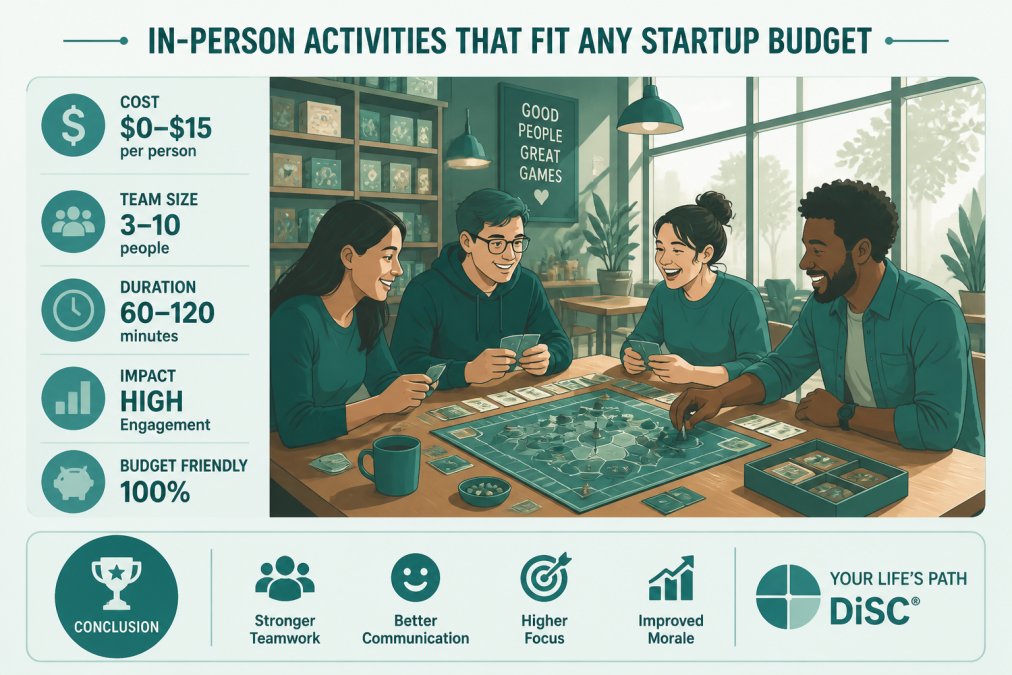
When your team is co-located or meeting in person, you have more options for budget friendly team building that creates lasting memory and connection.
Board Game Cafes provide access to hundreds of games, food, and drinks in a relaxed environment. Your team picks games, plays collaboratively or competitively, and bonds in a casual setting outside the office. What works here: board games force face-to-face interaction and natural conversation. Team members see each other’s problem-solving styles and communication preferences in action.
Improv Workshops teach communication and collaboration through theatrical exercises. The focus is on core improv skills like “Yes, And!” (accepting ideas and building on them) and active listening. Improv is powerful because it breaks down barriers fast. People who are normally reserved step outside their comfort zones in a supportive environment. The exercises directly translate to workplace communication, accepting others’ ideas, building on suggestions without shutting them down, listening actively instead of planning rebuttals.
DiSC Assessment for Team Development
While free activities build connection, structured assessments create a common language for understanding how people work. The Everything DiSC Workplace Profile from Your Life’s Path provides a personalized 20-page report on individual behavioral style, priorities, and communication preferences. Results are available instantly, with bulk discounts available for organizations purchasing assessments through EPIC sub-accounts.
DiSC categorizes people into four behavioral styles: Dominance (direct, results-focused), Influence (enthusiastic, people-focused), Steadiness (collaborative, patient), and Conscientiousness (detail-oriented, analytical). Once your team knows their styles, communication improves dramatically. A high-D person stops taking a high-S person’s caution personally; they understand it’s how that person is wired.
Google’s Project Aristotle identified psychological safety as the most critical factor for high-performing teams, according to Forbes’ analysis of Google’s team research. DiSC assessments build psychological safety by creating permission to be different. When people understand behavioral diversity, they stop seeing differences as problems.
Your Life’s Path offers specialized profiles beyond Workplace, Management, Sales, and Work of Leaders, each tailored to specific roles. For startups, the Workplace Profile is the foundation. The key to making DiSC stick is follow-up. Use results in team meetings, one-on-ones, and conflict resolution. When tension arises, reference DiSC styles: “I think this is a D-C clash, you want speed, they want accuracy. How do we honor both?”
Take The Official DiSC® Assessment Online Now! →
Improving Team Communication in Startups
Poor communication costs organizations billions of dollars annually, according to The Hub’s research on workplace communication costs. For startups, miscommunication between departments can derail product launches, alienate customers, or create internal conflict that talented people leave to escape.
Collaborative Problem-Solving Activities force communication under mild pressure. A simple group task with a time limit reveals communication patterns: who takes charge, who listens, who adapts when the plan isn’t working. Run a debrief after the activity and connect it to real workplace dynamics.
Regular Huddles are the cheapest, most underrated communication tool. Weekly 15-minute team huddles, standing, no chairs, focused on one topic, build communication rhythm. A survey from Team Tactics (2025) found that 65% of office workers say team building improves inter-generational workplace relationships, and 64% say it improves their knowledge of individuals’ strengths on the team. Consistent huddles create that knowledge.
Cross-Departmental Pairing is free and powerful. Pair someone from sales with someone from product for a weekly 30-minute coffee chat. These informal conversations break down silos and build empathy. A salesperson understands why engineers push back on feature requests. An engineer understands the customer frustration that sales hears daily.
Companies with engaged employees achieve 2.5 times more than those with disengaged staff, according to The Hub’s study on employee engagement impact. Communication is the foundation of engagement.
Measuring ROI and Building Sustainable Team Culture
Budget friendly team building only works if it drives measurable outcomes.
Define What Success Looks Like Before You Start
Success metrics depend on your specific challenges. If your problem is high turnover, track retention rates before and after implementing team building. If communication is the issue, measure internal conflict incidents or employee engagement scores. The research supports this: team building ROI can reach up to 400% through productivity gains, according to Careertrainer.ai’s 2026 team building statistics.
Track Engagement and Retention
Run a quick pulse survey before your first team building initiative: “How connected do you feel to the team? How likely are you to stay here in 12 months?” Run the same survey quarterly. Track retention explicitly, employee turnover can cost a company 6-9 months of that role’s salary, according to Visible.vc (2021).
Create Sustainable Rhythms, Not One-Off Events
The data from Groopeze (2026) shows that smaller, more frequent team gatherings are becoming the preferred approach over large corporate conferences. Build a calendar: monthly ice-breakers, quarterly in-person activities, annual larger event if budget allows. Consistency matters more than scale.
Use Your Life’s Path to Deepen Impact
For startups ready to invest in structured development, Your Life’s Path’s EPIC sub-account system makes administration simple and scalable. The Catalyst platform provides flexible facilitation tools, allowing you to customize workshops to your team’s specific communication gaps. The combination works: free or low-cost activities build initial connection, then structured assessments like DiSC create the common language that makes that connection productive.
Budget friendly team building for startups isn’t about cutting corners, it’s about being intentional. The most effective approaches combine low-cost activities (ice-breakers, volunteering, scavenger hunts) with structured insights (DiSC assessments) that help people understand each other. When you measure what matters and build sustainable rhythms, engagement rises, turnover drops, and your team becomes genuinely cohesive. Your Life’s Path’s DiSC assessments provide the framework that turns connection into measurable communication and collaboration improvements.
|
Activity Type |
Best For |
Time Required |
|---|---|---|
|
Two Truths and a Lie |
Quick ice-breaker, new teams |
10-15 min |
|
Virtual Escape Rooms |
Remote teams, problem-solving |
60 min |
|
Board Game Cafes |
Co-located teams, casual bonding |
90+ min |
|
Kahoot! Trivia |
Knowledge-sharing, quick engagement |
20 min |
|
DiSC Assessment |
Communication framework, team development |
30 min assessment + debrief |
|
Volunteering |
Meaningful bonding, community impact |
3-4 hours |
Frequently Asked Questions
What are some inexpensive and fun team building ideas that actually work for startups?
The most effective budget-friendly activities combine low cost with high engagement. Two Truths and a Lie, virtual scavenger hunts, and board game cafes ($7-$15 per person) consistently deliver results. According to research, 67% of office workers find team building activities enjoyable, and 65% say they help teams perform better together. The key is choosing activities that encourage genuine interaction—food-centered experiences, smaller quarterly gatherings, and collaborative problem-solving exercises create stronger bonds than expensive one-time events.
How can we measure the return on investment from team building activities?
Track metrics before and after team building initiatives: employee engagement scores, turnover rates, internal communication quality, and productivity levels. Research shows that engaged teams are 21% more productive, and team building ROI can reach up to 400% through productivity gains. Document specific improvements like faster project completion, reduced conflict incidents, or improved cross-departmental collaboration. Virtual team building costs 75% less than in-person alternatives while delivering up to 12% higher ROI, making it an efficient option for measuring impact on a budget.
What's the difference between virtual team building activities for startups and traditional in-person events?
Virtual activities cost 75% less and work for geographically dispersed teams, while in-person events build stronger face-to-face connections. Virtual escape rooms ($12-$50 per person) and online trivia suit remote teams, whereas board game cafes and volunteering require physical presence. The 2026 trend favors smaller, more frequent gatherings over large annual events—quarterly half-day experiences keep engagement higher than marathon schedules. Choose virtual for flexibility and cost savings, in-person for deeper relationship building, or hybrid for maximum reach.
How does improving team communication in startups actually reduce turnover and improve culture?
Poor communication costs businesses billions annually and drives turnover. Employee turnover can cost a company 6-9 months of that role's salary. When teams build psychological safety through structured activities and honest dialogue, people feel comfortable sharing ideas and admitting mistakes without fear. This foundation reduces conflict, increases belonging, and makes people want to stay. Startups that invest in communication-focused team building see measurable improvements in retention, cross-departmental collaboration, and overall workplace morale—creating a positive feedback loop for culture.
This article was written using GrandRanker