

Table of Contents
- Language Barriers and Proficiency Gaps
- Unconscious Bias and Stereotype Assumptions
- Cultural Norms and Communication Styles in the Workplace
- High-Context Versus Low-Context Communication Misalignment
- Non-Verbal Cues and Body Language Misinterpretation
- Strategies for Inclusive Team Communication
- DiSC Assessment for Team Communication and Behavioral Awareness
- Conclusion
Last Updated: August 17, 2026
Language Barriers and Proficiency Gaps
Communication barriers in diverse teams often start with the most obvious culprit: language itself. When team members speak English as a second, third, or additional language, proficiency gaps create friction that extends far beyond simple vocabulary mismatches.
The challenge runs deeper than pronunciation or grammar. A non-native speaker might understand every word in a sentence yet miss the intended meaning because idioms, cultural references, or conversational speed create cognitive overload. Native speakers, meanwhile, often unconsciously accelerate their speech in meetings or use industry jargon without realizing it excludes teammates who need more processing time.
These gaps compound in remote settings. Without visual cues to signal confusion, misunderstandings fester. A team member struggling to follow a video call might stay silent rather than interrupt to ask for clarification, creating a false impression of alignment.
What most managers miss: the problem isn’t the non-native speaker’s English level, it’s the team’s communication style. Slowing down, using plain language, defining acronyms, and checking for understanding aren’t accommodations. They’re baseline practices that benefit everyone. Teams that normalize this approach see fewer misinterpretations across the board.
Schedule a dedicated “clarity check” at the end of meetings. Ask: “What’s one thing you want to confirm we all agree on?” This simple practice surfaces misunderstandings before they become problems.
Unconscious Bias and Stereotype Assumptions
Unconscious bias doesn’t announce itself. It operates in the background, shaping how we interpret someone’s words, assign credit for ideas, or predict competence based on appearance or accent.
When a team member with an accent speaks up in a meeting, listeners sometimes unconsciously attribute lower credibility to their ideas than they would to the same idea from a native English speaker. When someone from a different cultural background suggests a non-traditional approach, it’s labeled "risky" instead of "innovative." These micro-judgments accumulate and create communication barriers that have nothing to do with actual proficiency or quality of thought.
Stereotype assumptions also shape how feedback lands. Research shows that identical feedback is perceived as harsher or more personal when it comes from someone of a different race or gender than when it comes from someone perceived as similar. The words are the same. The reception is entirely different.
The real cost: team members from underrepresented groups often self-censor to avoid confirming stereotypes or being labeled "difficult" or "aggressive" for saying the same things their peers say without penalty. This silences valuable perspectives and weakens team decisions.
If your team doesn’t actively address bias, high-performing people from underrepresented groups will leave. They’re choosing to work somewhere their contributions are valued without the added tax of managing others’ assumptions about them.
Cultural Norms and Communication Styles in the Workplace
Culture shapes communication in ways most teams never discuss. What counts as respect, directness, urgency, or even appropriate eye contact varies dramatically across cultures, yet teams operate as if there’s one "right" way to communicate.
In some cultures, disagreeing with a senior person in a meeting signals disrespect. In others, it signals engagement and critical thinking. In some, silence means agreement. In others, it means disagreement that the person is too polite to voice. A teammate from a culture that values indirect communication might soften feedback so much that it gets missed entirely, while a direct communicator’s feedback lands as harsh or confrontational.
Time orientation differs too. Some cultures prioritize long-term relationship-building before business discussions. Others want to get straight to the agenda. One isn’t better, but misalignment creates friction and false impressions of professionalism or engagement.
These norms also shape how people handle conflict. Some cultures address disagreement head-on and compartmentalize it from the relationship. Others see direct confrontation as damaging to the relationship itself and prefer to work through intermediaries or let time resolve tensions. A team with both styles will experience one group feeling ignored and the other feeling attacked.
Document your team’s communication norms explicitly. Don’t assume shared understanding. A 30-minute conversation about how your team prefers to communicate, how direct, how fast, how much context before decisions, prevents months of friction.
High-Context Versus Low-Context Communication Misalignment
High-context and low-context communication styles represent one of the deepest sources of misunderstanding in diverse teams, yet most teams don’t even have language for it.
In high-context cultures, meaning lives in what’s not said. Tone, body language, relationship history, and shared understanding carry as much weight as words. Communication is indirect. Criticism is wrapped in praise. Requests are implied rather than stated outright. The assumption is that people who know each other should understand without everything being spelled out.
Low-context cultures operate the opposite way. Meaning lives in the words themselves. Communication should be explicit, direct, and precise. Criticism should be specific and separated from praise. Requests should be stated clearly. The assumption is that you can’t assume shared understanding, you have to say it.
When a high-context communicator works with a low-context communicator, both feel the other is either rude or evasive. The high-context person thinks the low-context person is blunt and disrespectful. The low-context person thinks the high-context person is unclear and hard to work with. Neither is wrong, they’re operating from different frameworks about how communication works.
In practice, this shows up constantly. A manager from a low-context background gives direct feedback: "This presentation wasn’t clear. Here’s what needs to change." A high-context team member hears criticism without softening and feels attacked. A high-context manager says, "The presentation had some interesting ideas. Let’s talk about how we might strengthen the structure." A low-context team member thinks the feedback is vague and doesn’t know what actually needs to improve.
The solution isn’t to force everyone into one style. It’s to make the styles visible and build bridges. Teams that acknowledge high-context and low-context preferences and translate between them resolve misunderstandings before they calcify into resentment.
Non-Verbal Cues and Body Language Misinterpretation
Words carry only part of the message. The rest lives in posture, facial expression, eye contact, gesture, and proximity, and these vary wildly across cultures.
Direct eye contact signals confidence and honesty in some cultures and disrespect in others. Nodding means agreement in some places and just means "I’m listening" in others. Silence can signal agreement, disagreement, respect, or confusion depending on cultural context. A thumbs-up is friendly in some countries and offensive in others. Personal space preferences differ, what feels like comfortable distance to one person feels like intrusion to another.
In remote work, these cues get filtered through camera angles, lighting, and screen fatigue. A person who’s exhausted and staring at their notes with the camera angled down might appear disengaged or uninterested when they’re actually focused. Someone from a culture that values listening over talking might keep their camera off or stay quiet, and be perceived as not contributing.
Take The Official DiSC® Assessment Online Now! →
Video calls also create a lag that disrupts natural conversation flow. People interrupt each other more. Pauses feel longer and more awkward. Someone waiting for a thought to fully form before speaking gets talked over. These technical realities amplify cultural differences in communication pace and style.
The teams that handle this best make non-verbal communication explicit. They acknowledge that video calls are weird and exhausting. They give people permission to have cameras off. They build in pauses. They check in with quieter team members directly: "I haven’t heard from you, what’s your take?" This removes the burden of non-verbal cues doing all the work.
Strategies for Inclusive Team Communication
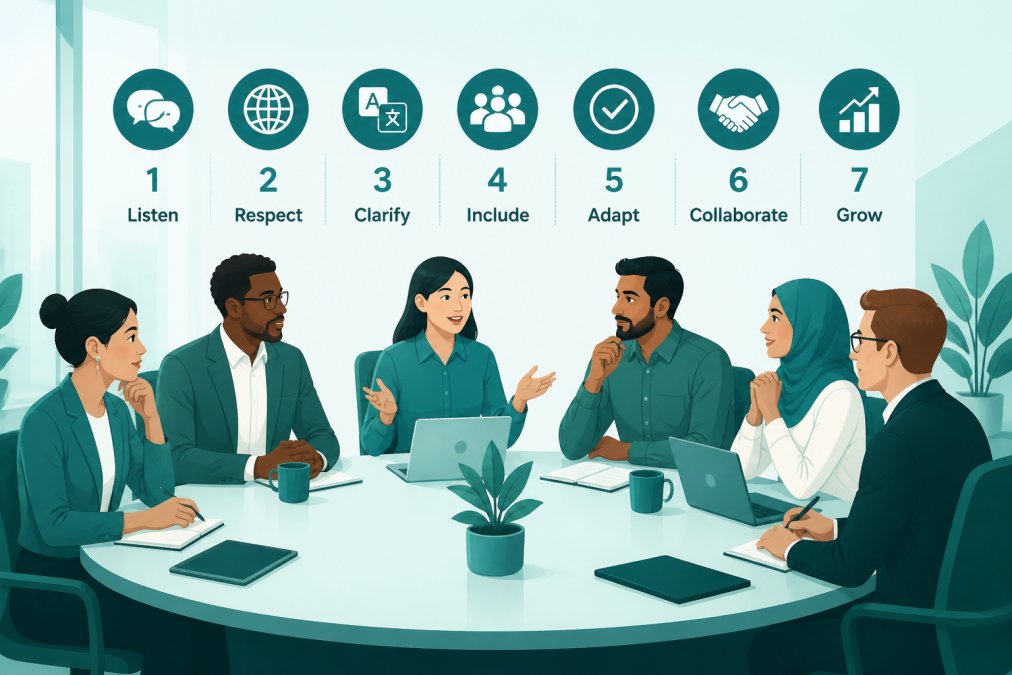
Building inclusive communication requires intentional practices that go beyond awareness training. It means changing how teams actually operate.
Start with psychological safety, the foundation that makes everything else possible. Teams where people fear judgment or punishment for speaking up, asking questions, or admitting mistakes will never communicate openly. High-context communicators will stay silent. People from underrepresented groups will self-censor. Non-native speakers will avoid speaking unless forced. Psychological safety doesn’t happen by accident. It requires leaders to model vulnerability, respond to bad news without blame, and actively invite dissenting views.
Normalize asynchronous communication where possible. Real-time meetings favor people with certain communication styles, those who think fast on their feet, those comfortable with interruption, those without caregiving responsibilities that make synchronous attendance difficult. Asynchronous channels (written updates, recorded messages, threaded discussions) give people time to process, compose thoughts, and participate without the performance pressure of live meetings. This levels the playing field for introverts, non-native speakers, neurodivergent team members, and anyone processing in a non-native language.
Create explicit communication agreements. What does your team value? How direct should feedback be? How much context do decisions need before they’re final? How quickly should people respond? What counts as urgent? Don’t assume shared understanding. A 30-minute conversation that surfaces these preferences prevents months of friction.
Use structured feedback frameworks that remove ambiguity. Instead of open-ended "What do you think?" ask specific questions: "What worked in this approach? What would you change? What’s one thing we should test?" Structured questions work across communication styles and language proficiencies because they remove the need to infer what you’re asking for.
Invest in tools that support diverse communication. Not every conversation needs to happen in real time. Not every idea needs to be shared in a meeting. Platforms that support written communication, recorded messages, and asynchronous feedback give people options to communicate in ways that work for them.
After every significant meeting or decision, send a written summary. Include what was decided, why, and what happens next. This benefits non-native speakers, people processing slower, and anyone who needs to refer back. It’s not extra work, it’s good communication practice.
DiSC Assessment for Team Communication and Behavioral Awareness
Understanding behavioral styles transforms how teams communicate. The DiSC model provides a framework for recognizing how different people naturally prefer to interact, make decisions, and handle conflict. It’s not about labeling people, it’s about making invisible patterns visible.
DiSC identifies four primary behavioral styles: Dominance (D), Influence (I), Steadiness (S), and Conscientiousness (C). A D-style person is driven by results and moving fast. They want the bottom line. An I-style person is motivated by people and enthusiasm. They want connection and buy-in. An S-style person values stability and loyalty. They want to know how changes affect relationships. A C-style person prioritizes accuracy and process. They want data and time to analyze.
None of these styles is better. But they communicate differently. A D-style manager’s direct feedback might feel harsh to an S-style employee who needs reassurance about the relationship. An I-style teammate’s enthusiasm might feel scattered to a C-style colleague who wants specifics. An S-style person’s need for consensus might frustrate a D-style person who wants to decide and move. A C-style person’s questions might feel like obstruction to an I-style person ready to launch.
When teams understand these patterns, misunderstandings become solvable. Instead of assuming someone is difficult or unmotivated, you can ask: "How does this person naturally prefer to work? What matters to them? How do I communicate in a way that lands?" A D-style person needs speed and results focus. An I-style person needs enthusiasm and involvement. An S-style person needs relationship reassurance. A C-style person needs data and time.
Your Life’s Path offers official DiSC® assessments that help teams map these styles and build communication bridges. The DiSC Workplace Profile is designed specifically for team settings. It gives individuals insight into their own style and practical strategies for working with other styles. When a team takes assessments together, they can see their composition and identify where communication gaps are most likely to emerge.
Beyond the assessment itself, the real value comes from structured conversations about what the results mean. A team that takes DiSC and never discusses it gets minimal benefit. A team that uses it as a springboard for conversations about how they actually work together, how they make decisions, handle disagreement, give feedback, manage deadlines, transforms the assessment into lasting behavioral change.

Conclusion
Communication barriers in diverse teams aren’t problems to eliminate, they’re realities to navigate skillfully. Language differences, cultural norms, communication styles, and unconscious bias don’t disappear through awareness alone. They require systems, practices, and tools that make communication explicit and create space for different ways of working.
Your Life’s Path’s official DiSC® assessments provide a concrete framework for building that awareness. By helping teams understand their own behavioral styles and those of their colleagues, DiSC creates a shared language for communication. Combined with intentional practices, psychological safety, asynchronous channels, structured feedback, and explicit communication agreements, assessments become catalysts for real change.
Take The Official DiSC® Assessment Online Now and start building a communication strategy that works for how your team actually operates.
Frequently Asked Questions
What are the most common communication barriers in a diverse workforce?
The most common barriers include language proficiency gaps, unconscious bias, cultural differences in communication styles, misunderstandings about high-context versus low-context communication, and non-verbal cue misinterpretation. Time zone differences and power distance expectations also create friction. These barriers often compound in remote settings where teams lack face-to-face interaction. Understanding each barrier's root cause helps leaders address them systematically rather than treating symptoms.
How can DiSC assessment for team communication help reduce misunderstandings?
DiSC assessments reveal individual behavioral styles and communication preferences, helping team members understand why colleagues approach tasks, feedback, and collaboration differently. When a Direct communicator realizes a Supportive colleague needs relationship-building before task discussion, friction decreases. Teams using behavioral frameworks report improved psychological safety because members recognize style differences as strengths, not deficiencies. This awareness reduces misattribution errors where intent is misread as rudeness or disengagement.
What are examples of non-verbal communication barriers in diverse teams?
Eye contact norms vary significantly across cultures; direct eye contact signals confidence in some cultures but disrespect in others. Hand gestures carry different meanings globally. Silence can indicate agreement, disagreement, or reflection depending on cultural background. Facial expressions and personal space expectations differ widely. In remote settings, video fatigue causes people to turn off cameras, removing non-verbal cues entirely. These misinterpretations often lead to incorrect assumptions about engagement, agreement, or emotional state, escalating conflict unnecessarily.
How do time zone and geographical distance affect team communication?
Distributed teams struggle with asynchronous communication delays, creating response lag that slows decision-making. Team members in different zones miss spontaneous collaboration moments and informal relationship-building. Some voices dominate synchronous meetings held during their convenient hours, while others join exhausted or sleep-deprived. This imbalance can silence quieter communicators or those from cultures favoring indirect feedback. Intentional asynchronous communication protocols and rotating meeting times help mitigate these barriers, ensuring equitable participation across geographies.
This article was written using GrandRanker